

GOTHENBURG/NEW DELHI: Prime Minister Narendra Modi’s back-to-back strategic engagements in the Netherlands and Sweden may ultimately be remembered as one of the defining moments in the transformation of India-Europe relations from a traditional economic partnership into a deeper geopolitical and technological alliance.
The outcomes of the two visits reveal a larger strategic reality unfolding across Europe: India is no longer being viewed merely as a large consumer market or an emerging economy, but increasingly as a critical geopolitical, technological, industrial, and strategic partner for Europe’s long-term future.
At a time when Europe is confronting economic uncertainty, supply-chain vulnerabilities, energy insecurity, technological competition, and the fragmentation of globalization, India has emerged as one of the few major powers capable of offering scale, stability, market depth, democratic credibility, industrial growth, and strategic balance simultaneously.
The significance of Modi’s Europe outreach lies not simply in diplomatic symbolism or investment announcements, but in the broader architecture now being built between India and Europe around semiconductors, artificial intelligence, defence manufacturing, critical minerals, resilient supply chains, green industrial transition, maritime security, and advanced technologies.
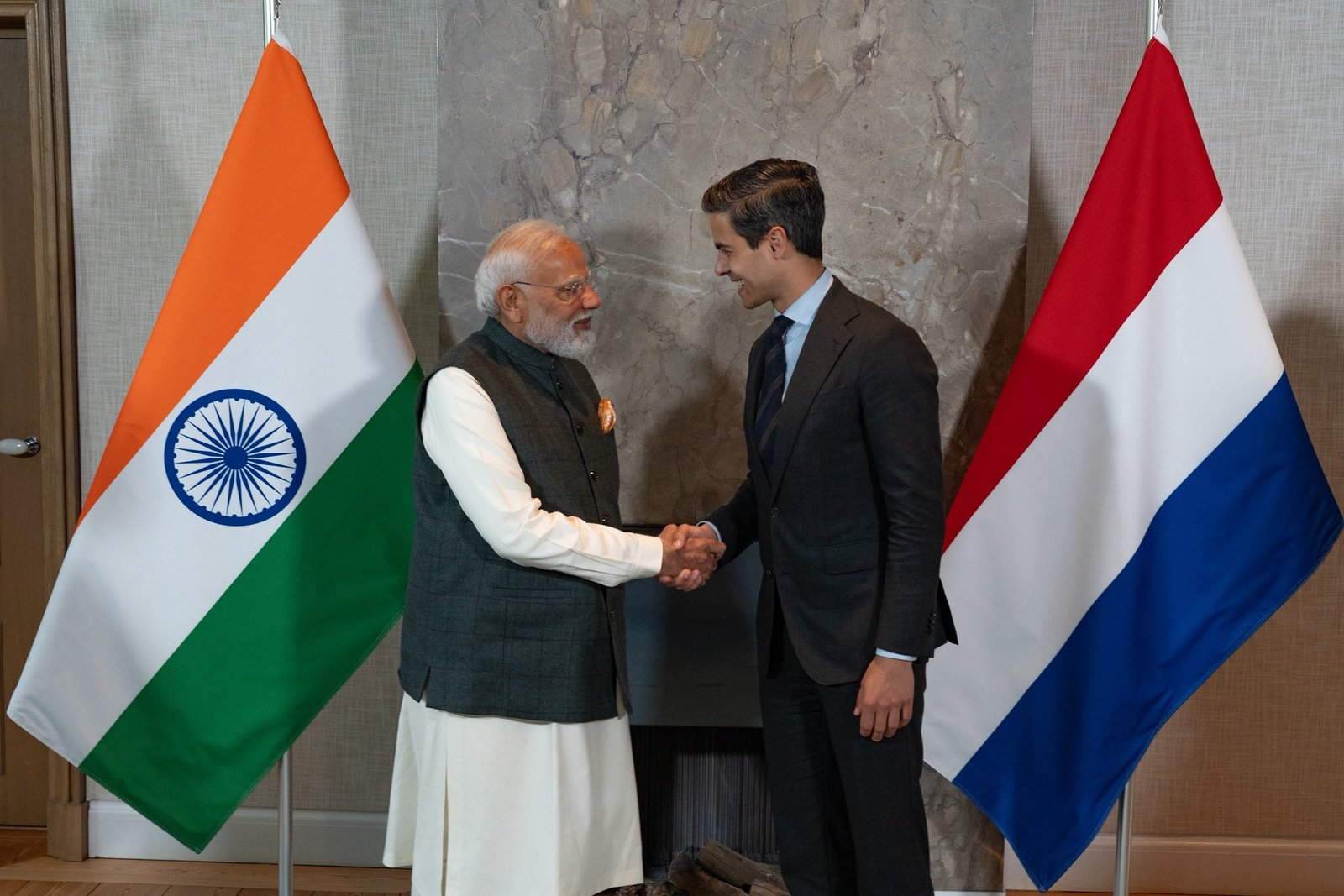
Together, the Netherlands and Sweden visits demonstrate that Europe’s engagement with India is becoming structural, strategic, and long-term. The most immediate breakthrough emerged in the Netherlands, where Prime Minister Modi and Dutch Prime Minister Rob Jetten witnessed the agreement between ASML and Tata Electronics to support India’s first front-end semiconductor fabrication facility in Dholera, Gujarat.
This development carries enormous geopolitical weight.
ASML occupies a uniquely powerful position in the global semiconductor ecosystem because its advanced lithography systems are indispensable for high-end chip manufacturing. In today’s world, semiconductor capability is no longer simply an industrial issue — it is directly tied to national security, technological sovereignty, military competitiveness, AI development, and economic resilience.
By securing cooperation with ASML, India has achieved something strategically significant: entry into one of the world’s most tightly controlled and technologically sensitive industrial ecosystems.
For Europe, partnering India in semiconductors also serves a broader strategic purpose. European economies increasingly recognize the dangers of concentrated supply chains and excessive dependence on limited manufacturing geographies. India’s emergence as an alternative manufacturing and technology hub therefore aligns closely with Europe’s own economic security interests.
The Netherlands visit also reflected a wider strategic convergence between India and Europe in areas such as maritime cooperation, green logistics, advanced manufacturing, water management, clean energy, and digital connectivity.
The Dutch decision to deepen engagement with India in the Indo-Pacific framework reflects Europe’s expanding realization that the Indo-Pacific is no longer a distant Asian theatre but the central axis of global trade, supply chains, energy flows, and geopolitical stability. Equally important was the elevation of India-Netherlands ties into a Strategic Partnership, supported by growing convergence on counter-terrorism, cyber security, resilient supply chains, and rules-based global governance.
The Sweden visit expanded this strategic transformation even further.
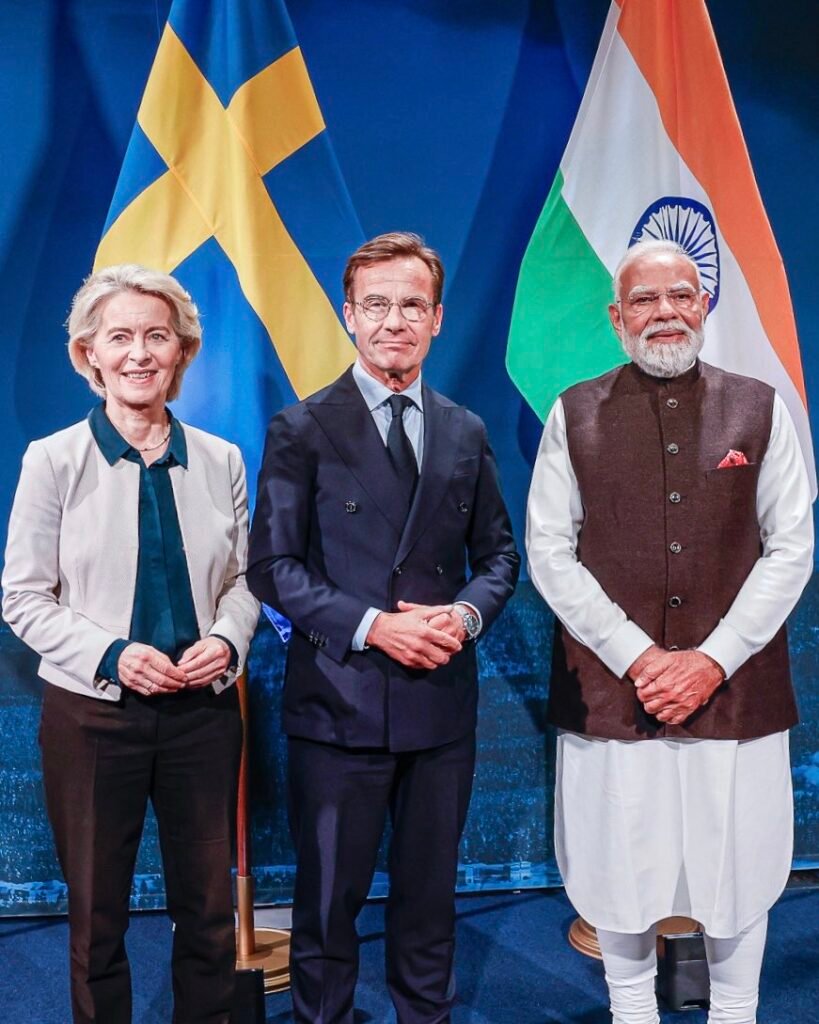
Prime Minister Modi and Swedish Prime Minister Ulf Kristersson elevated bilateral ties to a Strategic Partnership and adopted an extensive Joint Action Plan 2026–2030 that may become one of the most comprehensive long-term cooperation frameworks India has signed with a European nation. The framework demonstrates how India-Europe relations are evolving beyond trade into a multi-dimensional geopolitical partnership centered around technology, industrial resilience, defence, digital infrastructure, and innovation ecosystems.
The repeated emphasis on “trusted connectivity” is especially revealing.
In the emerging global order, digital systems, AI infrastructure, telecom networks, semiconductors, cyber systems, cloud architecture, and critical technologies are increasingly viewed through the lens of strategic trust rather than open globalization. Nations are now seeking reliable democratic technology partners capable of reducing vulnerabilities in sensitive sectors.
The launch of the Sweden–India Technology and Artificial Intelligence Corridor (SITAC), alongside cooperation in AI, quantum computing, 6G, space systems, cyber security, and digital infrastructure, reflects Europe’s growing recognition that India will become one of the defining technology powers of the coming decades. The creation of the India-Sweden Joint Science and Technology Centre further institutionalizes this long-term collaboration in emerging technologies and advanced industrial systems.
Perhaps one of the most strategically important aspects of the Sweden partnership is cooperation on critical minerals and advanced mining technologies.
Rare earths and strategic minerals are rapidly becoming the foundation of geopolitical competition because they are essential for semiconductors, electric vehicles, renewable energy systems, batteries, aerospace technologies, defence manufacturing, and AI hardware.
China’s overwhelming dominance in critical mineral processing has deeply alarmed both Europe and India. The India-Sweden framework on sustainable mining, mineral extraction, refining capabilities, and downstream processing therefore reflects an attempt to build resilient and diversified supply chains outside existing strategic dependencies.
This may eventually emerge as one of the most consequential pillars of future India-Europe cooperation.
The defence and security dimension of both visits is equally important.
The Joint Action Plan with Sweden includes defence innovation, cyber dialogues, counter-terrorism cooperation, defence industrial partnerships, and expanded Swedish investment in India’s defence corridors. Meanwhile, the Netherlands also reinforced security cooperation, maritime coordination, and strategic consultations.
These developments reveal that Europe increasingly views India not simply as an economic actor, but as a major strategic stabilizing power in an increasingly uncertain global order.
The strong condemnation of terrorism during both engagements including references to the Pahalgam attack in Jammu and Kashmir further reflects growing European political alignment with India’s security concerns and counter-terrorism priorities.
Climate and industrial transition emerged as another major pillar of India’s Europe outreach.
Sweden’s cooperation with India under LeadIT 3.0, green steel initiatives, clean technologies, circular economy systems, sustainable infrastructure, renewable energy, and industrial decarbonisation demonstrates how climate diplomacy is increasingly merging with industrial strategy.
This is a major geopolitical shift.
The green transition is no longer viewed purely as an environmental agenda. It is now directly linked to industrial competitiveness, supply-chain resilience, energy security, and technological leadership. Europe sees India as indispensable for scaling future green industrial systems globally, while India sees Europe as a source of advanced technologies, industrial innovation, and sustainable manufacturing expertise.
The broader geopolitical message from Modi’s Netherlands and Sweden visits is unmistakable: India and Europe are entering a new strategic era defined by co-development rather than transactional engagement. The age of hyper-globalisation is giving way to an era where resilience matters more than efficiency, trusted partnerships matter more than unrestricted dependency, and technological sovereignty matters as much as military power.
Europe’s growing strategic outreach toward India reflects its recognition that future global stability and economic resilience will increasingly depend on partnerships with democratic powers capable of balancing both growth and strategic autonomy.
For India, these visits represent something equally important the emergence of Europe as a central pillar in its long-term geopolitical and economic strategy. Together, the Netherlands and Sweden summits signal that India-Europe relations are no longer peripheral to global geopolitics. They are rapidly becoming one of its defining strategic equations.
-Alistair Bell and Dr. Shahid Siddiqui