

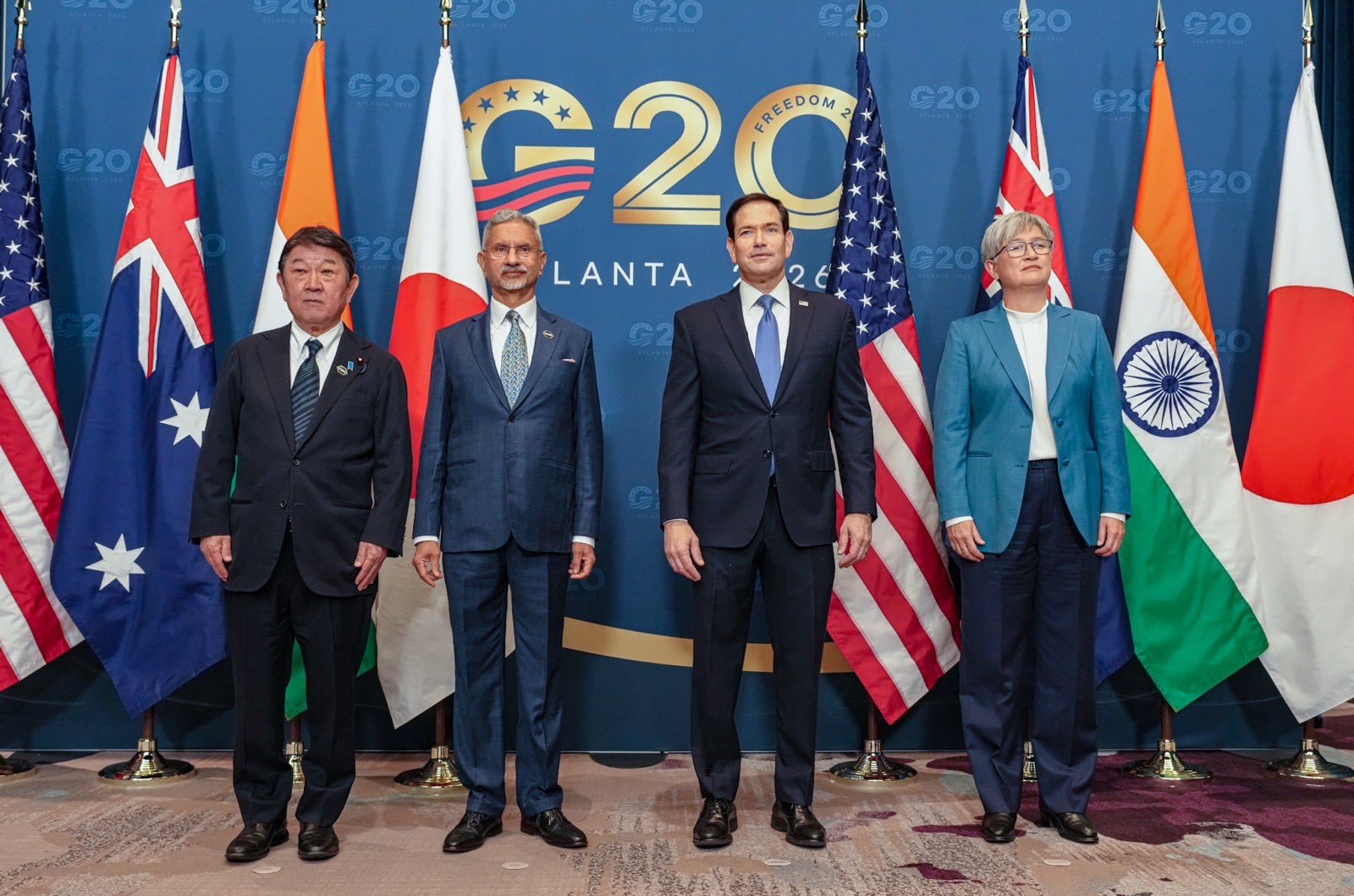
ATLANTA, USA: The Quad is repositioning economic strength, technological leadership and maritime security as foundations of Indo-Pacific power.
The Quad is moving into a more consequential phase of strategic cooperation, where the balance of power in the Indo-Pacific is increasingly being shaped by economic capabilities, technological access and control over critical infrastructure. The October 31, 2026, meeting of the foreign ministers of the United States, India, Japan and Australia in Atlanta, Georgia, signals this transition. Their joint statement places supply-chain resilience, critical minerals, artificial intelligence, semiconductor security, energy, maritime connectivity and commercial investment at the centre of a broader regional strategy.
The significance of the Atlanta declaration is not simply the expansion of the Quad’s existing agenda. It reflects a changing understanding of geopolitical power. In the contemporary international economy, strategic influence is no longer determined exclusively by military strength, territorial reach or diplomatic alliances. It increasingly depends on who can secure essential resources, sustain advanced industrial production, develop critical technologies and maintain access to international trade routes. Economic interdependence, once regarded primarily as a source of prosperity, has also become a potential instrument of geopolitical pressure.
The Quad’s response is an attempt to convert this vulnerability into collective resilience. Yet its success will depend on whether the four countries can move beyond strategic declarations towards commercially sustainable cooperation without creating another fragmented system of competing economic blocs.
The ministers’ concerns about economic coercion, arbitrary export restrictions and non-market practices reflect growing international anxiety over concentrated supply chains and industrial dependencies. Although the statement does not name any country, the language carries wider geopolitical implications amid tensions over critical minerals, industrial competition and export controls. The challenge is to diversify production and strengthen alternatives without replacing one form of dependence with another. Open markets, competitive investment and transparent trade regulations must remain central to this approach.
Critical minerals illustrate the scale of the challenge. Lithium, cobalt, nickel, graphite and rare earth elements are essential to batteries, electric vehicles, renewable energy, advanced electronics and semiconductor-related industries. The Quad Critical Minerals Initiative Framework, announced in May 2026, seeks to strengthen cooperation through the recovery of valuable materials from electronic waste and scrap. The United States’ commitment of $10 million towards recovery infrastructure and facilities in India and ASEAN countries gives the initiative a practical economic dimension.
For India, the opportunity extends beyond securing access to raw materials. Developing recycling, processing and refining capabilities could help the country capture greater value within advanced manufacturing supply chains. However, this requires technological investment, environmental safeguards, efficient cross-border regulations and private-sector participation. The strategic importance of critical minerals will ultimately be determined not only by their availability but also by the industrial capacity to transform them into commercially valuable products.
The technology dimension is equally significant. The ministers expressed their intention to provide more than $85 million in technical and financial assistance to expand access to trusted artificial intelligence across the Indo-Pacific, including through the Quad’s technology accelerator initiative. Their reference to Pax Silica and plans to identify vulnerabilities in semiconductor and AI hardware supply chains demonstrate that technological infrastructure is becoming a central component of economic security.
Artificial intelligence leadership requires an integrated ecosystem of advanced chips, computing infrastructure, specialised materials, reliable energy and skilled human resources. The Quad’s proposed cooperation on trusted 5G, 6G and Open Radio Access Networks could strengthen regional connectivity, but the larger competition concerns the industrial foundations of technological leadership. For India, the strategic objective should be to progress from a major digital market towards a more substantial role in semiconductor production, research, computing and advanced manufacturing.
The maritime dimension connects these economic ambitions to the wider geography of international trade. The joint statement specifically identifies the Strait of Hormuz, the Red Sea and the Bab el-Mandeb Strait as critical waterways where navigational rights and freedoms must be protected in accordance with international law, including UNCLOS. These corridors connect major energy-producing regions with global markets. Their disruption can affect shipping costs, insurance, energy supplies and the wider stability of international commerce.

India’s geographical position gives it particular importance in the Indian Ocean. The second Quad-at-Sea Ship Observer mission, which travelled from Chennai to Perth between September 25 and October 7 aboard an Indian Coast Guard offshore patrol vessel, represents progress in maritime coordination. The proposed exercise under the Indo-Pacific Maritime Surveillance Collaboration initiative at Sea Dragon 2027 and the planned Maritime Domain Awareness symposium in early 2027 could further strengthen regional information-sharing. The broader objective is to protect commercial navigation and maritime stability, not merely to expand operational cooperation.
Energy security reinforces this connection. The first-ever Quad Fuel Security Forum, convened in September, discussed strengthening strategic petroleum reserves and national fuel stockholdings. For India and Japan, reliable energy supplies remain essential to industrial growth and economic stability. However, resilience will also depend on diversified suppliers, renewable generation, energy storage and modern infrastructure. Strategic reserves can help manage immediate disruptions, but long-term security requires a more diversified and adaptable energy system.
The Quad’s engagement with Fiji demonstrates how this strategic agenda is extending into regional development. Cooperation on modernising the ports of Suva, Lautoka and Rokobili, supported by the United States’ Millennium Challenge Corporation and Australia’s feasibility assessment for a potential transshipment facility, connects maritime infrastructure with economic opportunity. More than 2,000 infrastructure fellowships provided across the Pacific, Southeast Asia and South Asia further recognise that connectivity requires technical expertise and institutional capacity alongside physical investment.
This approach is important because the Indo-Pacific is not composed exclusively of major powers. Smaller economies and island states have significant maritime and geographical importance, but frequently face constraints in financing, logistics, infrastructure and climate resilience. Their confidence in the Quad will depend on whether its initiatives address these development priorities rather than treating regional partnerships primarily as instruments of geopolitical competition.
The announcement of the first Quad Business Leaders’ Forum could help bridge the gap between diplomatic commitments and commercial outcomes. The planned meeting of Quad export credit agencies in Tokyo on November 18, building on their 2024 Memorandum of Cooperation, offers another avenue for facilitating investment. The real test will be whether these mechanisms generate manufacturing partnerships, infrastructure financing, technology collaboration and measurable commercial opportunities.

Digital connectivity presents another strategic vulnerability. The Quad’s efforts to develop trusted and redundant undersea cable routes, improve cybersecurity and advance digital identity standards recognise the dependence of modern economies on secure communication networks. Cooperation on 5G, 6G and emerging communications technologies is therefore not simply a technological initiative; it is connected to the reliability of financial systems, public services, international commerce and cross-border data exchange.
The ministers’ condemnation of online scam networks and transnational criminal groups also broadens the security agenda. Their concern involves not only financial losses but the trafficking and exploitation of people forced to participate in fraudulent operations. Addressing these networks will require coordinated law enforcement, financial investigations, intelligence-sharing and international cooperation. The issue illustrates how contemporary security challenges increasingly cross the boundaries between cybercrime, human trafficking and economic stability.
The humanitarian dimension provides a different but equally important measure of regional cooperation. The ministers recognised India’s leading role as the first responder following Nepal’s August 26, 2026, flash floods, alongside assistance from the other Quad countries. Australia, Japan and the United States will send observers to India’s AJHE-26 humanitarian assistance and disaster relief exercise in November. Progress on the Indo-Pacific Logistics Network also reflects efforts to strengthen the region’s capacity to respond to emergencies. For countries exposed to natural disasters and climate-related vulnerabilities, the ability to coordinate relief operations can be as consequential as conventional security cooperation.
For India, the Atlanta declaration creates opportunities to connect its domestic industrial ambitions with wider regional partnerships. Its geographical position, expanding digital economy, engineering capabilities and growing manufacturing base provide important foundations for cooperation. Yet participation in the Quad cannot substitute for domestic industrial development. India will need sustained investment in research, infrastructure, advanced manufacturing, workforce skills and technological innovation to translate diplomatic opportunities into economic influence.
The partnership also faces a broader institutional challenge. The United States, Japan, Australia and India have different economic structures, industrial priorities and diplomatic approaches. Their cooperation will require compromises over investment, market access, technology controls and the distribution of commercial benefits. Moreover, regional countries will assess the Quad through the practical opportunities it creates, not simply through its strategic declarations. An effective Indo-Pacific framework must accommodate diverse national interests and avoid making economic participation synonymous with geopolitical alignment.
The Atlanta meeting therefore represents more than another round of diplomatic consultations. It reflects an attempt to build a strategic framework around the economic foundations of power. Critical minerals support advanced manufacturing; semiconductors enable artificial intelligence; secure digital networks sustain modern commerce; energy supplies underpin industrial production; and maritime routes connect these capabilities to international markets. The strength of this architecture will depend on how effectively these interconnected priorities are implemented.
The Quad’s future influence will ultimately be determined by its ability to convert strategic convergence into practical cooperation. Announced financial commitments must produce operational projects, technology partnerships must strengthen regional capabilities, and infrastructure investment must deliver tangible economic benefits. For India, the opportunity is to deepen its role in the Indo-Pacific while preserving strategic autonomy and maintaining broader international partnerships.
The geopolitical contest of the coming decades will not be decided solely through military deployments or diplomatic alignments. It will also be shaped by industrial ecosystems, technological innovation, access to resources, energy networks and the institutions that sustain international commerce. The Quad’s Atlanta declaration reflects this changing reality.
The emerging contest for Indo-Pacific influence is increasingly about who can build, secure and sustain the economic and technological foundations of regional power.
-Andrea Lawder and Dr. Shahid Siddiqui