

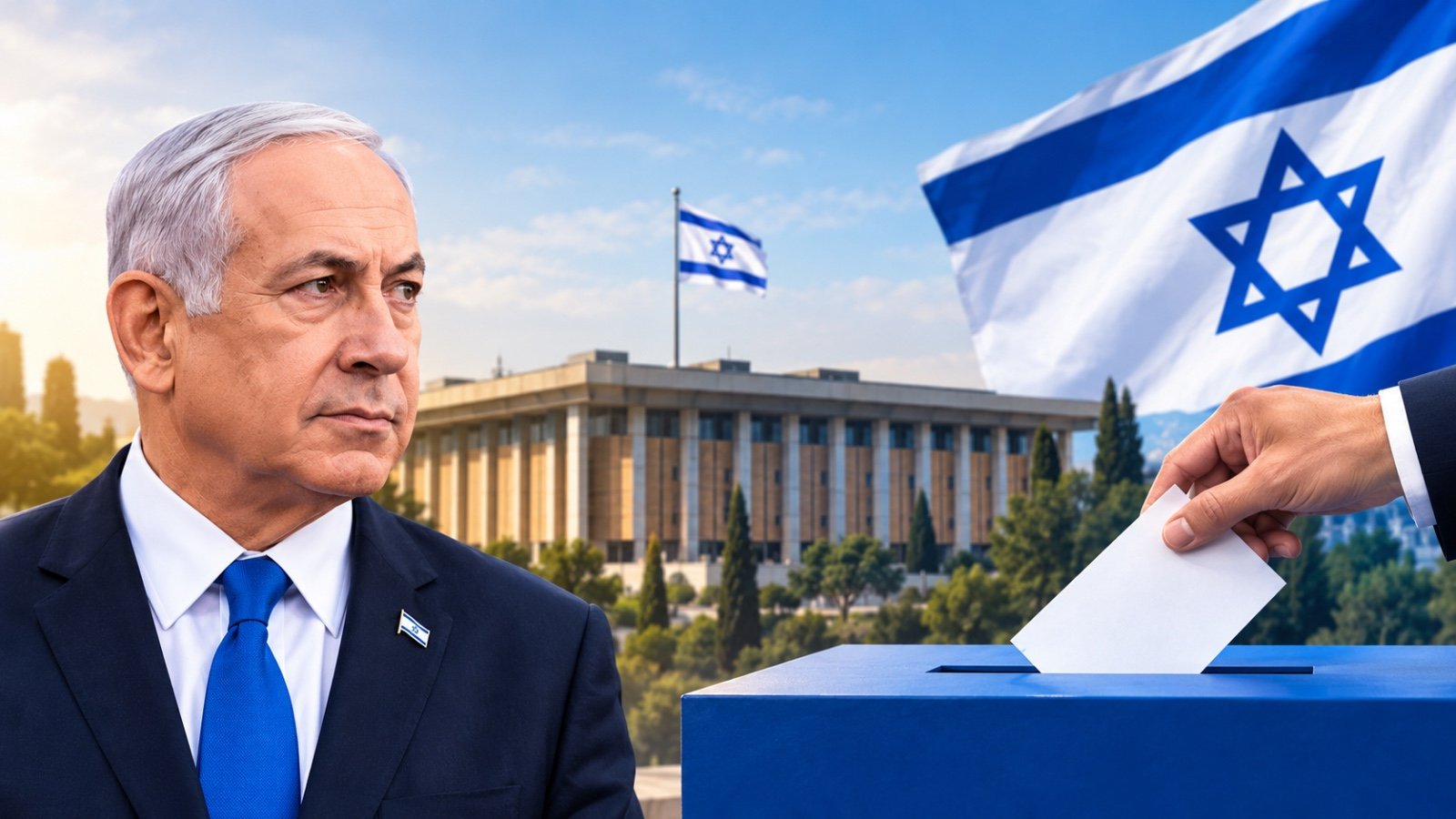
JERUSALEM: Israel’s latest election has produced a political landscape in which the most consequential question may no longer be simply who governs, but whether the country can manage an increasingly fragmented democracy without allowing allegations, identity politics and security concerns to undermine confidence in the electoral process.
According to the latest results, Prime Minister Benjamin Netanyahu’s Likud-led bloc has secured 53 seats in the 120-member Knesset, while the opposition bloc led by former military chief Gadi Eisenkot has 48. Arab-led parties have won 19 seats, their strongest representation in Israeli parliamentary history. Neither major bloc therefore has the 61 seats required to form a government independently.
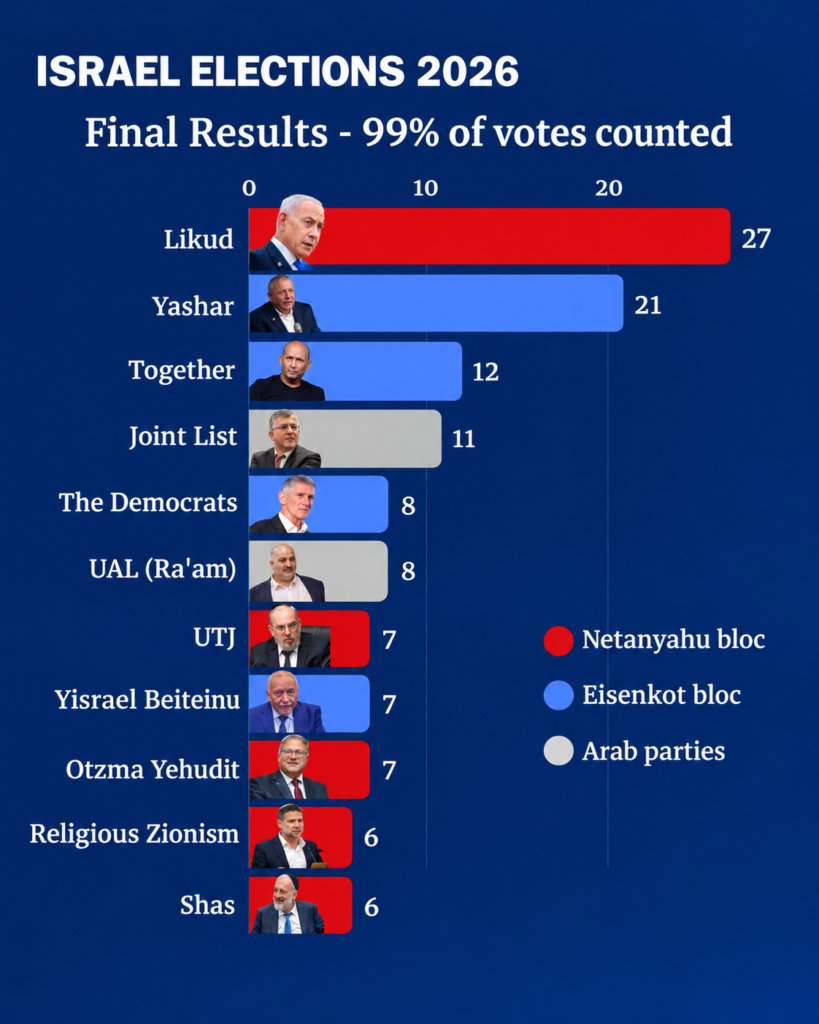
That arithmetic has transformed Israel’s Arab electorate from a frequently marginalised political constituency into a potentially decisive parliamentary force. It also explains why allegations surrounding foreign influence have become politically explosive.
The Central Elections Committee chairman, Supreme Court Justice Noam Sohlberg, has asked the Shin Bet security agency to investigate what he described as serious suspicions of improper foreign influence involving funding. Importantly, Sohlberg also said he could not personally verify the substance of those allegations. The investigation therefore remains an investigation, not proof that the election was manipulated. The elections authorities have separately stressed that allegations of systematic violations of electoral integrity are unsubstantiated.
This distinction matters enormously.
Likud and Netanyahu allies have nevertheless described the election as having been “stolen” and linked the allegations to a supposed foreign effort to influence Arab voters. Israeli media have reported suspicions involving Qatar, and some reports have also mentioned Turkey. Qatar has rejected the allegations. No evidence publicly establishing that Arab-led parties collectively stole the election has been presented.
A democratic system must investigate credible evidence of illegal foreign interference. Foreign financing, covert political influence and voter manipulation are legitimate security concerns in any democracy, particularly in a country where domestic politics and regional geopolitics are deeply intertwined. But an investigation must establish facts rather than begin with a predetermined political conclusion.
That is the central institutional test now facing Israel.
The danger is not limited to the possibility of electoral misconduct. There is also a second danger: treating an entire community’s legitimate political participation as inherently suspicious because its electoral strength changes the balance of power.
Arab citizens of Israel constitute roughly one-fifth of the population. Their record parliamentary showing reflects a significant mobilisation of voters and the ability of Arab-led parties to convert that participation into parliamentary representation. The surge has fundamentally altered coalition mathematics. The Arab parties are no longer peripheral to the immediate question of government formation; they potentially hold the votes required to bridge the gap between the two major blocs.
That development creates an uncomfortable question for Israel’s Jewish political parties: can a parliamentary system treat Arab citizens as full political participants when their votes become decisive, rather than only when their representation is politically convenient?
The answer will shape more than coalition negotiations.
For years, cooperation between Zionist parties and Arab-led parties has remained politically sensitive. Ra’am’s participation in a governing coalition after the 2021 election demonstrated that such cooperation was possible, but also exposed the ideological and security tensions surrounding it. The present configuration is potentially more consequential because Arab-led parties hold 19 seats and could materially alter the governing balance.
Eisenkot and other opposition figures now face a strategic choice. Cooperation with Arab-led parties could provide a parliamentary route toward replacing Netanyahu, but it could also generate resistance among parties whose campaigns rejected such cooperation. Alternatively, parties could attempt a broader coalition arrangement, potentially prolonging negotiations and increasing the possibility of another election if no stable government emerges.
Netanyahu, meanwhile, remains prime minister while the coalition process unfolds. The political stakes are particularly high because a change of government could affect the future direction of Israel’s domestic agenda, military policy, relations with Arab citizens and the handling of investigations surrounding the October 7, 2023 security failures and Netanyahu’s longstanding corruption cases.
The foreign-interference controversy therefore intersects with an unusually broad range of national questions.

President Isaac Herzog has attempted to separate those questions from the collective treatment of Arab citizens. He has called for the allegations to be investigated while warning against tarnishing an entire community that participated in the democratic process. That distinction provides an important institutional principle: evidence should determine individual or organisational responsibility, not ethnicity or political affiliation.
Israel’s security institutions now face the difficult task of determining whether any unlawful foreign activity occurred, whether money or influence reached political organisations, whether electoral laws were violated, and whether any such activity affected the allocation of parliamentary seats. Those questions require evidence, transparency where national security permits it, and a clear separation between security investigations and political messaging. The political consequences could extend beyond this election.
If allegations are repeatedly presented as established facts before investigations are completed, future losing parties may increasingly challenge electoral outcomes rather than accept them. If legitimate security investigations are dismissed simply because they have political consequences, public confidence can also suffer. Democracy requires both institutional vigilance against interference and institutional restraint against premature conclusions.
The deeper transformation is that Arab citizens have demonstrated the capacity to become decisive participants in Israel’s parliamentary system. Whether Jewish and Arab parties cooperate, whether another election becomes necessary, or whether an alternative coalition emerges, the 2026 election has already exposed a structural reality: Israel’s political future cannot be understood solely through the traditional contest between its Jewish blocs.
The next stage will test whether political leaders can convert that reality into functioning parliamentary politics.
The ultimate measure of this election will therefore not be which bloc claims victory. It will be whether Israel can investigate credible allegations rigorously, protect the legitimacy of every lawful vote, and allow parliamentary arithmetic to determine coalition possibilities without turning an entire community into the subject of collective suspicion.
In a deeply divided political system, preserving trust may prove as consequential as securing 61 seats.
-Cara Frankel