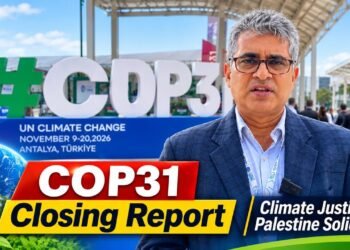





ANTALYA, TÜRKİYE: The collapse of the United Nations Climate Change Conference (COP31) in Antalya is not merely a failure of diplomatic negotiations. It is a reflection of a much deeper crisis confronting the international order: the growing inability of governments to reconcile national economic interests, energy security, geopolitical competition and the collective responsibility of protecting the planet.
After more than two weeks of negotiations, extending almost 50 hours beyond the scheduled conclusion, nearly 200 participating countries failed to reach consensus on the proposed overarching Antalya Pact. The disagreement exposed fundamental divisions over fossil fuels, climate finance, carbon-removal technologies and the responsibilities of developed and developing economies. The European Union, the United Kingdom and several other countries rejected the final proposal, arguing that it failed to address the principal drivers of global warming and fell short of the ambition demanded by climate science.
The breakdown marks the first failure to secure an overarching agreement at a UN climate summit since Copenhagen in 2009. More significantly, it raises difficult questions about whether the existing multilateral climate framework can deliver the scale of transformation required to confront an accelerating environmental emergency.
The Antalya outcome should be understood against a rapidly changing geopolitical landscape in which wars, energy-market instability, economic protectionism and strategic competition are increasingly influencing national climate policies. The world is not short of climate commitments. It is short of political consensus, financial accountability and the willingness to translate promises into measurable action.
The Fossil Fuel Dilemma: The Battle That Divided COP31
The most consequential disagreement at COP31 concerned the future of fossil fuels. Despite the scientific consensus identifying coal, oil and natural gas as the principal sources of human-induced global warming, the final proposal contained no explicit commitment to transition away from these energy sources. For the European Union and several climate-vulnerable countries, this omission represented a fundamental retreat from the direction established at previous climate conferences.
At COP28 in Dubai in 2023, governments had agreed to transition away from fossil fuels in energy systems in a just, orderly and equitable manner. Although the commitment did not establish a legally binding timetable for ending fossil fuel production, it represented an important diplomatic breakthrough after decades of resistance to explicitly naming fossil fuels in international climate agreements.
COP31 was expected to advance that commitment from political recognition towards implementation. Instead, the proposed Antalya Pact failed to establish a clear pathway.
Ireland’s Environment Minister Darragh O’Brien, representing the European Union, made the bloc’s position clear: an international climate agreement that did not even mention fossil fuels could not adequately respond to the climate crisis. More than 130 countries had reportedly supported demands for a clear transition pathway. Yet opposition from major fossil-fuel-producing economies prevented the language from surviving in the final proposal.
Saudi Arabia and Russia, among other countries resistant to explicit fossil-fuel transition commitments, maintained that energy systems must retain flexibility and that technological innovation should play a central role in reducing emissions.
This disagreement illustrates the central contradiction of contemporary climate diplomacy. Countries are negotiating a common environmental future while defending fundamentally different economic models.
For oil-producing economies, fossil fuels represent government revenue, employment, industrial infrastructure and geopolitical influence. A rapid transition threatens established economic structures and raises difficult questions about the future value of energy reserves and investments.
For countries dependent on imported energy, however, the transition also represents an opportunity to reduce strategic vulnerability, diversify energy supplies and improve long-term energy security.
The problem is that these interests cannot be reconciled simply by avoiding the words that describe the source of the crisis.
The failure to include fossil fuels in the Antalya Pact therefore represents more than a disagreement over diplomatic language. It demonstrates that the international community has yet to establish a credible political agreement on the future of the global energy economy.
Saudi Arabia, Energy Diplomacy and the Politics of Influence
The negotiations also exposed the growing influence of energy geopolitics within the UN climate process.
Saudi Arabia’s position deserves particular attention because the Kingdom occupies a central position in global petroleum markets and has substantial economic and strategic interests in the future of hydrocarbons. Riyadh has increasingly emphasised technological innovation, carbon management, hydrogen and economic diversification as components of its climate and development strategy. Its position reflects a broader argument among hydrocarbon-producing countries that emissions should be addressed without treating the elimination of fossil fuel production as the only available solution.
There is an important distinction between reducing emissions and eliminating fossil fuels. Carbon capture, storage, industrial efficiency and cleaner energy technologies can contribute to emissions reduction. However, their effectiveness depends on whether they complement or substitute for reductions in fossil fuel consumption.
At COP31, this distinction became a major source of disagreement.
The proposed agreement supported accelerating carbon-removal technologies, an approach welcomed by countries advocating technological solutions. However, critics argued that excessive reliance on future carbon removal could create a political justification for maintaining or expanding fossil fuel production.
This concern is not without substance. Carbon capture technologies may have an important role in hard-to-abate industrial sectors, but they cannot be treated as a universal substitute for renewable energy, energy efficiency and direct emissions reductions.
The deeper geopolitical question is whether technological innovation will accelerate the energy transition or become an instrument for protecting existing energy interests.
The international community must avoid treating these approaches as mutually exclusive. Technology is indispensable, but it cannot replace political decisions about the direction of energy investment.
Climate Finance: The Unfinished Promise to Developing Nations
While fossil fuels dominated the diplomatic confrontation, climate finance exposed the structural inequality underlying international climate negotiations. Developing countries have repeatedly argued that they cannot be expected to undertake ambitious climate action without predictable financial resources, affordable technology and meaningful support from wealthier economies. The argument is rooted in historical responsibility. Industrialised countries accumulated much of their wealth through decades of carbon-intensive economic development, while many developing economies now face the consequences of a crisis to which they contributed comparatively less.
Yet these countries are being asked to transform their energy systems, strengthen climate resilience and protect vulnerable populations while simultaneously addressing poverty, infrastructure deficits, unemployment and debt.
The proposed Antalya Pact called for tripling adaptation finance but did not establish a sufficiently clear baseline for calculating the increase. This ambiguity weakened the credibility of the proposed commitment.
For vulnerable countries, adaptation finance is not simply another development allocation. It is essential to economic survival. Rising temperatures threaten agricultural productivity and food security. Changing rainfall patterns increase pressure on freshwater resources. Coastal communities face rising sea levels, while increasingly destructive storms and floods threaten infrastructure and livelihoods. Africa illustrates this contradiction particularly clearly. Many African economies possess substantial renewable energy potential but lack affordable financing, modern electricity infrastructure and access to technology at the scale required to accelerate development.
The same challenge confronts South Asian economies, small island developing states and vulnerable countries across the Global South.
A climate transition that increases the cost of electricity, restricts development opportunities or creates additional debt without providing affordable alternatives risks undermining the very countries it is intended to protect.
The issue is therefore not whether developing countries should participate in decarbonisation. It is whether the international financial system will provide the resources necessary to make that transition equitable.
Climate justice cannot remain a rhetorical principle. It must translate into accessible finance, technology partnerships, capacity building and transparent delivery mechanisms.
The Global South Is Not a Single Climate Bloc
One of the most important lessons from Antalya is that the Global South cannot be treated as a unified negotiating constituency.
Its members have different economic structures, energy requirements, political priorities and exposure to climate risks.
An oil-producing developing economy may view an immediate fossil-fuel phase-out as a threat to fiscal stability. A small island state may consider the same transition essential to its physical survival. A rapidly industrialising country may need additional electricity capacity to sustain manufacturing, employment and poverty reduction. These differences make consensus difficult, but they also demonstrate why a universal transition formula is unlikely to succeed.
India provides an important example. Its climate strategy must balance industrial expansion, energy access, urbanisation and emissions reduction. Renewable energy, electric mobility, green hydrogen and energy efficiency offer opportunities to reduce dependence on imported fossil fuels while supporting economic development.
However, India’s transition cannot be separated from questions of affordability, grid reliability, storage capacity and technology access. The same principle applies to other emerging economies. The international climate framework must recognise differentiated national circumstances without allowing those differences to become permanent excuses for inaction. The real challenge is to construct a transition in which economic development and environmental responsibility reinforce each other rather than compete.
Electrification: An Opportunity That Requires Infrastructure
Türkiye’s proposal to increase electricity’s share of global final energy consumption to 35 per cent by 2035, from approximately 23 per cent today, represented one of the more forward-looking elements of the proposed agreement.
Electrification could transform transport, manufacturing, heating and other sectors that remain heavily dependent on fossil fuels. Electric vehicles, electric public transport, industrial electrification and modern heating systems can substantially reduce emissions when supported by increasingly clean electricity generation.
However, electrification is not synonymous with decarbonisation.
If additional electricity demand is met through coal-fired power plants, the environmental benefits will be limited. Similarly, countries without modern transmission networks, storage systems and reliable electricity distribution may struggle to convert ambitious electrification targets into practical outcomes.
Developing countries need substantial investment in grid modernisation, battery storage, renewable generation and cross-border electricity infrastructure. The proposed target was therefore an opportunity, but its success would depend on the financial and technological arrangements supporting it.
It also highlighted an important policy distinction: the energy transition is not simply about replacing one source of energy with another. It requires redesigning the systems through which economies generate, distribute and consume energy.
Climate Diplomacy in a Fragmented International Order
The collapse of COP31 also reflects the changing nature of global geopolitics.
The international environment has become increasingly fragmented by armed conflicts, trade disputes, strategic rivalries and competition over critical resources. Energy security has returned to the centre of national policy calculations. Wars and regional instability have exposed the vulnerability of international energy supply chains, encouraging governments to prioritise reliable and affordable energy over longer-term environmental objectives.

The limited participation of the United States for a second consecutive year, following the Trump administration’s withdrawal from the Paris Agreement, further complicated the diplomatic environment. The absence of one of the world’s largest economies and historical greenhouse gas emitters has implications beyond its own national climate policy. It affects the credibility of international financial commitments, technological cooperation and the ability of major powers to broker agreements.
China, meanwhile, occupies a particularly consequential position as a major industrial economy, a leading manufacturer of clean-energy technologies and a significant participant in global emissions.
Cooperation between Washington, Beijing, Brussels and other major economic centres remains essential to the future of climate diplomacy. Without coordination among these powers, the burden of consensus increasingly falls on countries with fewer financial and diplomatic resources. The result is an international negotiating system in which almost every country is expected to agree on a common outcome despite profoundly unequal capacities and conflicting strategic interests.
The consensus-based nature of COP negotiations remains essential to their legitimacy. However, the Antalya experience demonstrates how easily a small number of entrenched objections can prevent a broader agreement.
This does not necessarily mean abandoning consensus. It means improving the transparency of negotiations, strengthening the inclusion of vulnerable countries and ensuring that final decisions reflect both scientific urgency and practical economic realities.
The Paris Agreement Survives, but Its Credibility Is Under Pressure
It would be incorrect to interpret the failure of COP31 as the collapse of the Paris Agreement. The 2015 agreement remains in force, and previously adopted decisions and national commitments are not erased by the failure to approve a new overarching political declaration.
The Paris framework has also produced measurable changes in the global energy landscape. When the agreement was adopted, projections based on then-existing policies suggested that the world was heading towards approximately 4°C of warming this century. Current projections are considerably lower, although estimates vary according to assumptions about policies and implementation. The improvement demonstrates that multilateral climate diplomacy has had an impact. International commitments have helped accelerate renewable energy investment, encourage technological innovation, strengthen national climate policies and create greater certainty for businesses.
Yet the remaining gap is enormous.
The world is expected to exceed the Paris Agreement’s 1.5°C temperature threshold, and current policy trajectories remain inconsistent with the level of emissions reduction required to avoid the most dangerous climate impacts. The scientific challenge has become more urgent precisely when political cooperation is becoming more difficult. This contradiction threatens the credibility of the international climate system.
If governments repeatedly adopt ambitious language but fail to agree on implementation, businesses may face uncertainty, developing countries may lose confidence in promised financial support, and vulnerable populations may increasingly question the value of international climate institutions.
Nevertheless, the progress achieved on separate negotiating tracks at COP31, including just transition and other climate-related decisions, should not be overlooked. The failure of the Antalya Pact does not mean that every aspect of the conference failed. The distinction matters because the future of climate cooperation will depend on preserving areas of agreement while confronting the disagreements that remain unresolved.
COP32 in Ethiopia: An Opportunity for the Global South
The next major opportunity will come at COP32 in Ethiopia, placing Africa at the centre of the next phase of international climate diplomacy.
Ethiopia’s position as the next host carries considerable significance.
Africa contributes a relatively small share of historical global greenhouse gas emissions but faces disproportionate exposure to climate-related economic and humanitarian risks. Water insecurity, agricultural vulnerability, extreme weather and infrastructure deficits make adaptation an urgent continental priority. At the same time, Africa possesses enormous potential in solar, wind, hydropower and other renewable resources.
COP32 must therefore become more than another diplomatic gathering. It should provide an opportunity to address the structural financing gap, improve access to clean-energy technologies and establish credible partnerships between African economies and international investors. The Ethiopian presidency will also inherit the unresolved divisions from Antalya.
The central challenge will be to bring together countries with different energy interests without diluting the scientific requirements of climate action. Africa’s leadership could help reposition the debate around development, climate justice and energy access. However, that opportunity will only be realised if developed economies translate their financial commitments into practical support.
The Real Failure of COP31
The most important lesson from Antalya is that climate change has become inseparable from international political economy.
Energy is not merely an environmental issue. It is connected to trade, national security, industrial competitiveness, fiscal stability, technological leadership and geopolitical influence. This is why negotiations over fossil fuels and climate finance have become so difficult. The transition away from carbon-intensive energy threatens established economic interests, while the consequences of delaying that transition threaten the economic security of the entire international community.
The challenge is to manage this transformation without creating new inequalities or destabilising developing economies. For Türkiye and Australia, the failure to secure the Antalya Pact represents a serious diplomatic disappointment. For the European Union, it reinforces the difficulty of converting climate ambition into global consensus. For fossil-fuel-producing countries, it demonstrates the continuing political strength of energy interests. For developing nations, it highlights the gap between promises of climate solidarity and the financial support available to implement them.
But the greatest cost will ultimately be borne by communities that have little influence over international negotiations and the generations that will inherit the consequences of today’s decisions.
Climate diplomacy cannot survive indefinitely on declarations, voluntary initiatives and promises of future technological solutions. The international community needs a credible fossil-fuel transition pathway, predictable climate finance, affordable technology, stronger adaptation measures and an equitable framework for economic transformation.
Antalya has demonstrated that the world can negotiate for weeks without resolving the fundamental questions. It has also demonstrated that an imperfect agreement is not necessarily better than no agreement if it undermines previous commitments and fails to address the science.
The responsibility now is to ensure that COP31 becomes a turning point rather than another missed opportunity. The planet does not negotiate. Climate systems do not wait for political consensus. And the economic and human consequences of delayed action will not be distributed equally.
The collapse of COP31 is ultimately a warning that the world’s climate crisis is no longer just a crisis of emissions. It is a crisis of political leadership, international trust and collective responsibility.
– Lewis Hobson