


New Delhi: India’s renewable energy ambitions are entering a more consequential phase. The challenge is no longer simply to install more solar panels, wind turbines or non-fossil electricity capacity. It is to convert that expansion into reliable power, reduce exposure to international fuel-market disruptions, build globally competitive manufacturing industries and secure the investment required to modernise the country’s energy infrastructure.
That broader strategic challenge shaped the Bharat Renewable Energy Summit & Expo 2026, inaugurated by Prime Minister Narendra Modi at Bharat Mandapam on 2 November. Against the backdrop of continuing instability in West Asia and uncertainty in international energy markets, Modi placed clean energy at the intersection of national security, economic resilience and technological development.
“The future of Energy Security lies in Clean Energy,” the Prime Minister declared. His argument reflects a significant shift in the way renewable energy is increasingly understood: not merely as an instrument of climate policy, but as an economic and strategic asset for countries exposed to imported fossil fuels and volatile international markets.

The relationship between energy security and geopolitical vulnerability is particularly important for India. As one of the world’s largest energy-consuming economies, India remains exposed to fluctuations in international oil and gas prices, maritime supply disruptions and external geopolitical developments. Such shocks can affect inflation, the current-account balance, industrial costs and household expenditure. Expanding domestic renewable electricity cannot eliminate these vulnerabilities, particularly in transport, industrial heat and other sectors that remain dependent on conventional fuels. However, it can reduce the amount of imported fuel required to generate electricity and diversify the country’s energy supply.
The International Energy Agency’s India Renewable Energy Market Report 2026, released on 3 November, provides substantial evidence for this argument. According to the report, India’s renewable electricity expansion saved more than US$100 billion in cumulative coal and natural-gas import costs between 2011 and 2025. Without the solar, wind and bioenergy capacity added since 2010, India’s coal imports in 2025 would have been approximately 110 million tonnes higher. The IEA expects cumulative savings to more than double by 2030. These findings demonstrate that renewable energy is already contributing to India’s economic resilience, rather than representing only a future climate benefit.
The Prime Minister also highlighted India’s progress towards its international climate commitments. India achieved its pledge to source 50 per cent of installed electricity capacity from non-fossil sources in 2025, five years ahead of its 2030 deadline. Modi reaffirmed the ambition of reaching 500 GW of non-fossil capacity by 2030 and announced an additional ambition to add another 500 GW over the following decade.
The distinction between installed capacity and actual electricity generation, however, remains essential. Solar and wind capacity figures measure the maximum potential output of installations under specified conditions; they do not establish how much electricity is generated or available at every hour. A power system increasingly dependent on weather-variable sources requires storage, flexible generation, stronger transmission and more sophisticated demand management. India’s ability to achieve its targets will therefore depend as much on the infrastructure connecting renewable projects to consumers as on the pace at which new projects are commissioned.
Modi’s call for a new phase of solar innovation addressed this wider challenge. “This new era of the solar revolution is not just about adoption, it is equally driven by innovation,” he said, urging startups, IITs, researchers and entrepreneurs to develop systems capable of meeting a household’s energy requirements throughout the day and across seasons.
His proposals included rooftop solar-powered cooking, household charging for electric vehicles, solar applications in agriculture and the expansion of installations across government buildings, educational institutions, hospitals and street-lighting networks. The underlying objective is to move solar energy beyond large power plants and integrate it into household consumption, transport, agriculture and public infrastructure.
This decentralised approach could have important economic implications. Rooftop solar can reduce household exposure to electricity costs, agricultural solarisation can lower dependence on conventional power supplies, and solar-powered cooking could reduce reliance on imported cooking fuels. Yet these benefits will depend on affordable financing, effective maintenance, reliable distribution networks and storage systems that allow electricity to be used when generation is unavailable. Access to rooftop systems also remains uneven, making implementation and affordability central questions for policymakers.
India’s manufacturing ambitions form the second major pillar of this transition. Modi highlighted the expansion of solar module manufacturing capacity from approximately 2 GW a decade ago to more than 200 GW, alongside nearly 40 GW of solar cell manufacturing capacity. Union Minister for New and Renewable Energy Pralhad Joshi presented further figures, stating that module manufacturing capacity had reached 225 GW and solar cell capacity approximately 45 GW. He also cited an expansion in wind-turbine manufacturing capacity from 10 GW to 24 GW.
These figures indicate a substantial expansion of India’s manufacturing base. But manufacturing capacity must not be confused with actual annual production, domestic value addition or technological independence. The ability to manufacture modules at scale does not automatically mean that every upstream component, advanced material, production technology or critical mineral is sourced domestically. The IEA has identified strategic upstream segments of the solar supply chain as an important area for India, particularly because global dependence on imports from China exceeds 95 per cent in some parts of the supply chain.
This exposes a central tension in India’s clean-energy strategy. The country wants to reduce external dependence while participating in an industry whose supply chains remain internationally concentrated. Domestic manufacturing is therefore not simply an industrial-policy objective; it is part of a wider effort to diversify supply chains and strengthen strategic autonomy. Its long-term success will depend on research and development, manufacturing efficiency, quality standards, access to critical minerals and the ability of Indian producers to compete internationally without relying indefinitely on policy protection.
Joshi reinforced the government’s position by describing India’s renewable energy journey through three defining elements: “Scale, Speed and Aatma Nirbharta.” He cited the growth of solar capacity from 2.8 GW to approximately 171 GW and wind capacity from 21 GW to around 60 GW. He also highlighted the reduction in solar tariffs from approximately ₹10–11 per unit in 2011–12 to ₹2.15 per unit in 2024–25.
The reduction in solar tariffs is an important indicator of the progress achieved through competitive procurement, manufacturing expansion and economies of scale. However, the price discovered in a renewable energy auction is not the same as the total cost of providing reliable electricity throughout the day. Storage, balancing, transmission, land, financing and distribution costs must also be considered. As the share of variable renewable generation increases, the economics of the entire electricity system become more important than the generation tariff of an individual project.
Joshi also highlighted India’s green hydrogen ambitions and invited international investors with the statement: “Invest in India. Innovate in India. Grow with India.” His message was intended to position the country not only as a major renewable energy market but also as a destination for manufacturing, technology development and long-term investment.
The investment opportunity is substantial. Modi stated that India’s renewable energy sector had attracted more than ₹15 lakh crore over the preceding decade, including over ₹6 lakh crore during the two years following the 2024 RE-INVEST Summit. He projected investment opportunities exceeding ₹20 lakh crore by the end of the decade. These are government-reported investment figures and projections; their long-term significance will depend on how much capital is converted into completed projects and productive infrastructure.
The IEA’s assessment reinforces the scale of the opportunity while identifying the conditions required to realise it. The agency forecasts that India’s renewable power capacity could reach approximately 530 GW by 2030, with solar accounting for more than 80 per cent of the growth. It also expects renewables to supply around 35 per cent of India’s electricity by 2030. At the same time, the report identifies faster transmission development, improved forecasting and dispatch, energy storage, demand-side flexibility and stronger electricity distribution-company finances as essential requirements. Addressing these barriers could accelerate renewable capacity deployment by more than 20 per cent over 2026–2030.
The significance of these findings is difficult to overstate. India may have the land, solar resources, manufacturing potential and investor interest to expand renewable generation, but electricity cannot be delivered reliably without an interconnected system capable of balancing supply and demand. Weak distribution-company finances can delay payments to power producers, undermine investor confidence and constrain new investment. Transmission delays can leave generation projects unable to deliver electricity where demand is concentrated. Storage remains necessary to manage the mismatch between periods of renewable generation and peak consumption.
These are not peripheral technical issues. They are central questions of national energy security.
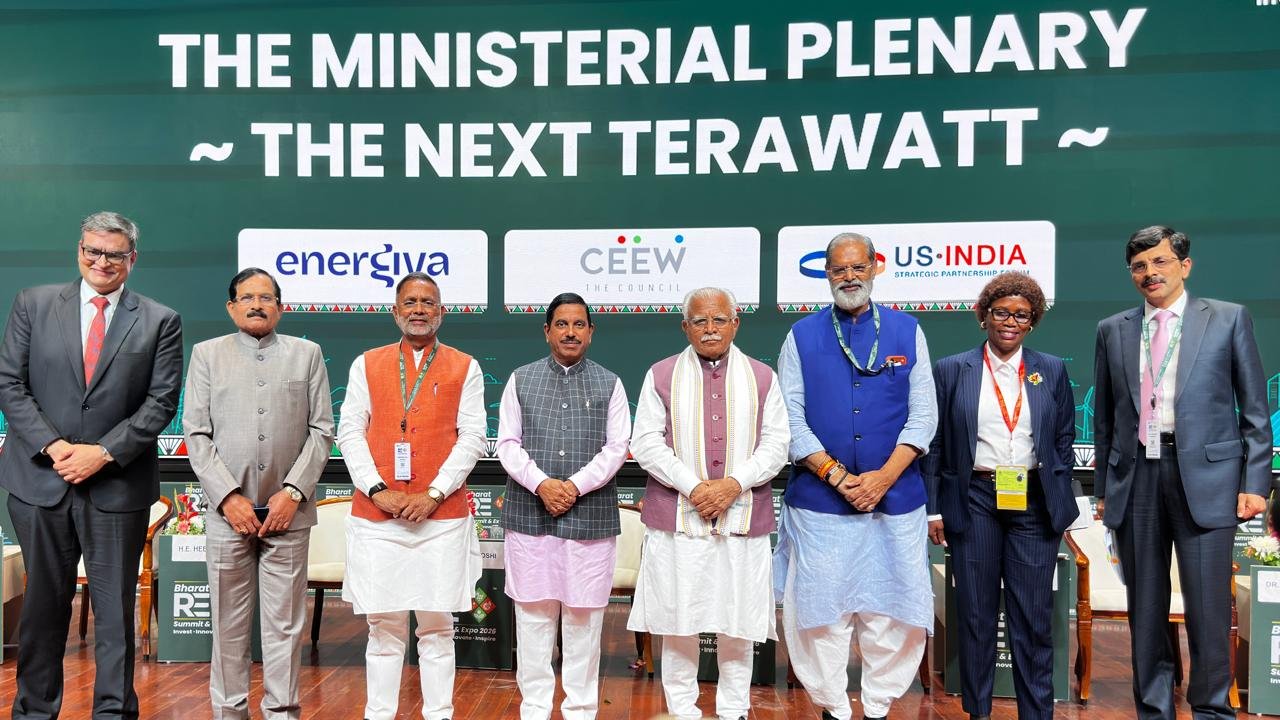
The ministerial dialogue titled “The Next Terawatt”, convened by the International Solar Alliance, the Council on Energy, Environment and Water and Energiva Ventures, addressed precisely these structural challenges. Joshi participated alongside Union Minister for Power and Housing and Urban Affairs Manohar Lal Khattar and Minister of State for New and Renewable Energy and Power Shripad Yesso Naik.
The discussions identified four priorities: integrated energy planning, supply and storage; expansion and resilience of energy infrastructure; financing renewable energy projects at terawatt scale; and the application of digitalisation and artificial intelligence to secure affordable electricity. The dialogue outlined a roadmap towards 2050, aligned with India’s Viksit Bharat 2047 ambition.
The emphasis on integrated planning is particularly relevant. A country cannot build a reliable renewable energy system by treating solar generation, wind power, hydropower, storage and transmission as separate policy exercises. Their deployment must be coordinated with regional demand, industrial requirements and the availability of flexible electricity sources. Artificial intelligence and digital grid management may improve forecasting, dispatch and operational efficiency, but they cannot replace investment in physical infrastructure or sound electricity-market institutions.
India’s official capacity figures illustrate the progress already achieved. According to the Ministry of New and Renewable Energy, as of 30 September 2026, installed renewable energy capacity, including large hydropower, stood at approximately 299.25 GW. Total non-fossil capacity, including nuclear power, was 308.03 GW. Solar accounted for 171.05 GW and wind for 59.20 GW. These categories should be distinguished: the non-fossil total includes nuclear power, while the renewable energy total includes large hydropower.
The figures demonstrate the scale of the transformation, but they also reveal why the next stage requires a different policy approach. India must move from measuring progress predominantly through installed capacity towards assessing electricity actually generated, delivered and consumed reliably. The IEA’s finding that variable renewables could account for approximately 26 per cent of India’s total electricity supply by 2030 makes investment in grids, storage and system flexibility increasingly urgent.
The international dimension of the summit is equally significant. BRE Summit & Expo 2026 has brought together representatives from more than 130 countries, including over 40 ministers, policymakers, investors, financial institutions and industry leaders. Australia, Denmark, the European Union, France, Germany, the Netherlands, Norway, Sweden and the United Kingdom are participating as Country Partners, while 13 Indian States and Union Territories are showcasing their renewable energy potential and investment opportunities.
For India, this international participation offers an opportunity to strengthen technology partnerships, attract capital and expand its position in global clean-energy supply chains. For participating countries, India represents a large and rapidly expanding market for renewable generation, manufacturing, storage and related infrastructure. The relationship, however, must be mutually beneficial: investment partnerships will be more durable when they support technology development, skills, local manufacturing and diversified supply chains rather than merely expanding project portfolios.
Modi also connected India’s international energy ambitions with the need to make finance and technology more accessible to developing economies. He referred to a proposed US$200 million Africa Solar Facility under the International Solar Alliance. The proposal reflects an important dimension of India’s energy diplomacy: the transition cannot be considered equitable if countries with abundant renewable resources remain unable to develop them because of high borrowing costs, inadequate infrastructure and limited access to technology.
For African economies, the issue is particularly consequential. Renewable energy can support mining, agriculture, manufacturing and digital infrastructure, but these sectors require dependable electricity rather than generation capacity alone. Financing arrangements must therefore address transmission, storage, utility reform and the ability of electricity purchasers to meet payment obligations. Without these foundations, even technically viable projects can struggle to attract sustainable private investment.
The perspective of Zimbabwe’s Secretary of Energy, Dr. Gloria Magombo, brought these practical concerns into the summit’s discussions. In her intervention, she described the need to expand independent power production to meet rising electricity demand from agriculture and mining. She explained how hydropower could complement solar generation by reducing hydroelectric output during daylight hours and increasing it at night, while also recognising the growing need for utility-scale storage.
Her remarks highlighted a challenge shared by many developing economies: renewable energy expansion must be compatible with the reliability and financial viability of the entire electricity system. Magombo also stressed the importance of private-sector participation, appropriate policies and regulations, and financially sustainable utilities capable of paying independent power producers. Her intervention underlined that attracting investors requires more than announcing renewable energy targets; it requires credible institutions and commercially viable electricity markets.
The investment announcements at the summit offered an indication of how India’s states are seeking to translate the national energy agenda into regional development opportunities. Odisha announced 18 MoUs representing proposed investments of approximately ₹1.17 lakh crore and a tentative capacity addition of 11,742 MW. The proposals span pumped storage, solar, wind, hybrid renewable energy, battery storage, green hydrogen and green data centres.
Separately, Bondada Engineering Ltd., part of the Bondada Group, signed an MoU with the Goa Investment Promotion and Facilitation Board for a proposed investment of approximately ₹3,000 crore in solar energy and biogas projects. The company has indicated that the projects could generate more than 700 employment opportunities. The agreement is non-binding and subject to further evaluation, statutory approvals and other formalities.
These announcements demonstrate the growing competition among Indian states to attract clean-energy investment. They also illustrate why proposed investment values must be interpreted carefully. An MoU represents an expression of investment intent, not necessarily financial closure, construction or operational capacity. The real test will be whether projects secure financing, obtain approvals, connect to the grid and begin generating electricity within credible timelines.
Innovation and research formed another dimension of the summit through “Watts Next: Innovators’ Ideas for India’s Energy Security, Agenda 2047”, curated in partnership with BloombergNEF. Participants included Sumant Sinha of ReNew, Shreya Mishra of SolarSquare, Girish R. Tanti of Suzlon Group, Professor Ashok Jhunjhunwala of IIT Madras and Meredith Annex of BloombergNEF. Their participation reflected the need for closer cooperation among industry, entrepreneurs, research institutions and policymakers.
The broader significance of this collaboration lies in the changing nature of energy competition. The next phase will involve battery technologies, power electronics, smart grids, artificial intelligence, green hydrogen and more efficient manufacturing. Countries that can combine research capabilities with commercially viable deployment models will be better positioned to shape the emerging energy economy. But technological ambition must be matched by practical implementation, access to finance and institutions capable of delivering projects at scale.
The central message emerging from BRE Summit 2026 is that the global clean-energy transition has entered a more demanding phase. The first phase focused heavily on targets, investment commitments and the rapid expansion of renewable generation. The next will be judged by the reliability of electricity systems, the resilience of supply chains, the affordability of power and the ability to turn manufacturing and technological capabilities into lasting economic advantages.
For India, this is an opportunity to connect energy security with industrial development and international influence. Modi’s emphasis on clean energy as a strategic necessity and Joshi’s focus on scale, speed and self-reliance establish the political and industrial direction. The IEA’s latest assessment, meanwhile, makes clear that the next stage requires stronger grids, storage, flexibility and financially viable utilities.
Ultimately, the credibility of India’s ambition will not be determined by installed-capacity targets or investment announcements alone. It will depend on whether projects are completed, electricity reaches consumers when needed, domestic manufacturing becomes internationally competitive and renewable power reduces the economy’s exposure to external energy shocks.
The next terawatt will be shaped not by capacity targets alone, but by the nations that can finance, manufacture, integrate and deliver reliable clean energy at scale.
-Staff Reporter
READ THE FULL E-MAGAZINE | WorldAffairs: For Decision-Makers Who Need More Than Headlines