



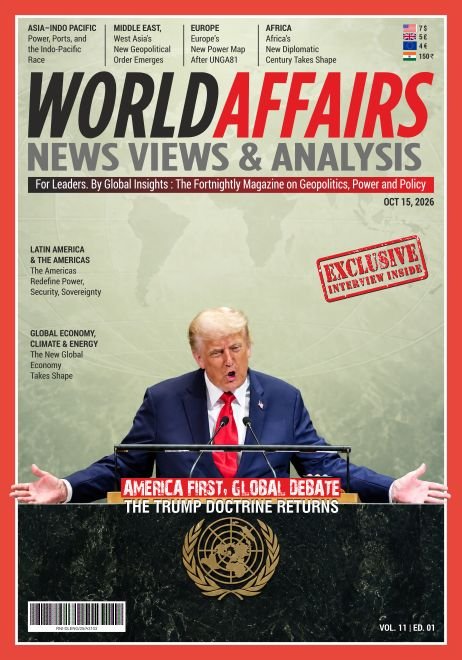
NEW YORK, USA: Africa’s next health crisis will not be defined only by how quickly governments can respond after an outbreak begins. It will be defined by what they have built before the crisis arrives: surveillance systems capable of detecting threats early, laboratories able to confirm them quickly, health workers prepared to act, regional mechanisms capable of crossing borders, domestic manufacturing able to protect essential supplies, and financing systems strong enough to sustain the response. That is increasingly the logic behind Kenya’s evolving health-security strategy, and an exclusive WorldAffairs interview at the 81st United Nations General Assembly in New York offered a detailed insight into how Nairobi is approaching that transition.
In an exclusive conversation with Dr. M. Shahid Siddiqui, Editor-in-Chief of WorldAffairs and WNN, Deputy Minister Mary Muthoni Muriuki, Principal Secretary for Public Health, Government of Kenya, described a health-security model that increasingly connects public health with economic resilience, regional integration, climate adaptation, manufacturing and diplomacy. Her central message was direct: “The most important change is moving from a reactive approach to a more proactive preparedness model.” That distinction matters because the institutional challenge facing African health systems is no longer simply how to manage an emergency once it becomes visible. It is how to identify risk earlier, mobilise capacity faster and prevent local outbreaks from becoming regional or global emergencies.

Kenya’s second-generation National Action Plan for Health Security 2026–2030 reflects that shift. WHO reported in February that Kenya had validated the plan following a 2024 Joint External Evaluation, with priorities including stronger sub-national systems, integrated digital surveillance, emergency response and laboratory systems, and collaborative surveillance across human, animal and environmental health. The strategy therefore places the One Health approach at the centre of preparedness, recognising that modern health threats do not respect the traditional boundaries between public health, agriculture, environment and animal health. Muriuki reinforced that broader understanding, explaining that “Health security cannot be treated only as an emergency response issue.” The implication is significant: preparedness must become a continuing function of government rather than an extraordinary activity activated only when a crisis becomes politically unavoidable.
That logic becomes even more important in East Africa, where national borders cannot contain infectious disease. “A disease outbreak does not recognise political boundaries,” Muriuki told WorldAffairs, arguing that surveillance, information-sharing and emergency-response mechanisms must therefore operate across borders as well. Kenya’s role within regional health-security architecture is reinforced by its hosting of the Africa CDC Eastern Africa Regional Coordinating Centre, creating a platform for regional cooperation. The objective is not simply to exchange information during emergencies but to institutionalise interoperability before emergencies occur. “The goal should be to make regional coordination routine rather than something we establish only after an outbreak has already crossed a border.” This is perhaps one of the most important lessons of the post-COVID era: regional cooperation is most valuable when it exists before the emergency, not when governments are already racing against transmission.
The second major pillar is health-product security. COVID-19 exposed the vulnerability of countries dependent on distant manufacturing centres for vaccines, medicines, diagnostics and medical equipment. Kenya is now attempting to turn that vulnerability into an industrial-policy opportunity. In June 2026, the country launched its Health Products and Technologies Local Manufacturing Strategy 2026–2030, designed to expand domestic production of medicines, vaccines, diagnostics and medical devices while strengthening regulatory systems. WHO reported that Kenya still imports an estimated 70–80 percent of the pharmaceuticals it consumes, underscoring the scale of the challenge despite an established domestic manufacturing base.
Muriuki framed the issue not as a retreat from globalisation but as an effort to make African health systems more resilient within it. “Health security requires a degree of health sovereignty, and local and regional manufacturing is an important part of that.” But she immediately added an important qualification: “But self-reliance does not mean that every African country must manufacture every product.” Her argument points toward regional specialisation rather than national duplication countries developing complementary capabilities, regional markets absorbing production, procurement systems creating predictable demand and regulators reducing unnecessary barriers to cross-border trade.
The economic dimension of that argument is critical. Africa’s health-manufacturing ambition will not succeed merely because governments announce factories or attract investors. Manufacturers require customers, financing, infrastructure, technology and regulatory certainty. Muriuki expressed that reality in four words: “A factory needs a market.” She argued that predictable demand, appropriate financing, reliable procurement, strong regulation and regional market access must develop alongside production capacity. The African Union has set a continental ambition to progressively increase local manufacturing capacity so that at least 60 percent of Africa’s health-product needs can be met through local production by 2040. The challenge is therefore simultaneously industrial, commercial and geopolitical: Africa must create not merely factories, but a functioning regional health-products ecosystem.
That ecosystem will depend heavily on regulatory harmonisation and regional trade. If manufacturers face substantially different requirements in every national market, the cost of serving Africa remains high and the incentives for investment weaken. Muriuki argued for regional specialisation and technology transfer, with the objective of moving beyond basic production toward diagnostics, vaccines, advanced medical technologies and other higher-value products. “That is where health security and economic development come together.” Her formulation captures a broader transformation in African health policy: health security is increasingly being treated not only as a public-health responsibility but as part of industrial development, trade strategy and economic sovereignty.
The same transformation is visible in health diplomacy. The pandemic demonstrated that access to vaccines, diagnostics, technology and scientific expertise can be shaped by international relationships as much as by domestic capacity. “Health diplomacy has become increasingly important,” Muriuki said. “Health is not separate from foreign policy, trade or national security.” For Kenya and other African states, the question is therefore how to engage international partnerships without allowing external financing or supply chains to become permanent structural dependencies. Muriuki put the principle clearly: “The objective should be partnerships that strengthen African capacity rather than creating permanent dependence.”
Financing will test whether that principle can be sustained. Kenya’s engagement with the Global Fund comes at a time when the organisation’s eighth grant cycle, covering 2026–2028, places greater emphasis on prioritisation, domestic co-financing, sustainability, integration into national systems and predictable transition planning. The Global Fund has explicitly linked its new approach to stronger domestic financing and sustainable health-system delivery.
For Kenya, the transition cannot simply mean replacing external money with domestic money overnight. It requires building national systems capable of sustaining services, commodities and community health programmes over time. As Muriuki explained, “For Kenya, the important principle is that external financing should help strengthen sustainable national systems.”
Climate change adds another dimension to this preparedness architecture. Kenya’s Climate Change and Health Strategy 2024–2029 formally connects climate risks with health-system planning, disease surveillance and resilience. During interview at the sideline of UNGA 81, Muriuki also highlighted the importance of climate-resilient primary healthcare, climate-informed surveillance and early-warning systems. Recent Kenyan government reporting from the UNGA period similarly identified resilient health facilities, stronger community systems and access to climate finance as priorities. Her assessment is unequivocal: “Climate and health can no longer be considered separate issues.”
That statement captures perhaps the largest conceptual change in Africa’s health-security debate. A flood is no longer only an environmental emergency if it disrupts health facilities, contaminates water systems, displaces communities and changes disease patterns. A heat event is not merely a meteorological occurrence if it increases pressure on hospitals and vulnerable populations. A change in ecological conditions can alter disease-vector patterns and create new demands on surveillance systems. Health preparedness therefore increasingly requires information flowing between meteorological agencies, environmental authorities, public-health institutions and community networks.
The investment implications are equally significant. Kenya is positioning healthcare manufacturing, medical technology, diagnostics, vaccines, infrastructure and public-private partnerships as areas where international capital can support both commercial activity and national health-system resilience. But the investment proposition is not simply about market size. It depends on regulation, infrastructure, skills, predictable demand and access to regional markets through frameworks including the East African Community, COMESA and the African Continental Free Trade Area.
Muriuki’s argument is that Africa should connect these agendas rather than treat them as separate policy silos. “The opportunity is to connect health policy with industrial policy and trade policy.” That approach could potentially transform health security from a cost-centre into a wider development strategy, one that creates manufacturing capacity, skilled employment, technology transfer, regional trade and stronger domestic healthcare systems at the same time.
The deeper message emerging from the WorldAffairs exclusive interview is that Africa’s health-security future will depend less on emergency declarations and more on institutional architecture. Surveillance must become continuous. Regional coordination must become routine. Manufacturing must become commercially sustainable. Financing must become more predictable. Climate information must become part of health planning. And international partnerships must increasingly be structured around capacity-building rather than indefinite dependency.
Kenya’s strategy does not eliminate the vulnerabilities facing African health systems, nor does preparedness guarantee that future outbreaks can be contained. But it reflects a significant change in the policy question itself. The debate is moving from how Africa responds when a pandemic arrives to what Africa must build before the next pandemic arrives. That is the strategic shift at the heart of Kenya’s health-security agenda and one that extends well beyond Nairobi. The future of African health security will ultimately depend on whether preparedness can be converted from a policy document into functioning laboratories, trained personnel, reliable supply chains, regional information systems, resilient health facilities, sustainable financing and manufacturing capacity.
As Muriuki concluded in the WorldAffairs conversation, the objective is “to build partnerships that create value for investors while also strengthening Kenya’s health system and contributing to Africa’s broader health-security agenda.” In a continent where the next health emergency may cross borders faster than governments can convene, preparedness is no longer simply a medical priority. It is becoming an essential pillar of economic resilience, regional cooperation and national security.
– Stephen Maina