


NEW DELHI: For more than a decade, Prime Minister Narendra Modi has cultivated a reputation for political resilience. Whether confronted by opposition parties, civil society campaigns or mass street protests, his government has rarely appeared willing to retreat under public pressure. The resignation of Union Education Minister Dharmendra Pradhan, following weeks of nationwide demonstrations over alleged examination paper leaks, therefore marks far more than the exit of a cabinet minister. It is one of the most significant political concessions of the Modi era and a defining moment in the evolving relationship between India’s youth, its democratic institutions and its political leadership.

The youth-led “Cockroach Janta Party” (CJP) movement formally ended its agitation after announcing that the government had accepted all of its principal demands. The protests, which began over allegations of widespread irregularities in India’s competitive entrance examinations, secured what very few protest movements have achieved since Narendra Modi came to power in 2014: the resignation of a senior Union minister and a public commitment to institutional reforms. The government’s willingness to concede also recalls the withdrawal of the controversial farm laws in 2021 after a year-long farmers’ movement, one of the rare occasions when sustained public pressure forced a policy reversal.
The immediate trigger for the protests was the alleged leak of question papers for India’s national medical entrance examination, forcing authorities to cancel results and conduct a retest affecting nearly two million students. In a country where competitive examinations determine access to higher education, government employment and social mobility, the controversy struck at the heart of India’s merit-based aspirations. Millions of students invest years of preparation, substantial financial resources and enormous emotional commitment in these examinations. For many, the leaks represented not merely an administrative lapse but a betrayal of the promise that hard work and merit alone should determine success.
What initially appeared to be an education controversy rapidly evolved into a much broader political and social movement. Students were joined by unemployed graduates, professionals, parents, teachers and civil society activists who viewed the examination scandal as symptomatic of deeper structural problems confronting India’s younger generation. Protest sites in New Delhi and other cities became platforms for wider discussions about unemployment, delayed government recruitment, transparency, accountability and the widening gap between educational achievement and meaningful employment opportunities.
The movement resonated because it reflected anxieties that extend far beyond examination halls. India today possesses one of the world’s youngest populations, with millions entering the labour market every year. Although the country continues to record impressive economic growth, employment generation has struggled to keep pace with rising educational attainment and aspirations. Repeated controversies surrounding recruitment examinations, delays in government hiring and perceptions of declining institutional credibility have generated widespread frustration among educated youth. The examination leak therefore became a symbol of something much larger, a growing crisis of confidence in the institutions responsible for guaranteeing fairness and equal opportunity.
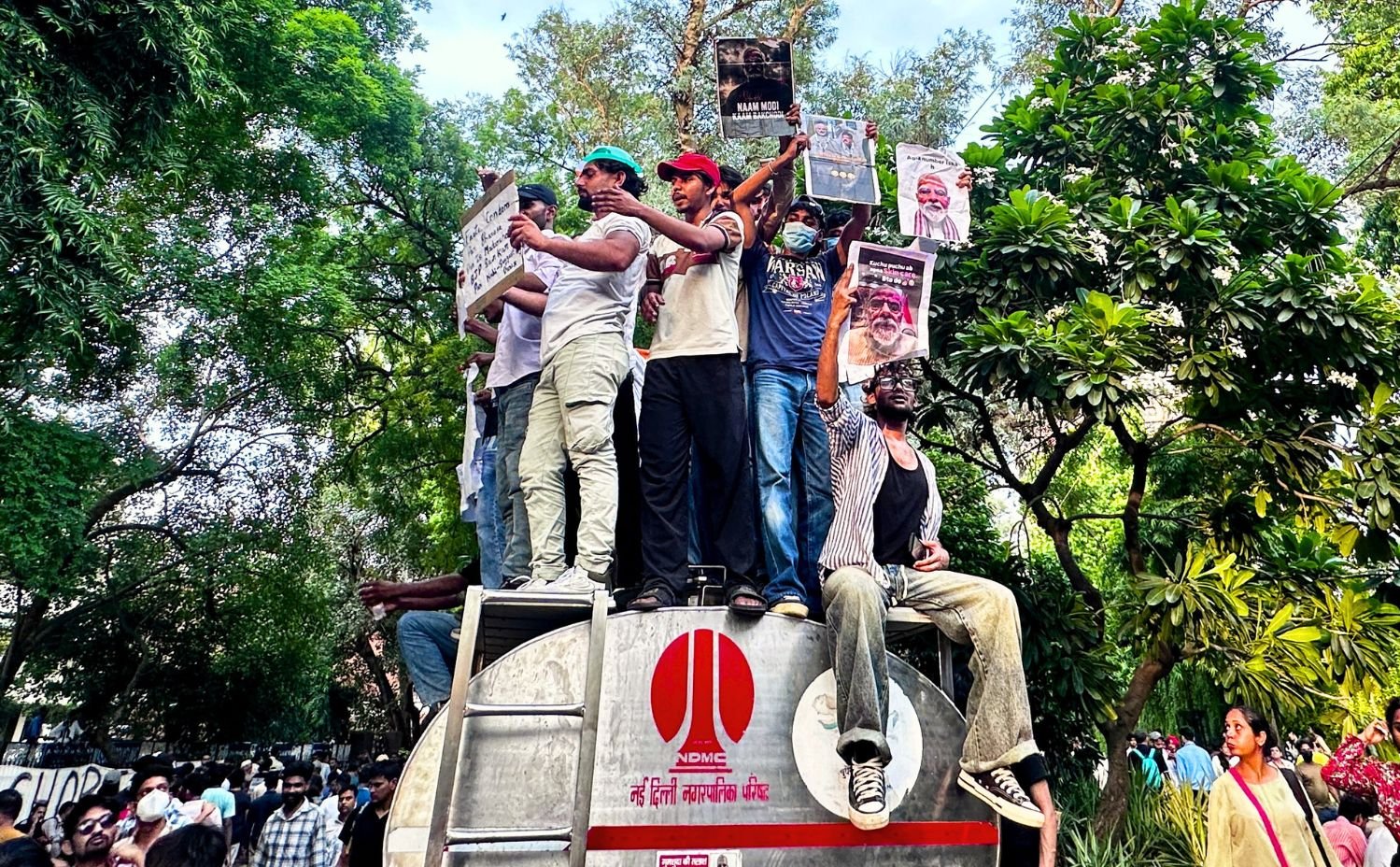
The protests were remarkable not only for their scale but also for their composition. Unlike many previous movements driven primarily by political parties or trade unions, this agitation originated organically among students themselves. The young demonstrators referred to themselves as “cockroaches,” reclaiming what began as an insult into a symbol of resilience and determination. Their persistence through weeks of demonstrations, sit-ins and hunger strikes gradually transformed a student campaign into one of the most significant youth-led democratic mobilisations witnessed in India in recent years.
Although the movement remained fundamentally independent and youth-driven, it increasingly found a powerful political voice in Rahul Gandhi. As Leader of the Opposition, Gandhi elevated the issue from an administrative controversy into one of the defining political debates of the Monsoon Session of Parliament. He repeatedly accused the Modi government of failing millions of young Indians whose futures had been jeopardised by examination irregularities and argued that the crisis reflected deeper failures of governance rather than isolated administrative errors.
Rahul Gandhi’s intervention fundamentally altered the political dynamics surrounding the movement. Inside Parliament, Congress MPs repeatedly disrupted proceedings, demanding Dharmendra Pradhan’s resignation and comprehensive reforms of India’s examination and recruitment systems. Outside Parliament, Gandhi joined demonstrators near Jantar Mantar and later staged a high-profile sit-in close to the Prime Minister’s residence alongside Congress General Secretary Priyanka Gandhi Vadra.
Their subsequent detention by Delhi Police generated extensive national attention and further intensified public scrutiny of the government’s handling of the protests. By physically standing alongside students rather than merely speaking on their behalf, Gandhi sought to position himself as the parliamentary voice of India’s younger generation while ensuring that the movement’s demands remained at the centre of national political discourse.
Yet the movement’s legitimacy rested on the students themselves. Rahul Gandhi and opposition parties amplified the protests, but they did not create them. The demonstrations were sustained by young Indians who believed that repeated examination scandals, shrinking employment opportunities and delayed recruitment had eroded confidence in the country’s institutions. Their message transcended partisan politics. They demanded accountability rather than political patronage and institutional reform rather than symbolic assurances.
As demonstrations intensified, opposition parties disrupted parliamentary proceedings throughout the week, while dramatic images of police using tear gas and baton charges against protesters circulated widely across television channels and social media platforms. Those images transformed what many initially viewed as an education dispute into a broader national debate over democratic rights, freedom of peaceful assembly and the government’s response to public dissent. The protests also drew support from noted activist Sonam Wangchuk, who undertook a 26-day hunger strike in solidarity with the movement and later described Pradhan’s resignation as “a victory of peace, patience and perseverance.”
The mounting pressure eventually produced an outcome that few political observers had anticipated. Following another round of negotiations, Health Minister J.P. Nadda and Minister of State Jitendra Singh held a joint press conference alongside representatives of the Cockroach Janta Party, announcing that the government had accepted all major demands raised by the protesters. These reportedly included comprehensive reforms to India’s examination system, withdrawal of police cases against protesters, compensation for families of students who died by suicide following the examination paper leak controversy and broader measures to strengthen institutional transparency and accountability.
Shortly thereafter, Dharmendra Pradhan announced his resignation through a post on X. In his statement, he said he had decided to step down so that “anti-national forces” would not exploit the prevailing situation while expressing his deep respect for the aspirations, emotions and legitimate expectations of India’s youth. His resignation came as a surprise because Modi has cultivated a reputation for resisting political pressure and rarely allowing ministerial resignations in response to public protests.
Pradhan, a senior Bharatiya Janata Party leader who had served as Education Minister since 2021 and was once considered a potential future BJP president, became only the second Union minister to resign following a major public controversy during Modi’s tenure, after M.J. Akbar stepped down in 2018 amid allegations raised during India’s #MeToo movement.
The announcement triggered scenes of celebration at Jantar Mantar in New Delhi, where thousands of protesters embraced, waved the national flag, distributed sweets and sang the national anthem. Roads surrounding Connaught Place were temporarily closed as crowds swelled, while mobile internet services that had been suspended for much of the week were restored and Delhi Metro stations around the protest site reopened. “We have done it,” declared CJP founder Abhijeet Dipke to loud cheers. Spokespersons Ashutosh Ranka and Saurav Das formally announced the withdrawal of the agitation, urging demonstrators to return home peacefully after confirming that every principal demand had been accepted by the government. For many protesters, the resignation represented not simply political victory but institutional accountability. “This had to be done. Someone must be held accountable,” said Prachi Kumar, a corporate employee who had joined the demonstrations.
The political significance of these events extends well beyond the resignation of a single minister. The Bharatiya Janata Party has traditionally enjoyed substantial support among young voters by presenting itself as the party of aspiration, entrepreneurship, technological innovation and national development. However, the protests revealed that today’s young Indians are increasingly motivated not only by ideology but also by concerns over governance, transparency, employment opportunities and institutional credibility. These issues cut across social, regional and political identities, creating an unusually broad coalition united by shared frustration rather than partisan affiliation.
For Rahul Gandhi, the movement also represented an important political moment. By consistently raising the issue inside Parliament while joining protesters outside it, he reinforced his attempt to reposition himself as the principal national advocate for India’s younger generation. Whether that strategy translates into electoral gains remains uncertain, but there is little doubt that his parliamentary interventions and public demonstrations significantly increased pressure on the government during one of its most challenging domestic crises in recent years.
The Modi government now confronts a far more demanding challenge than accepting the protesters’ demands. Restoring public confidence will require structural reforms capable of preventing future examination leaks, modernising recruitment systems, strengthening institutional oversight and addressing the broader concerns surrounding youth unemployment and economic opportunity. Political concessions may calm immediate public anger, but only meaningful institutional reforms can rebuild trust among millions of young Indians who increasingly question whether merit alone guarantees opportunity.
Dharmendra Pradhan’s resignation therefore closes one chapter while opening another. It demonstrated that peaceful civic mobilisation remains capable of influencing public policy in the world’s largest democracy. It also illustrated how sustained pressure from the streets, amplified by parliamentary opposition led by Rahul Gandhi, can reshape the national political agenda. The students built the movement; Rahul Gandhi ensured their demands echoed inside Parliament; civil society sustained public attention; and ultimately the government concluded that the political costs of continued resistance outweighed the costs of concession.
Whether this extraordinary episode becomes a genuine turning point for India’s education system or merely a temporary political compromise will depend on the government’s willingness to translate promises into lasting reforms. Yet one conclusion already appears unmistakable. India’s youth are no longer simply an electoral constituency waiting for the next election. They have emerged as one of the country’s most influential democratic forces, capable of shaping public debate, influencing parliamentary politics and compelling even one of India’s most powerful governments to listen.
-Dr. M Shahid Siddiqui