

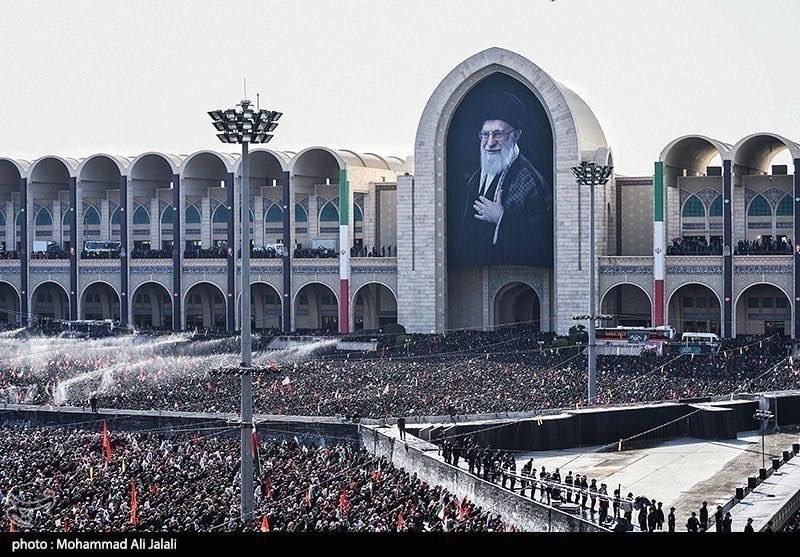
TEHRAN: Iran’s state funeral for Ayatollah Ali Khamenei is no longer simply a national farewell. It has become the first public demonstration of political continuity following one of the most consequential leadership transitions in the Islamic Republic’s history. As millions gather to honour the late Supreme Leader, the carefully choreographed ceremonies are also intended to reassure both domestic and international audiences that the country’s political institutions remain firmly in control.
The symbolism became even more pronounced on Sunday when three of Khamenei’s sons Mostafa, Meysam and Masoud appeared beside their father’s coffin during funeral prayers at Tehran’s Imam Khomeini Grand Mosalla. Missing, however, was Mojtaba Khamenei, the country’s new Supreme Leader, whose continued absence has drawn significant attention at a moment when public visibility carries immense political weight.
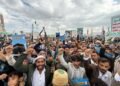
Iranian state television broadcast images of senior political leaders, military commanders and religious figures participating in the prayers, while thousands of mourners filled the sprawling religious complex. President Masoud Pezeshkian and Parliament Speaker Mohammad Baqer Qalibaf joined the ceremony, underscoring the state’s effort to project institutional unity.
According to sources familiar with Iran’s leadership cited by WorldAffairs, Mojtaba Khamenei sustained serious injuries during the February 28 Israeli and U.S. strikes that killed Ayatollah Khamenei and several members of his family. The reported injuries have not been officially confirmed, and Iranian authorities have offered no explanation for his absence from public events since assuming the country’s highest office.
Whether driven by medical recovery, security considerations or broader political calculations, his absence has inevitably become part of the story surrounding Iran’s transition. In a political system where the Supreme Leader represents both religious authority and state legitimacy, public appearances often carry strategic significance beyond ceremonial protocol.
The funeral itself has been designed as a national display of resilience. Following ceremonies in Tehran, the procession will travel through the holy city of Qom before continuing to the revered Shiite shrine cities of Najaf and Karbala in Iraq. The final burial will take place in Mashhad near the shrine of Imam Ali al-Ridha, reinforcing both Khamenei’s religious legacy and Iran’s enduring connection to the wider Shiite world.
Authorities have mobilised extensive transportation, accommodation and public services to facilitate what is expected to be one of the largest funeral processions in the country’s modern history. Officials portray the nationwide ceremonies as a demonstration of national unity following months of conflict and regional instability.
The timing is equally significant. The funeral comes after a ceasefire paused months of hostilities involving Iran, Israel and the United States, creating a brief period in which Tehran seeks to consolidate its domestic political position before diplomatic engagement resumes. The leadership transition therefore unfolds not only against the backdrop of national mourning but also amid shifting regional dynamics and renewed international scrutiny.
For Tehran, the objective extends beyond commemorating a leader who shaped Iran’s political and strategic direction for nearly four decades. The funeral is intended to reinforce confidence in the continuity of the Islamic Republic’s institutions and to signal that the transfer of authority has occurred without destabilising the state.
Yet the ceremonies also illustrate the challenges that accompany any historic succession. While the public appearances of Khamenei’s family reinforce an image of unity, the absence of the new Supreme Leader ensures that questions surrounding the consolidation of authority will persist long after the mourning period concludes.
Ultimately, the success of Iran’s post-Khamenei transition will be measured not by the scale of the funeral processions, but by the new leadership’s ability to maintain political cohesion, manage regional tensions and navigate an increasingly complex geopolitical environment.
-Talha Abdallah