




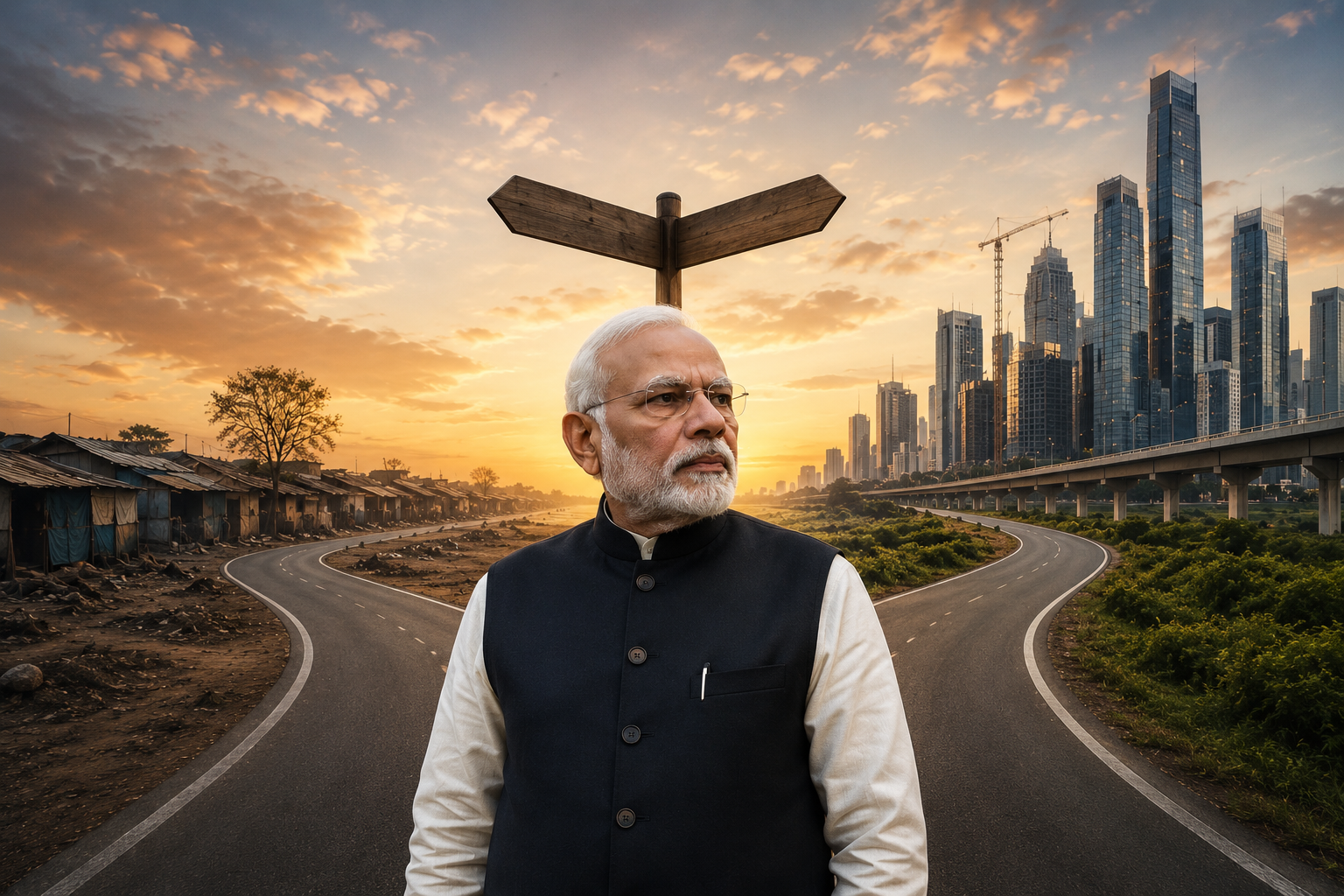
WASHINGTON/NEW DELHI: For much of the past decade, India has been presented as the world’s next great economic story. A youthful population, expanding digital infrastructure, geopolitical relevance, and aspirations of becoming a developed nation by 2047 have fueled optimism both domestically and internationally. Under Prime Minister Narendra Modi, India has sought to project itself as a rising power capable of challenging established economic centers while serving as a strategic alternative to China.
Yet a recent Wall Street Journal opinion article argues that beneath the narrative of progress lies a more uncomfortable reality: India may be losing momentum precisely when global economic conditions offer it a historic opportunity.
The article is not a rejection of India’s achievements. Rather, it questions whether those achievements are sufficient to transform India into the manufacturing, technological, and economic powerhouse its leaders envision. At its core, the argument revolves around a simple question: Has India modernized its infrastructure faster than it has modernized its economy?
The Infrastructure Success Story
Any serious assessment of India’s economy must begin by acknowledging the substantial changes that have taken place since 2014.
India today possesses a vastly expanded highway network, modernized airports, improved logistics corridors, a thriving digital payments ecosystem, and one of the world’s most ambitious public digital infrastructure projects. UPI has revolutionized transactions, financial inclusion has expanded dramatically, and the state has become increasingly capable of delivering services digitally. These accomplishments are not cosmetic. They represent real structural improvements that have enhanced efficiency, reduced transaction costs, and strengthened state capacity.
However, the Wall Street Journal’s critique is that infrastructure alone cannot substitute for economic reform.
Roads, ports, and digital platforms can facilitate growth, but they do not automatically create globally competitive industries. The article argues that the harder task reforming institutions, labor markets, investment regulations, and state-owned enterprises remains incomplete.
The Rupee as a Reflection of Structural Weakness
The article’s focus on the weakening rupee is symbolic as much as economic.
Currencies are ultimately reflections of confidence. While exchange rates are influenced by numerous global factors, sustained depreciation often raises questions about competitiveness, productivity, and capital flows. For an aspiring economic superpower, a persistently weak currency presents challenges. It increases the cost of imports, particularly energy and technology, while complicating efforts to attract long-term investment.
More importantly, the rupee’s trajectory raises broader questions about whether India’s productivity growth is keeping pace with its ambitions.
China’s rise was accompanied by extraordinary gains in manufacturing efficiency and export competitiveness. The Wall Street Journal suggests that India has yet to generate a comparable engine of productivity growth capable of supporting a stronger economic foundation.
The Investment Paradox
Perhaps the most significant concern highlighted in the article is the paradox of investment.
India is widely regarded as one of the most attractive long-term markets in the world. It possesses favorable demographics, political stability relative to many developing economies, and increasing geopolitical importance. Yet despite these advantages, foreign investment inflows have not consistently matched expectations.
The question is why.
Critics argue that investors continue to encounter regulatory uncertainty, complex compliance requirements, judicial delays, and policy unpredictability. While major multinational corporations remain interested in India, enthusiasm has not always translated into investment at the scale witnessed in East Asian success stories.
The Wall Street Journal’s concern is not that investors are leaving India. Rather, it is that India is not attracting enough investment relative to the enormous opportunity before it. In a world seeking alternatives to China, India should theoretically be the primary beneficiary. The article argues that this opportunity has not been fully captured.
The Manufacturing Challenge
The most consequential element of the critique concerns manufacturing. Historically, successful economic transformations from Japan and South Korea to China and Vietnam were built upon export-oriented manufacturing. India has attempted to replicate this model through initiatives such as “Make in India” and production-linked incentives. However, manufacturing’s share of employment and GDP has not expanded as rapidly as policymakers hoped.
The result is a persistent challenge: creating sufficient high-quality jobs for millions entering the workforce each year.
India’s service sector has been globally successful, but services alone may not generate the broad-based employment required for a nation of over 1.4 billion people.
This is where the comparison with Vietnam becomes particularly significant. Vietnam has emerged as a manufacturing hub by aggressively integrating into global supply chains, maintaining export competitiveness, and providing policy consistency. While India’s domestic market is far larger, the article argues that market size alone cannot compensate for differences in competitiveness.
Artificial Intelligence and the Threat to India’s Traditional Advantage
One of the article’s most forward-looking arguments concerns artificial intelligence.
For decades, India’s IT services industry represented a model of economic success. It generated foreign exchange, created a globally respected workforce, and established India as a knowledge economy.
However, AI may fundamentally alter that equation.
Many of the tasks that fueled India’s outsourcing boom routine coding, software maintenance, data processing, and customer support are increasingly susceptible to automation.
The challenge is not immediate collapse but gradual erosion. Countries that once benefited from labor-cost advantages may discover that algorithms now perform many tasks more efficiently than large human workforces.
This places India at a critical juncture. The future belongs not merely to technology adoption but to technological innovation. The article suggests that India must transition from being a service provider to becoming a creator of advanced technologies and intellectual property.
Reform Fatigue and Political Constraints
A recurring theme in the critique is the tension between economic necessity and political reality. Many economists argue that India’s labor laws, land acquisition procedures, and public-sector inefficiencies require substantial reform.
Yet reforms often generate political resistance. The withdrawal of agricultural reforms following nationwide protests became, for many observers, a symbol of the limits of economic reform in a democratic society. Unlike China, India’s leaders must operate within a highly competitive political system where every major reform carries electoral consequences.
The Wall Street Journal implies that political caution may have slowed the pace of transformation at a time when bold reforms were needed most.
Economic Nationalism Versus Global Integration
The article also questions whether India has struck the right balance between self-reliance and openness. The government’s emphasis on strategic autonomy and domestic manufacturing has undeniable appeal. The disruptions caused by the pandemic and geopolitical tensions exposed vulnerabilities in global supply chains.
However, economic history suggests that sustained growth often emerges from integration rather than insulation.
The concern raised by the article is that protectionist policies, however well-intentioned, may ultimately reduce competitiveness by limiting exposure to global competition. The challenge for India is therefore not choosing between self-reliance and globalization, but finding a model that combines both.
The Counterargument: Why India May Still Be Better Positioned Than Critics Suggest? Even critics acknowledge that declaring failure would be premature.
India remains among the world’s fastest-growing major economies. Its digital public infrastructure is increasingly studied internationally. Government revenues have strengthened, logistics have improved, and the country’s geopolitical standing has risen substantially.
Moreover, India faces a very different challenge from earlier Asian success stories. It is attempting to modernize a democracy of continental scale rather than a centralized developmental state. The comparison with Vietnam or China, while useful, is inherently imperfect. India’s transformation is likely to be slower, more uneven, and more politically contested. Yet it may also prove more durable because it rests on democratic legitimacy rather than administrative command.
The Real Test Lies Ahead
The Wall Street Journal’s critique ultimately raises a question that extends beyond Narendra Modi or any single government.
Can India convert its undeniable advantages population, democracy, technology, entrepreneurship, and geopolitical relevance into sustained economic dominance?
The answer remains uncertain.
India has built roads, digital platforms, and international influence. The next phase will require building productivity, competitiveness, innovation, and institutional efficiency at a similar scale. The coming decade may determine whether India fulfills its long-promised economic destiny or remains a country of extraordinary potential that never fully translated promise into power. That is the central challenge identified by the Wall Street Journal and one that will continue to shape debates about India’s future long after the current political era has passed.
-WNN Global Desk
READ THE FULL E-MAGAZINE | WorldAffairs: Power, Markets, Policy Decoded