



NEW DELHI, India: The 2026 Quad Foreign Ministers’ Meeting in New Delhi marked one of the most consequential strategic gatherings of the four Indo-Pacific democracies in recent years, underscoring how rapidly the geopolitical balance in Asia is shifting amid intensifying competition between the United States and China. Bringing together India’s External Affairs Minister S. Jaishankar, U.S. Secretary of State Marco Rubio, Australian Foreign Minister Penny Wong, and Japanese Foreign Minister Toshimitsu Motegi, the meeting reflected a growing strategic convergence around maritime security, resilient supply chains, emerging technologies, critical minerals, and countering coercive behavior across the Indo-Pacific.
The New Delhi meeting unfolded against the backdrop of unprecedented geopolitical churn following the return of U.S. President Donald Trump to the White House, rising instability in West Asia, intensifying maritime tensions in the South China Sea, and mounting concerns over economic coercion and technological competition. In this environment, the Quad has increasingly evolved from a consultative dialogue into a multidimensional strategic framework shaping the future security and economic architecture of the Indo-Pacific.
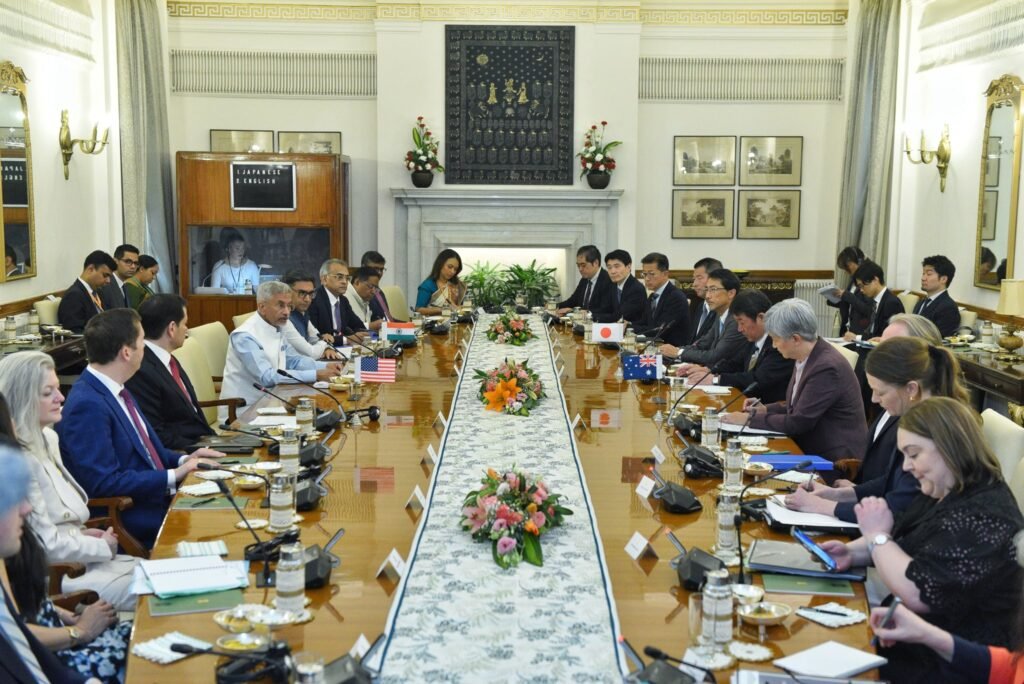
A central outcome of the meeting was the launch of the Indo-Pacific Maritime Surveillance Cooperation Initiative, announced by Marco Rubio, aimed at deepening coordination among Quad members on maritime surveillance and regional monitoring. The initiative complements the expansion of the Indo-Pacific Maritime Domain Awareness initiative and demonstrates the Quad’s growing emphasis on real-time maritime coordination in response to rising regional tensions and increased military activity in contested waters.
The ministers also agreed to develop a Common Operational Picture across the Indo-Pacific by integrating existing efforts under the Indo-Pacific Partnership for Maritime Domain Awareness (IPMDA). India’s operationalization of the Indian Ocean Region programme through the Information Fusion Centre–Indian Ocean Region in Gurugram was welcomed as a major step in strengthening collective maritime awareness and regional information-sharing mechanisms.
The Quad’s maritime agenda carried unmistakable strategic messaging directed at developments in the South China Sea and East China Sea. Although China was not explicitly named in several sections of the joint statement, the language reflected growing concern over coercive maritime actions, militarization of disputed territories, obstruction of lawful navigation, and unsafe maneuvers at sea. The four countries reiterated their commitment to international law and emphasized adherence to the United Nations Convention on the Law of the Sea (UNCLOS), including the protection of navigational rights, uninterrupted global commerce, and freedom of navigation through critical waterways such as the Strait of Hormuz and the Red Sea.
The statement also strongly opposed attacks on commercial shipping and criticized measures inconsistent with UNCLOS, including the imposition of tolls or restrictions affecting maritime commerce. These concerns have become increasingly significant amid instability in West Asia and disruptions to global trade routes that connect Europe, Asia, and the Indo-Pacific.
The Quad’s strategic coordination extended beyond security into economic resilience and technological competition. One of the most important outcomes was the launch of the Quad Critical Minerals Framework designed to strengthen cooperation in mining, processing, recycling, and securing supply chains for critical minerals essential for semiconductors, batteries, defense systems, and advanced manufacturing. The initiative reflects rising concerns among Quad nations over vulnerabilities created by concentrated supply chains and export restrictions affecting rare earths and strategic minerals.
The ministers also announced a new Quad Initiative on Indo-Pacific Energy Security intended to stabilize energy markets and build resilient energy supply chains across the region. In addition, the grouping emphasized trusted semiconductor ecosystems and secure digital infrastructure under the broader “Pax Silica” framework aimed at reducing strategic dependence in sensitive technology sectors.
Emerging technologies formed another major pillar of the discussions. The Quad reaffirmed cooperation on artificial intelligence, 5G and 6G telecommunications, semiconductors, trusted digital infrastructure, and digital identity standards. The ministers also announced plans for workforce development initiatives and Track 1.5 dialogues on standards and technological governance, signaling a long-term effort to shape the rules and norms of the next-generation digital economy.
Infrastructure connectivity and digital resilience were also prioritized. The Quad announced new cooperation with the Government of Fiji on port infrastructure development while reaffirming support for ensuring all Pacific Islands Forum member states are connected through resilient undersea cable systems by 2026. The emphasis on undersea cables reflects growing recognition that digital connectivity infrastructure has become a core geopolitical asset in the contest for regional influence.
On regional security, the Quad ministers reaffirmed support for ASEAN centrality and expressed concern over the continuing crisis in Myanmar. The ministers also reiterated their commitment to the complete denuclearization of North Korea and condemned Pyongyang’s ballistic missile and weapons programs alongside concerns regarding cyber activities and military cooperation.
The meeting also delivered one of the Quad’s strongest collective messages against terrorism. The four countries unequivocally condemned terrorism in all forms, including the Pahalgam terror attack in India on April 22, 2025, and the Bondi Beach attack in Australia on December 14, 2025. The ministers called for decisive action against terror financiers, networks, sponsors, and proxies while pledging deeper cooperation against cybercrime, trafficking, transnational organized crime, and online scam centers operating across Southeast Asia.
Humanitarian assistance and disaster response emerged as another area of expanding cooperation. The ministers highlighted coordination during responses to the Papua New Guinea landslide and the Myanmar earthquake while reaffirming the role of the Indo-Pacific Logistics Network in improving rapid disaster response capabilities across the region.
China responded cautiously to the Quad meeting, reiterating that regional cooperation should contribute to peace, stability, and prosperity rather than target third parties. Chinese Foreign Ministry spokesperson Mao Ning stated that Beijing opposed the formation of exclusive blocs and warned against actions that could undermine trust and cooperation among regional countries. Yet the scale and scope of the Quad’s new initiatives suggest that the four democracies increasingly view coordinated strategic action as essential to preserving a rules-based Indo-Pacific order.
The significance of the New Delhi meeting lies not only in the initiatives announced but in the broader transformation of the Quad itself. What began years ago as a loose strategic dialogue has steadily evolved into a comprehensive geopolitical platform spanning maritime security, supply chains, critical technologies, infrastructure, energy, counterterrorism, disaster response, and regional governance. The 2026 ministerial meeting demonstrated that the Quad is no longer simply a symbolic coalition but an increasingly operational strategic framework responding to a rapidly changing global order.
At a time when geopolitical competition is intensifying across multiple theaters, the Quad’s message from New Delhi was unambiguous: the Indo-Pacific’s leading democracies intend to deepen coordination, strengthen resilience, and shape the future regional order against the backdrop of rising coercion, technological rivalry, and strategic uncertainty.
-Dr. M Shahid Siddiqui