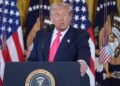


WASHINGTON D.C, USA: In a high-stakes return to the White House, Saudi Crown Prince Mohammed bin Salman (MBS) received a lavish welcome from U.S. President Donald Trump, a meeting marked by soaring investment promises, strategic military deals, and renewed controversy over Jamal Khashoggi’s killing. The optics were unmistakable: marching bands, ceremonial horsemen, and a military flyover underscored Trump’s embrace of the Saudi leader he described as “a fantastic friend” and “a brilliant man.” But behind the pomp, the visit exposed sharp tensions between Trump and the American press, culminating in a heated confrontation where he accused ABC News of “fake news” during a live briefing.
The flashpoint came when an ABC News reporter pressed MBS on the 2018 killing of Washington Post columnist Jamal Khashoggi, a U.S. resident murdered inside the Saudi consulate in Istanbul. U.S. intelligence agencies had concluded that MBS approved the operation. Trump flatly contradicted his own intelligence community, insisting the crown prince “knew nothing about it,” adding dismissively, “Things happened, but he knew nothing about it, and we can leave it at that.”
Visibly irritated, Trump accused the reporter of trying “to embarrass our guest,” calling the question “insubordinate” and “terrible.” When she later asked about Trump’s refusal to release Jeffrey Epstein–related records, the president escalated further, saying ABC News “should lose its broadcasting license” and declaring the network “fake news.” “Somebody psyched you over at ABC,” Trump snapped, as MBS sat beside him. “You’re a terrible person and a terrible reporter.”
The exchange drew immediate rebuke from Khashoggi’s widow, Hanan Elatr Khashoggi, who told WNN partners that no criticism of her late husband could justify dismissing his killing: “Nothing can justify such a horrible crime… I wish Trump would meet me and know the real Jamal.”
Still, the Saudi crown prince maintained a calm posture, calling Khashoggi’s death “painful” and saying the kingdom had “improved our system to be sure nothing like that happens again.” Despite longstanding human rights concerns, Trump repeated that MBS had done an “incredible job on human rights,” though he offered no specifics.
A Pivot to Strategy, Deals, and Diplomacy
Once the tense exchange passed, both leaders shifted to the core agenda: strengthening U.S.–Saudi strategic cooperation.
Trump announced the approval of F-35 fighter jet sales to Riyadh potentially 48 aircraft marking a historic policy shift that could alter the military balance in the Middle East. He emphasized that the jets would not be downgraded, a departure from Washington’s traditional insistence that Israel must retain a “qualitative military edge.”
“They’d like you to get planes of reduced calibre,” Trump told MBS. “I don’t think that makes you too happy. As far as I’m concerned, both countries should get top-of-the-line equipment.”
The White House also confirmed that Washington and Riyadh had signed a Strategic Defense Agreement “fortifying deterrence across the Middle East,” though it fell short of the NATO-style mutual defense pact the Saudis originally sought.
Additionally, the two governments signed a joint declaration completing negotiations on civil nuclear energy cooperation—a move that could eventually open the door to U.S. nuclear technology, though Washington still insists Riyadh renounce uranium enrichment. Trump said a full agreement was possible but “not urgent.”
Israel, Iran, and the Abraham Accords
The leaders also discussed regional diplomacy. Trump said the pair had “good talks” on normalizing Saudi-Israel relations, while MBS reiterated that Riyadh remains committed to a two-state solution as the basis for any deal.
“We want to be part of the Abraham Accords,” MBS said, “but we must secure a clear path to a two-state solution.”
On Iran, Trump boasted about U.S. strikes against nuclear facilities earlier this year but also suggested diplomatic movement, saying Tehran “wants a deal” and that Washington is “totally open to it.” MBS signaled support, saying Saudi Arabia would “do our best to help reach a deal.”
Trump repeatedly highlighted what he called “hundreds of billions of dollars” of Saudi investment expected to flow into the U.S. economy. “You’ve agreed to invest $600 billion,” Trump said, before adding with a smile, “and because he’s my friend, he might make it $1 trillion.”
MBS matched the rhetoric: “Our investments will likely rise to $1 trillion,” though he offered no timeline. The two also signed agreements on artificial intelligence, critical minerals, and technology cooperation.
Analysts, however, noted that Saudi Arabia is already financing several massive megaprojects at home, making the feasibility of $1 trillion in overseas commitments uncertain.
Political Optics and Personal Chemistry
The public rapport between Trump and MBS was unusually warm even by the standards of diplomatic pageantry. Trump grabbed the crown prince’s hand, contrasting it with President Joe Biden’s 2021 “fist bump” in Riyadh. “I grabbed that hand. I don’t give a hell where that hand’s been,” he said.
The embrace marks a symbolic restoration of U.S.–Saudi ties after years of turbulence. Trump celebrated the moment: “We have a highly respected man in the Oval Office today… and I’m very proud of the job he’s done.”
Despite lingering tensions over Khashoggi, human rights, and nuclear proliferation, both governments projected unity with Trump using the occasion to reinforce political messaging, confront the media, and champion U.S.–Saudi economic integration.
-Matt Holland