
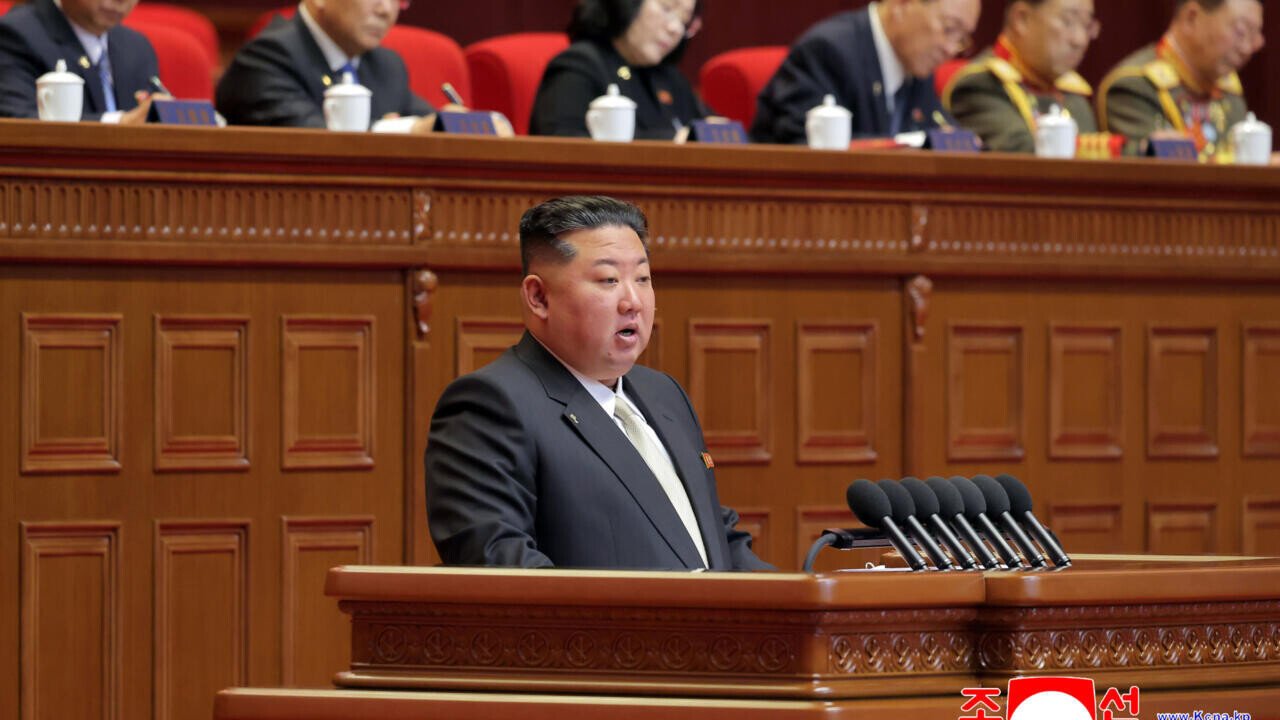
SEOUL: North Korean leader Kim Jong Un has been reelected as general secretary of the ruling Workers’ Party of Korea, with state media portraying the move as a unanimous endorsement of his expanding nuclear doctrine and assertive foreign policy.
The announcement came during the party congress in Pyongyang, a tightly choreographed political gathering held every five years, where thousands of delegates praised Kim for strengthening the country’s nuclear arsenal and elevating what they described as North Korea’s “national prestige.”
According to the official Korean Central News Agency, Kim’s reappointment reflected the “unshakable will” of party members. The 42-year-old leader has held the party’s top post since 2012, with the title evolving from first secretary to chairman and later to general secretary.
Nuclear Buildup at the Core
The congress underscored Kim’s continued commitment to military expansion. Party statements credited him with building a nuclear force capable of countering “any threat of aggression,” signaling that Pyongyang will likely accelerate efforts to integrate conventional and nuclear capabilities.
North Korea already possesses missiles capable of reaching U.S. allies in Asia and parts of the American mainland. Analysts expect Kim to unveil fresh military objectives for the next five years, reinforcing a deterrence strategy that has become central to his rule.
Leadership Shake-Up Reflects Generational Shift
The congress also approved a reshuffle of the powerful 138-member Central Committee, replacing several senior figures. Notably absent from the new list was Choe Ryong Hae, long regarded as one of Pyongyang’s most influential officials. Military marshals Pak Jong Chon and Ri Pyong Chol were also removed.
South Korea’s Unification Ministry described Kim’s reelection as predictable, saying Seoul would monitor signals from the congress regarding future policy directions.
The leadership overhaul appears to mark a generational shift within Kim’s inner circle, sidelining older elites as he consolidates authority around a newer cadre of loyalists.
Diplomacy in Deep Freeze
North Korea’s relations with Washington and Seoul remain strained. Talks with the United States have stalled since the collapse of the 2019 Hanoi summit between Kim and then-U.S. President Donald Trump, which failed to bridge differences over sanctions relief and denuclearization.
Since then, Pyongyang has suspended meaningful diplomacy and rebuffed renewed dialogue offers, insisting that the United States abandon its demand for denuclearization as a precondition for talks.
Inter-Korean ties have deteriorated further. In 2024, Kim formally scrapped the North’s long-standing goal of peaceful reunification, labeling South Korea a permanent adversary, a move that institutionalized hostility between the two Koreas.
Closer Ties with Beijing and Moscow
The congress also highlighted Kim’s strengthening external partnerships. He has deepened cooperation with Moscow amid the war in Ukraine and resumed high-level engagement with Beijing, including a recent summit with Chinese President Xi Jinping.
China’s state-run media reported that Xi congratulated Kim on his reelection, a symbolic nod to Beijing’s continued support as Pyongyang navigates international isolation.
What Comes Next
With a renewed mandate and a reshaped leadership team, Kim appears poised to entrench a strategy centered on nuclear deterrence, military modernization and economic “self-reliance.” While state media has yet to detail specific policy shifts, the congress signals continuity and potentially escalation in North Korea’s confrontational posture toward the United States and South Korea.
The message from Pyongyang is clear: Kim’s grip on power is firm, and his nuclear ambitions remain non-negotiable.
⁃ Kim Tong Chan