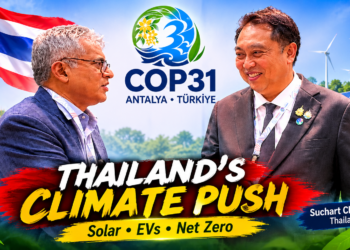


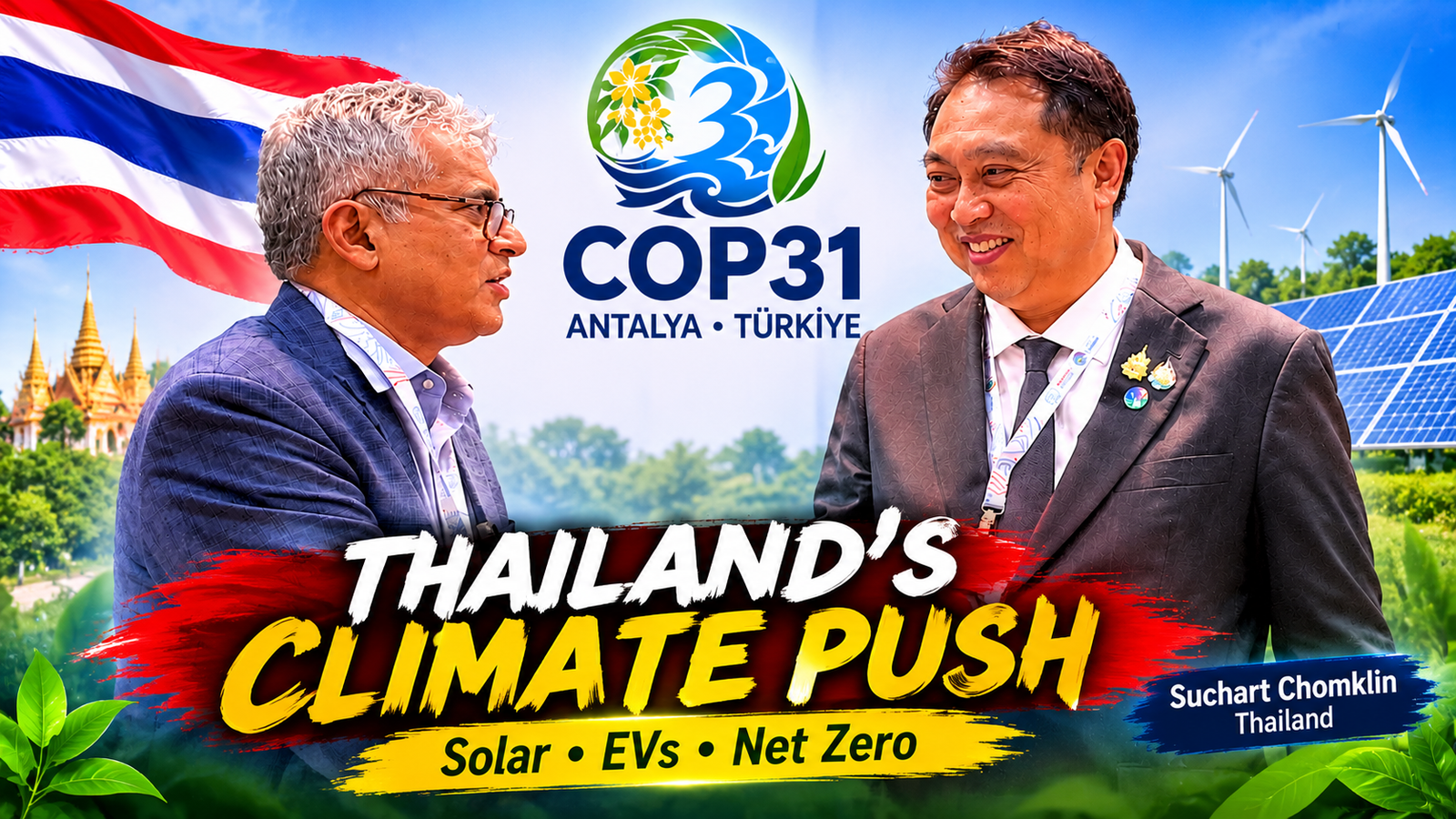
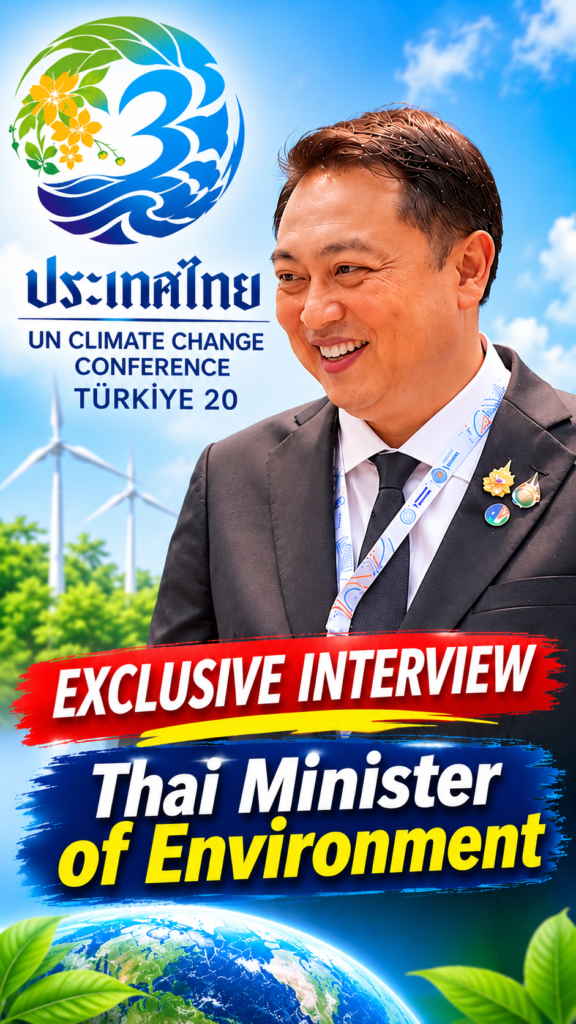
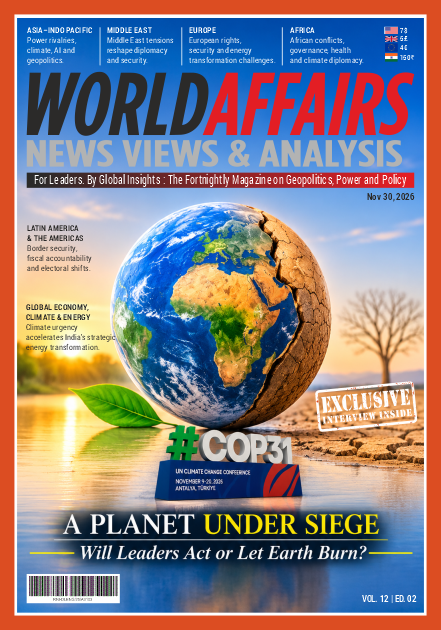
ANTALYA, TÜRKİYE: Thailand is stepping up its climate ambitions through renewable energy expansion, electric mobility, industrial decarbonisation and stronger climate resilience, with Natural Resources and Environment Minister Suchart Chomklin calling for greater international cooperation to turn global commitments into measurable results. Speaking at COP31 in Antalya, Türkiye, and in an exclusive interview with WorldAffairs, the Minister emphasised that climate change cannot be tackled by individual countries acting independently. He highlighted Thailand’s initiatives to expand household solar power and encourage electric vehicles, while urging governments to work together to reduce greenhouse gas emissions.
“Thailand alone cannot deliver the reduction on greenhouse gas. All the countries have to join hands and help one another,” Chomklin said through a translator during the interview with Dr. M. Shahid Siddiqui, Editor-in-Chief of WorldAffairs. Thailand’s climate roadmap includes a target to reduce net greenhouse gas emissions by 47 per cent by 2035 compared with 2019 levels and achieve net-zero emissions by 2050. Its updated Nationally Determined Contribution, known as NDC 3.0, reflects an accelerated transition towards a low-carbon economy, bringing forward the country’s previous net-zero target of 2065. The Minister’s message at COP31 centred on two connected priorities: implementing domestic climate policies and ensuring that developing countries receive the financial, technological and institutional support required to accelerate the transition.
From climate commitments to action
Addressing the resumed high-level segment of COP31 on 17 November, Chomklin reaffirmed Thailand’s commitment to strengthening climate action and contributing to the international effort to limit global warming to 1.5°C. The country’s 2035 emissions-reduction target represents a significant step in its climate transition. However, achieving it will require coordinated action across energy, transport, industry, agriculture and land use, alongside investment in climate-resilient infrastructure. During the WorldAffairs interview, Chomklin said Prime Minister Anutin Charnvirakul had introduced policies to reduce greenhouse gas emissions by moving away from fossil fuels towards cleaner energy. He identified household solar installations and the transition from conventional vehicles to electric vehicles as two important elements of the government’s strategy.
“These are not simply policy announcements,” the Minister indicated, explaining that Thailand was already working to implement the initiatives. He encouraged other countries to adopt comparable measures according to their national circumstances. His remarks reflect a broader challenge facing international climate diplomacy. Countries have announced increasingly ambitious targets, but the credibility of those commitments will depend on the speed of implementation, the availability of finance and the ability to measure actual emissions reductions.
One million solar homes
One of the most prominent initiatives in Thailand’s domestic climate programme is the People’s Solar Initiative, which aims to promote rooftop solar installations across one million households. Officially launched on 27 October 2026, the programme seeks to expand household access to solar-generated electricity. The government has announced a subsidy of 50,000 baht for each participating household.
Thailand’s Department of Climate Change and Environment estimates that the one-million-household initiative could reduce emissions by approximately 2.9 million tonnes of carbon dioxide equivalent annually. The programme is significant because it brings households directly into the national energy transition. Rather than depending exclusively on large-scale power projects, Thailand is seeking to expand decentralised renewable energy generation and encourage families to participate in cleaner electricity production. Household solar power can help reduce dependence on conventional electricity sources, improve energy security and potentially lower electricity costs. The programme also creates opportunities for households to become electricity producers, including through arrangements for selling surplus power where permitted. However, its long-term success will depend on affordability, installation capacity, grid integration, maintenance and the accessibility of subsidies. The real measure of progress will be the renewable electricity generated and the emissions avoided, rather than the number of installations announced.
Electric mobility and the energy transition
Electric vehicles are another important component of Thailand’s climate strategy. Chomklin highlighted the transition from conventional vehicles to EVs as part of the government’s effort to reduce dependence on fossil fuels. The expansion of electric mobility can contribute to lower transport emissions, reduce petroleum consumption and support the development of new industries. For Thailand, the transition also carries implications for manufacturing, investment, charging infrastructure and its position in the regional automotive market.
Nevertheless, the environmental benefits of EV adoption depend on the electricity used for charging, the development of reliable charging networks, battery production and recycling, and the availability of affordable vehicles. Connecting transport electrification with renewable electricity will be particularly important. Expanding EV use while continuing to depend heavily on fossil-fuel-based electricity would limit the overall emissions benefits.
Thailand’s approach therefore requires a broader transformation of its energy system, with household solar power and electric mobility forming part of a wider low-carbon development strategy.
Climate finance: The accountability question
Climate finance remains one of the most sensitive issues in international negotiations, particularly for developing countries seeking to balance economic development with the costs of climate mitigation and adaptation. Countries across the developing world require substantial investment to modernise infrastructure, expand renewable energy, protect vulnerable communities and prepare for climate-related disasters. Access to affordable finance, clean technologies and technical expertise is therefore essential to implementing national climate commitments.
Thailand’s COP31 position emphasises the importance of international support and a fair transition that recognises the different capacities and circumstances of countries. During the WorldAffairs interview, Chomklin was asked whether the international climate finance system was fair to developing countries. He responded cautiously, saying that he could not make a definitive assessment without knowing how many countries were receiving financial support and how the funding was being distributed.
He then proposed a practical approach to improving transparency.
“Maybe next year on COP32 they can actually showcase what have they done after receiving the funds,” the Minister said through a translator.
The suggestion places accountability and measurable outcomes at the centre of the climate finance debate. Countries receiving international support, he indicated, could use COP32 to present their achievements and demonstrate how the funding had contributed to climate action. Chomklin also indicated that Thailand receives climate-related funding. However, the translated explanation of how those resources had been used across different areas was not sufficiently clear to establish specific spending details.
His proposal nevertheless raises an important question for climate diplomacy: how can the international community ensure that financial commitments translate into tangible benefits?
For recipient countries, transparent reporting can demonstrate the impact of international assistance and strengthen confidence in climate programmes. For donor countries and institutions, predictable and accessible funding remains essential to enabling developing economies to implement their commitments. Thailand also supports the broader international ambition to mobilise US$1.3 trillion annually in climate finance from all sources by 2035. The challenge is to translate that global ambition into resources that developing countries can access on appropriate terms and use effectively.
Protecting communities from climate risks
Thailand’s climate agenda extends beyond emissions reduction to adaptation, disaster preparedness and the protection of vulnerable communities. Floods, droughts and extreme weather events pose growing risks to agriculture, infrastructure, livelihoods and economic activity. For countries with significant agricultural and tourism sectors, climate-related disruptions can affect employment, supply chains, food production and household incomes.
Thailand has therefore emphasised the importance of strengthening adaptation and disaster preparedness, particularly for farmers, low-income households, vulnerable populations and small businesses. The country’s climate priorities include stronger international support for adaptation, the Global Goal on Adaptation and mechanisms addressing loss and damage. These are distinct but interconnected areas of climate action. Mitigation seeks to reduce the greenhouse gas emissions driving global warming. Adaptation helps communities and economies prepare for and manage climate impacts. Loss and damage addresses climate-related harm that cannot be avoided through mitigation and adaptation alone.
A credible climate strategy must advance all three. For Thailand, strengthening resilience is not simply an environmental objective. It is also a matter of economic security, development planning and social protection.
Industrial decarbonisation and climate governance
Thailand’s ambition to achieve net-zero emissions by 2050 will require structural changes beyond household solar power and electric vehicles. Industrial production, agriculture, waste management and forest conservation will all be important to achieving an economy-wide emissions reduction. Industrial decarbonisation, in particular, will require investment in energy efficiency, cleaner production technologies and low-carbon industrial processes.
Technology cooperation and international partnerships can help accelerate this transformation, particularly where developing economies face financial or technical constraints. The government is also advancing a draft Climate Change Act, with the stated objective of bringing it into force by 2027. The proposed legislation is intended to strengthen national climate governance and establish a more structured framework for emissions reduction, adaptation and climate-related financing.
Its effectiveness will depend on clear institutional responsibilities, reliable emissions data, coordination across government agencies and the ability to translate legal provisions into enforceable action. Thailand’s wider objective is to pursue economic development while reducing environmental pressures. A just transition will need to create new investment and employment opportunities without placing disproportionate costs on workers, farmers, small businesses and lower-income households.
Tourism and environmental responsibility
The WorldAffairs interview also addressed the challenge of balancing Thailand’s tourism growth with biodiversity conservation and environmental protection. Tourism is closely connected to the country’s natural landscapes, coastlines and ecological resources. These assets are central to its international appeal and form an important part of its economy. Asked how the government balances tourism development with environmental protection, Chomklin clarified that the household solar initiative and tourism are addressed through separate policy areas.
“The policy … changing their solar system to the households is concerning with only households, but not in tourism,” he said through the translator, adding that tourism was a separate subject.
The Minister did not elaborate on specific measures linking tourism development with biodiversity protection during the interview.
However, the issue remains important for tourism-dependent economies. Sustainable tourism requires responsible management of natural resources, protection of sensitive ecosystems, effective waste management, water security and resilient infrastructure. The participation of local communities is equally important in ensuring that tourism generates economic opportunities without undermining the natural environment. For Thailand, environmental protection and tourism competitiveness are closely connected. Preserving biodiversity and natural landscapes is not only an ecological responsibility but also an investment in the long-term sustainability of the tourism sector.
The message ahead of COP32
In his closing message, Chomklin returned to the central theme of collective responsibility. He said Prime Minister Anutin Charnvirakul had introduced climate policies while working to create greater public awareness of the issue.
“One person cannot do this alone,” he said, urging countries and individuals to help one another and contribute to reducing greenhouse gas emissions.
The message reflects the wider direction of Thailand’s climate diplomacy: domestic action must be matched by international cooperation, while financial and technological support must enable developing countries to accelerate their transition. Thailand’s 47 per cent emissions-reduction target by 2035, its net-zero ambition for 2050, the one-million-household solar initiative and the proposed Climate Change Act provide important benchmarks against which future progress can be assessed.
But the real test will be implementation. Solar installations must translate into renewable electricity; EV adoption must be supported by cleaner power and reliable infrastructure; industrial targets must deliver actual emissions reductions; and adaptation finance must reach communities exposed to climate risks. As the international community looks towards COP32, Chomklin’s message from Antalya underlines a central challenge for climate diplomacy: ambition must be matched by resources, national policies by implementation, and global commitments by measurable results.
For Thailand, the energy transition is not simply an environmental undertaking. It is also a question of economic resilience, energy security, social inclusion and future industrial competitiveness. The broader message is equally relevant to the developing world: climate action can become sustainable only when countries are equipped to pursue it collectively, fairly and effectively.
Interview conducted by Dr. M. Shahid Siddiqui, Editor-in-Chief, WorldAffairs, with Suchart Chomklin, Minister of Natural Resources and Environment of Thailand, on the sidelines of COP31 in Antalya, Türkiye.
– With Input From WNN Turkiye Desk, WorldAffairs Newsroom.