

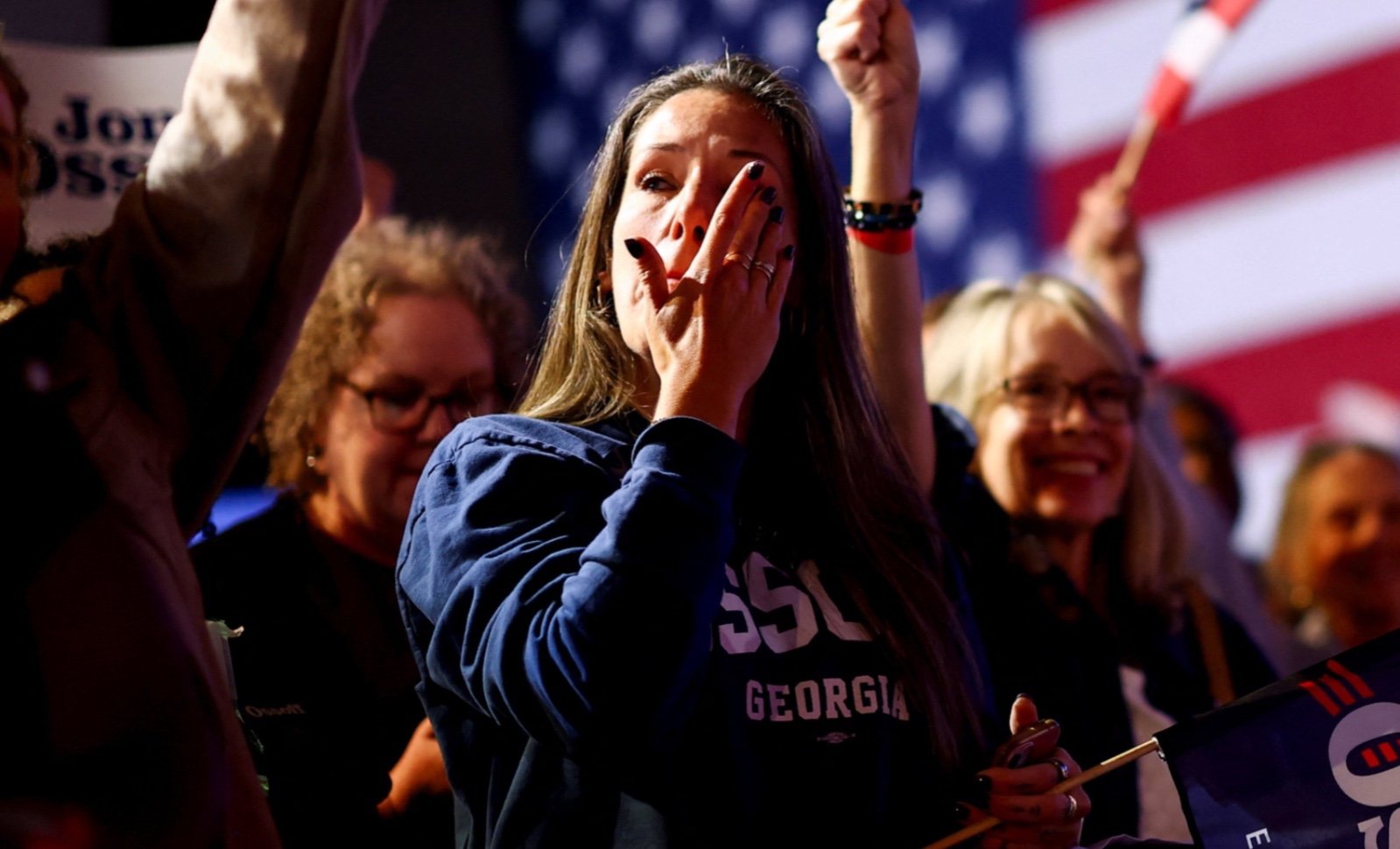
Washington, USA: The 2026 US midterm elections have delivered a devastating political setback to President Donald Trump, with Democrats capturing control of both chambers of Congress in a sweeping repudiation of the Republican administration. The scale of the reversal, extending into traditionally Republican strongholds, signals more than a routine electoral correction. It reflects mounting voter dissatisfaction over economic pressures, the consequences of the war with Iran and concerns about the concentration of presidential power. For Trump, the result threatens to transform the final two years of his presidency into a prolonged struggle with a Congress increasingly positioned to challenge his domestic and foreign policy agenda.
Democrats made significant gains in the Senate, flipping at least seven seats in states that included Kansas, Iowa, Texas, Ohio, Maine, North Carolina and South Carolina. The victories in traditionally Republican territory are particularly consequential. Kansas, which had not elected a Democratic senator in nearly a century, became a striking symbol of the electoral shift. Democrats also retained competitive seats in Georgia and Michigan, consolidating their position in the upper chamber.
The House of Representatives witnessed an equally damaging reversal for Republicans, with Democrats flipping more than two dozen districts, including constituencies that had supported Trump by double-digit margins in 2024. The political consequences were immediately visible within Republican leadership. House Speaker Mike Johnson reportedly decided not to seek re-election as the Republican leader, reflecting the internal pressures confronting a party that had entered the election expecting to retain its congressional influence.
The outcome has fundamentally altered the balance of power in Washington. With Democrats controlling both chambers, Trump will face a Congress capable of blocking legislative priorities, rejecting appointments requiring Senate confirmation and launching investigations into his administration. The shift does not automatically end the President’s ability to exercise executive authority, particularly in foreign policy and national security. However, it substantially increases political scrutiny and creates institutional obstacles to implementing his agenda.
The electoral verdict also raises questions about the Republican Party’s political strategy. Trump repeatedly encouraged voters to treat the midterms as a referendum on his presidency, telling supporters to “pretend I’m on the ballot.” Following the defeat, however, he sought to distance himself from the outcome and place responsibility on Republican candidates, arguing that he did not view the result as a personal setback. Such an explanation may offer temporary political protection, but it does little to resolve the deeper question of whether the administration’s policies have alienated voters beyond the Republican base.
The economy appears to have been a decisive factor. Rising fuel prices and the increasing cost of everyday goods intensified voter frustration, particularly as the conflict with Iran disrupted international energy markets and contributed to economic uncertainty. The AP Voter Poll indicated that many voters held the Trump administration responsible for high living costs and wanted Congress to impose stronger checks on presidential power. The result suggests that foreign policy decisions are increasingly being judged through their domestic economic consequences.
The Iran war has therefore emerged as a central political liability for the administration. Vice President JD Vance explicitly connected the Republican defeat to public dissatisfaction with the conflict, acknowledging that voters must be prepared to debate whether the war was worth its costs. His response reflects a growing tension within the Republican coalition, where support for a more assertive foreign policy must contend with concerns about military expenditure, economic disruption and the prospect of prolonged American involvement in another regional conflict.
For Trump, the challenge is no longer limited to defending the military rationale behind the war. He must also confront its economic and political consequences at home. Higher energy costs can affect transportation, manufacturing, food prices and household budgets, turning an overseas conflict into a direct domestic concern. In an election where voters were already sensitive to inflation and the cost of living, the perception that military escalation was worsening economic pressures appears to have weakened Republican support.
The consequences of the election extend well beyond Washington. In Tehran, the Democratic victory was welcomed by many Iranians as a rejection of Trump’s political leadership, although Iran’s leadership has shown little expectation that a change in congressional control will fundamentally alter American policy towards the Islamic Republic. Supreme Leader Ayatollah Mojtaba Khamenei dismissed the prospect that partisan shifts within the United States would produce a meaningful change in Washington’s hostility towards Iran. His remarks underline Tehran’s longstanding view that American policy towards the Islamic Republic reflects broader strategic and institutional interests rather than the preferences of an individual administration alone.
This distinction is important. Democratic control of Congress may constrain Trump’s domestic agenda and increase scrutiny of military decisions, but it does not automatically produce a diplomatic opening with Iran. The President retains considerable authority in national security and foreign affairs, while Congress exercises its influence through funding, oversight, legislation and confirmation powers. The precise impact will depend on how far Democratic lawmakers are prepared to challenge the administration and whether disagreements within the Republican Party create additional political constraints.
Across the Middle East, the election has intensified uncertainty over the future direction of the conflict. Regional governments remain concerned about the possibility of renewed large-scale American military operations against Iran. Diplomatic efforts to prevent another escalation are continuing, while several US partners in the region have urged Washington to avoid returning to a war that has already inflicted severe damage on Iran and destabilised the wider regional economy.
Israeli Prime Minister Benjamin Netanyahu has reportedly advocated further military strikes, while Trump has alternated between threatening major military action and expressing interest in a negotiated settlement. This divergence between military pressure and diplomatic engagement has created uncertainty over Washington’s strategic objectives. For regional governments, the central concern is whether the United States intends to pursue a sustainable diplomatic arrangement or continue a cycle of military escalation that could widen the conflict.
The election may strengthen the political influence of lawmakers seeking greater congressional oversight of the war. Democratic control of the House and Senate could lead to more demanding hearings, investigations into the administration’s decision-making and scrutiny of military spending and authorisations. It could also complicate efforts to secure congressional support for additional military commitments. Nevertheless, the extent of this constraint should not be overstated: a congressional majority cannot by itself guarantee an immediate end to hostilities or compel Iran and Israel to accept a diplomatic settlement.
For Iran, the political outcome in Washington offers an opportunity to emphasise the domestic costs of American military policy, but it does not eliminate the strategic pressures facing Tehran. The Iranian leadership must still contend with the consequences of the war, economic damage, regional security challenges and the long-term implications of its confrontation with the United States and Israel. Public celebration of Trump’s electoral setback should therefore not be confused with evidence of a diplomatic breakthrough.
The wider international implications are equally significant. A prolonged conflict involving Iran carries consequences for energy markets, maritime security, regional trade and the economic stability of countries far beyond the Middle East. Disruptions to energy supplies can affect import-dependent economies in Asia and Europe, while uncertainty surrounding strategic shipping routes can raise transportation and insurance costs. For countries such as India, the stakes include energy security, inflation management, trade connectivity and the safety of regional maritime routes.
The election also exposes a broader political reality: American voters increasingly expect foreign policy decisions to be measured against their consequences at home. Military power may remain a defining instrument of US global influence, but its political sustainability depends partly on whether citizens believe that overseas commitments serve national interests without imposing disproportionate economic and human costs. The Iran conflict has brought this tension into sharp focus.
The Democratic victory is consequently both a warning to the Republican Party and a test of American institutional resilience. For Trump, the remaining two years of his presidency will require navigating a divided political environment in which Congress can challenge his policies more forcefully. For Democrats, controlling both chambers brings responsibility as well as opportunity: they must demonstrate that their electoral mandate can translate into effective governance, credible oversight and a coherent alternative on economic and international policy.
The decisive question is whether Washington can translate the electoral rejection of escalation into a more sustainable approach to the Middle East. A change in congressional control may alter the political calculations surrounding the Iran war, but durable stability will require more than partisan advantage. It will depend on diplomacy, credible security arrangements and a willingness among the principal parties to avoid another cycle of confrontation.
The midterm elections have exposed the domestic price of Trump’s foreign policy and weakened his political authority at a critical moment. Yet the regional conflict remains unresolved, and the possibility of renewed military action continues to threaten an already fragile international environment. Democrats may have changed the balance of power in Washington, but whether that shift can change the course of the Iran war remains the defining test of America’s political and diplomatic leadership.
-Chibuike Lawson