



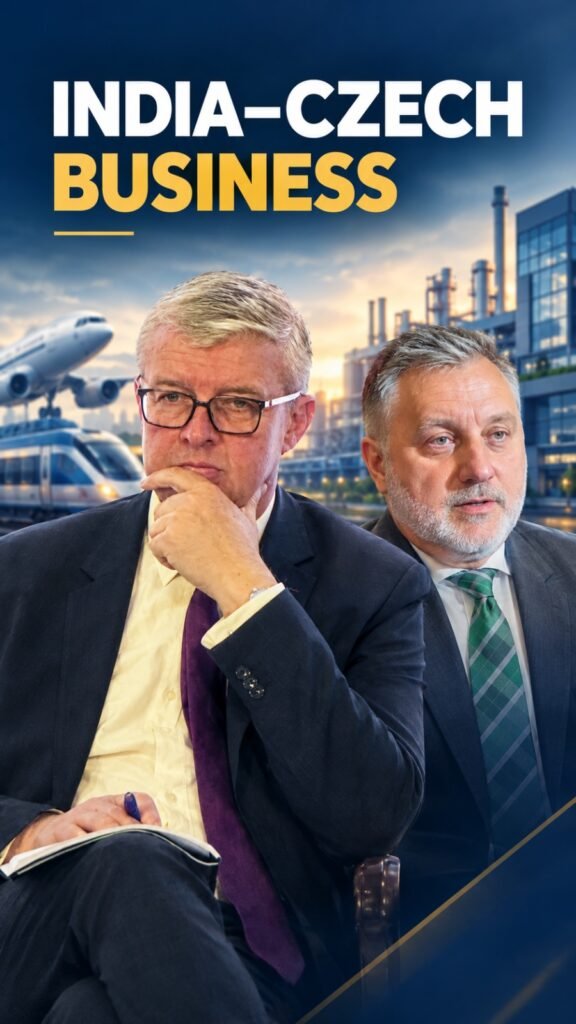
WorldAffairs’ Exclusive Conversation with Czech Deputy Prime Minister Karel Havlíček and Jan Rafaj, President of the Confederation of Industry of the Czech Republic, on India–Czechia economic cooperation, investment, potential aircraft manufacturing, advanced defence-related technologies, energy costs and the prospects of the India–EU free trade agreement.
As businesses confront geopolitical uncertainty, shifting trade policies and pressure on industrial competitiveness, the Czech Republic is looking towards India as a partner for investment, manufacturing and technological cooperation. For Prague, the opportunity extends beyond exporting products to one of the world’s largest markets: Czech companies are exploring joint ventures, industrial partnerships and a stronger presence in India’s expanding economy.
On the sidelines of the CII India–Czech Republic Business Forum, Czech Deputy Prime Minister Karel Havlíček and Jan Rafaj, President of the Confederation of Industry of the Czech Republic, spoke with WorldAffairs about opportunities to deepen India–Czechia economic cooperation. Rafaj outlined the objectives of the business MoUs, the role of industry associations in facilitating cross-border partnerships, and potential cooperation in engineering, radar systems, drones, cybersecurity and semiconductors. Their insights come amid broader efforts to deepen bilateral ties in trade, investment, innovation, defence, science and technology. The proposed India–European Union free trade agreement could further shape commercial opportunities, subject to its legal completion, entry into force and implementation. The conversations examine the potential, practical challenges and conditions that will determine whether growing engagement translates into lasting industrial partnerships and tangible economic gains.
Havlíček said bilateral trade stood at approximately US$4 billion and that a Czech business delegation had signed several memorandums of understanding (MoUs) with Indian companies across automotive, transportation, aircraft manufacturing, railways and healthcare. “India is the most important partner for the Czech Republic in this region. But definitely, the potential for economic growth is much higher,” he told WorldAffairs.
In a separate interview, Jan Rafaj, President of the Confederation of Industry of the Czech Republic, outlined the objectives of the business MoUs, the role of industry associations in facilitating cross-border partnerships, and potential cooperation in engineering, radar systems, drones, cybersecurity and semiconductors. These engagements reflect broader efforts by India and Czechia to deepen ties in trade, investment, innovation, defence, science and technology. The proposed India–European Union free trade agreement could further expand commercial opportunities, subject to its legal completion, entry into force and implementation. Together, the interviews examine the potential, practical challenges and conditions that will determine whether stronger bilateral engagement translates into lasting industrial partnerships and tangible economic gains.
INDIA’S ECONOMIC POTENTIAL
WorldAffairs: You have brought a business delegation to India at a time when companies are reassessing their international markets and supply chains. Why is India important to Czechia?
Karel Havlíček: India is the most important partner for the Czech Republic in this region. The potential for economic growth is much higher than the current level of cooperation suggests. India offers opportunities for Czech companies across manufacturing, engineering, transportation, energy and technology. We want to strengthen commercial relations and encourage companies to explore partnerships that can develop into lasting business relationships. Our objective is not limited to exporting products. Czech businesses are interested in joint ventures and investment in India, working alongside Indian companies to identify commercially viable opportunities.
WorldAffairs: Bilateral trade stands at approximately US$4 billion. What needs to happen for the relationship to move to the next level?
Havlíček: The existing trade relationship provides a foundation, but we believe there is considerable room for expansion. We want to see more direct cooperation between companies, greater investment and stronger industrial partnerships. Czech businesses should explore opportunities in India, while Indian companies can consider Czechia as a partner for manufacturing, engineering and technology. The potential is there. The important task is to translate business interest into practical cooperation.
FROM EXPORTS TO INVESTMENT
WorldAffairs: You have emphasised that Czech companies want to invest in India rather than simply export products. How does this align with India’s Make in India ambitions?
Havlíček: We are coming not only as exporters but also as entrepreneurs. Czech companies are ready to explore joint ventures with Indian businesses and invest in India. We understand that Make in India is an important economic priority for the country. Our companies see opportunities to work with Indian partners in manufacturing and other industrial activities. We are also ready to offer cooperation in construction, energy and transportation, as well as research and development. The objective is to identify opportunities that work commercially for both sides and establish partnerships that can continue over the long term.
WorldAffairs: What is the significance of the MoUs signed during the business delegation’s visit?
Havlíček: The delegation has signed several MoUs with Indian companies across automotive, transportation, aircraft manufacturing, railways and healthcare. These MoUs provide a framework for strengthening business relationships and exploring potential areas of cooperation. Their signing marks an important step in the process, but the next phase will depend on how the participating companies develop these opportunities into concrete projects, investment decisions or commercial agreements.
AIRCRAFT MANUFACTURING AND ENGINEERING
WorldAffairs: Aircraft manufacturing has emerged as a prominent area of interest. How can Czechia’s engineering capabilities complement India’s industrial ambitions?
Havlíček: The Czech Republic is an engineering-oriented nation and one of the countries capable of producing a complete aircraft. We see opportunities to explore cooperation with Indian companies in aviation and other engineering-intensive sectors. Transportation and aviation are important areas for industrial collaboration. The objective is to identify where our capabilities and India’s requirements can complement one another.
WorldAffairs: What could such cooperation mean for India’s domestic manufacturing sector?
Havlíček: Cooperation can take different forms, depending on the requirements of the businesses involved. Our broader interest is in developing stronger industrial relationships through joint ventures, investment and other forms of cooperation. Discussions concerning the potential manufacturing of 19-, 40- and 90-seat passenger aircraft in India remain exploratory, and the specific arrangements will depend on the participating companies and the opportunities they identify. Moving forward would require clarity on aircraft design and certification, financing, technology arrangements, manufacturing responsibilities and demand from prospective operators. If the initiative develops into a commercially viable programme, it could help India expand domestic industrial participation and strengthen its technical capabilities, while creating opportunities for Czechia to access a larger market and build long-term engineering and manufacturing partnerships.
DEFENCE-RELATED TECHNOLOGIES AND CYBERSECURITY
WorldAffairs: Czech industry has capabilities in heavy vehicles, radar systems, drones and cybersecurity. Could these areas provide another dimension to India–Czechia cooperation?
Jan Rafaj: Czech companies can offer Indian partners a range of industrial products and technologies, including trucks, heavy vehicles, radar systems, drone technologies and cybersecurity solutions.
There are also opportunities in the semiconductor sector, which could provide a basis for further industrial and technological cooperation. Industry associations can help businesses identify partners and explore opportunities in each other’s markets. The objective is to strengthen industrial cooperation and help companies establish productive commercial relationships.
WorldAffairs: How important are industry associations in converting this potential into actual projects?
Rafaj: Industry associations can help companies entering new markets identify potential business partners, financial institutions and investment opportunities. The MoUs signed with Indian companies are intended to provide a framework for strengthening industrial cooperation and exploring opportunities to improve market access. However, translating these engagements into concrete projects will require further discussions between the participating businesses to establish their respective requirements and identify viable areas for collaboration. While sectors such as defence-related technologies, drones, radar systems and cybersecurity offer potential avenues for cooperation, these discussions should not be interpreted as confirmation that specific contracts have been concluded.
GLOBAL SUPPLY CHAINS AND ECONOMIC UNCERTAINTY
WorldAffairs: Geopolitical tensions and disruptions in global supply chains are forcing companies to reconsider their dependencies. How can closer cooperation between India and Czechia help?
Rafaj: Industrial partnerships can help companies respond to geopolitical tensions and disruptions in global markets. Businesses need to identify partners, explore new opportunities and strengthen their presence in different markets. Cooperation between Indian and Czech companies can help them develop commercial relationships and examine opportunities across sectors.
WorldAffairs: Does this make India a more important destination for Czech businesses seeking to diversify their markets?
Havlíček: We believe there is considerable potential for further cooperation with India. Czech companies are interested in exploring opportunities in manufacturing, transportation, energy and technology, as well as establishing joint ventures and investing in the country. We want businesses to identify partners and develop commercial relationships that can deliver results. For companies facing uncertainty in international markets, developing new business relationships and exploring additional opportunities is important.
WorldAffairs: How do energy prices affect Czech industrial competitiveness?
Havlíček: Energy costs are an important factor in the competitiveness of European industry. During our discussion, I referred to a natural-gas price of €73 per megawatt-hour in Europe. Developments involving the United States and Russia could also influence energy markets, although it is too early to determine whether any potential energy arrangement between Washington and Moscow would lead to lower prices in the United States. The coming days may provide greater clarity. For industrial businesses, energy costs remain one of several factors shaping competitiveness, alongside productivity, technological capabilities, investment and access to international markets.
INDIA–EU FREE TRADE AGREEMENT
WorldAffairs: How important is the proposed India–European Union free trade agreement to the future of India–Czechia economic relations?
Havlíček: The trade agreement between Europe and India creates a free trade zone for over 2 billion people, and it’s absolutely amazing. It is extremely important because it can create opportunities for companies on both sides. Europe needs new markets for exports and investment, and India offers considerable potential. There is a chance for Indian companies to work with Czech firms, and Czech companies are ready to be active in India.
WorldAffairs: What opportunities could closer India–EU economic relations create for industrial cooperation?
Rafaj: The proposed India–EU free trade agreement could create opportunities to strengthen commercial ties by improving market access and reducing trade barriers, subject to its final legal status and implementation. For businesses, the potential benefits would depend on the agreement’s specific provisions and how they are applied in practice. Industry associations can play an important role in helping companies identify suitable partners, understand the evolving trade framework and explore opportunities for cooperation and expansion.
WorldAffairs: Looking ahead, what would demonstrate that India–Czechia economic relations have reached a more advanced stage?
Havlíček: We want stronger commercial relationships, greater investment and more cooperation between Indian and Czech businesses. The objective is to develop joint projects, encourage technological collaboration and establish partnerships that continue beyond individual business missions. Both countries have capabilities that can complement one another. We need to build on those strengths through sustained engagement between companies, industry associations and governments. The task is to translate the potential into practical cooperation and create relationships that deliver lasting value.
FROM AMBITION TO IMPLEMENTATION
The conversations with Havlíček and Rafaj point to a shared ambition to make India–Czechia economic relations more investment-oriented and technologically sophisticated. The proposed aircraft manufacturing initiative is a prominent example, while the MoUs covering automotive, transportation, railways and healthcare reflect the broader scope of business engagement.
For India, the opportunity is to attract investment that strengthens domestic manufacturing, expands technical expertise and creates sustainable industrial capabilities. For Czechia, India offers a market in which engineering expertise and specialised technologies could support new commercial relationships. The prospective India–EU trade agreement could provide a wider framework for cooperation, but its benefits will depend on its legal status, implementation and sector-specific provisions. Similarly, the value of the MoUs will ultimately depend on whether businesses translate them into contracts, investment and operational projects. The most important test will be execution. Aircraft manufacturing requires credible technical and financial arrangements. Advanced-technology partnerships require clear commercial objectives and compliance with relevant regulations. Broader industrial cooperation requires sustained engagement beyond diplomatic visits and business forums.
The conversations nevertheless reveal a clear direction: both countries want to explore a relationship that goes beyond the sale and purchase of goods towards investment, engineering and technological cooperation. For India and Czechia, the opportunity is significant. The next measure of success will be the projects delivered, investments realised and lasting industrial value created.
– WNN Desk