




NEW YORK | UNGA 81: For Grenada, the climate crisis is not a future scenario to be debated in international conference halls. It is a fiscal reality that can arrive overnight, destroy infrastructure, disrupt agriculture, widen financing requirements and force a government to make difficult choices between reconstruction, social protection and long-term development. That reality gives unusual significance to Grenada’s economic strategy. The country is attempting to build something more sophisticated than a conventional post-disaster recovery programme: a financial and investment architecture in which fiscal discipline, catastrophe financing, tourism, agriculture, infrastructure, foreign investment and climate resilience reinforce one another.
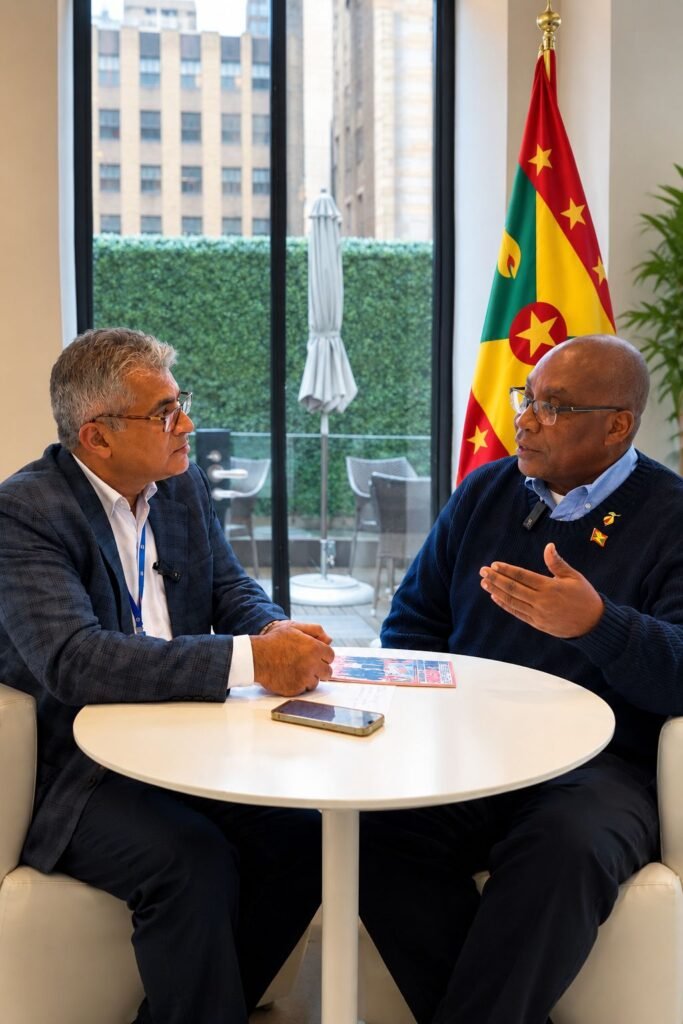
In an exclusive conversation with Dr. M. Shahid Siddiqui of WorldAffairs/WNN on the sidelines of the 81st United Nations General Assembly, Hon. Dennis Cornwall, Minister of Finance of Grenada, described a country trying to prepare financially for the next shock while continuing to invest in growth today. His message was direct: for a small island economy, resilience cannot be treated as an environmental add-on. It has to become part of economic policy itself.
The numbers explain why.
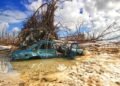
When Hurricane Beryl struck Grenada in July 2024, the storm caused an estimated US$218 million in direct economic damage, equivalent to about 16.5 percent of the country’s 2023 GDP, according to the World Bank. The damage was concentrated particularly in Carriacou and Petite Martinique, with buildings, infrastructure, agriculture and other productive assets heavily affected.
That scale of destruction illustrates the structural problem confronting Caribbean small states. In a large diversified economy, a disaster affecting one region can be absorbed by the wider national economic base. In a small island economy, the same shock can simultaneously hit infrastructure, food production, tourism, public revenue and household livelihoods. Climate vulnerability therefore becomes a balance-sheet vulnerability.
Grenada has already experienced the consequences. Hurricane Ivan in 2004 caused damage equivalent to more than the country’s annual economic output, while Beryl demonstrated that even a storm whose direct economic impact was concentrated in the northern islands could produce a national financing challenge.
But Grenada’s response to Beryl also provides an important insight into the evolution of small-state economic policy. Instead of treating disaster financing as something to be arranged after catastrophe strikes, the government has increasingly emphasized pre-arranged liquidity, catastrophe insurance, fiscal buffers and mechanisms capable of releasing resources quickly.
The IMF has noted that Grenada was able to use a combination of disaster-financing instruments following Beryl, including its catastrophe-deferred drawdown facility and a US$55.5 million parametric insurance payout from the Caribbean Catastrophe Risk Insurance Facility. These instruments helped provide liquidity while limiting the hurricane’s longer-term effect on public debt dynamics.
That is the deeper economic lesson behind Cornwall’s argument. For vulnerable economies, resilience is increasingly about having cash available before the disaster rather than simply having a reconstruction plan after it.Grenada’s broader economic performance provides some room for that strategy. The IMF projects real GDP growth of 3.1 percent in 2026, while the World Bank estimates that the economy grew 4.5 percent in 2025, with construction playing a significant role. The World Bank expects 2026 growth to be supported by construction investment, including the planned US$250 million Project Polaris hospital initiative.
Yet the headline growth figure should not obscure the underlying challenge. Grenada remains highly exposed to tourism cycles, global commodity prices, climate events, external financing conditions and fluctuations in foreign investment. The World Bank explicitly identifies natural disasters, higher oil prices, weaker tourism-origin economies, disruptions to Citizenship by Investment and foreign direct investment flows, and delays in major investment projects among the downside risks. This is where Cornwall’s emphasis on fiscal buffers becomes significant.
According to the minister, Grenada has been building a contingency reserve through the Eastern Caribbean Central Bank, with a portion of revenues generated by the Citizenship by Investment Programme deposited regularly. The logic is straightforward: revenues that do not arise from conventional taxation or borrowing can, if managed prudently, create fiscal space that can be deployed when an external shock arrives.
For Grenada, this matters because borrowing after a disaster can be particularly expensive. A hurricane does not wait for favourable international financial conditions. Reconstruction must begin when roads, bridges, homes, farms, ports and public facilities need to be restored, regardless of whether global interest rates are high or capital markets are receptive.The policy challenge is therefore to build buffers during good years and preserve enough fiscal credibility to access additional financing during bad ones.
The Citizenship by Investment Programme sits at the centre of that equation and also at its most complicated intersection with international regulation. Cornwall defended CBI as an important source of non-debt revenue that can finance infrastructure, education and public services without adding equivalent borrowing obligations. But the programme’s future cannot be separated from international scrutiny. The European Commission has continued to raise concerns about investor-citizenship schemes in the Eastern Caribbean, including issues surrounding security screening, due diligence, transparency and information sharing. The five Eastern Caribbean countries operating such programmes have taken steps toward common standards, including a harmonized minimum investment threshold and stronger screening mechanisms.
For Grenada, therefore, the question is no longer simply whether CBI can generate revenue. The larger question is whether such revenue can remain sufficiently predictable, transparent and internationally accepted to serve as a dependable component of national financial planning. That distinction matters.
A revenue source can be substantial without being structurally permanent. A prudent fiscal strategy must therefore treat CBI income differently from conventional domestic taxation. Grenada’s long-term resilience will depend partly on converting exceptional or volatile revenues into productive assets, reserves and human capital rather than allowing temporary inflows to create permanent expenditure commitments. The same principle applies to foreign investment.
Cornwall’s position is that Grenada wants investment, but not investment disconnected from national development. Investors must be able to repatriate legitimate profits and operate within a predictable business environment, while projects should also generate local employment, skills development and technology transfer. That is an increasingly important debate across small economies. Foreign capital can solve the problem of limited domestic savings and accelerate infrastructure and tourism development. But capital inflows alone do not automatically produce broad-based economic transformation. The quality of investment, its employment effects, local supply-chain linkages, tax contribution, skills transfer and resilience characteristics can matter as much as its headline value. Grenada’s tourism strategy demonstrates this dilemma.
Tourism remains central to the country’s economic model, but the same geographic characteristics that make Grenada attractive to visitors make it vulnerable to climate disruption. Hotels, airports, ports, coastal infrastructure, agriculture and transportation networks can all be affected by extreme weather. The answer cannot simply be to expand tourism capacity indefinitely. It has to be to make tourism infrastructure more resilient while developing additional economic pillars. Cornwall pointed to major hospitality investments, including projects associated with Six Senses, InterContinental and Kimpton Kawana Bay, alongside continued investment in agriculture, infrastructure and emerging sectors. The objective is diversification, but diversification within a small economy has a different meaning from diversification in a large industrial state. Grenada cannot realistically create dozens of globally competitive industries overnight. Its more practical task is to build interconnected sectors: tourism linked to agriculture and food production; agriculture linked to agro-processing; renewable energy linked to lower operating costs; infrastructure linked to logistics; and investment linked to skills development. That makes energy particularly important.
Cornwall identified renewable and sustainable development among Grenada’s priority areas and also referred to the potential for offshore oil and gas resources, while emphasizing that any future development would require further commercial confirmation and responsible consideration of environmental and economic factors.
The distinction is important. The energy transition for small island states is not simply about reducing emissions. It is also about reducing exposure to imported fuel prices. When international energy prices rise, an import-dependent island economy can experience higher electricity costs, transport costs, food prices and production costs simultaneously.
This is why renewable energy can become a competitiveness issue as much as a climate issue. Infrastructure financing presents another piece of the same puzzle. Cornwall described Grenada’s use of a Design–Build–Finance model, under which contractors can design, construct and initially finance infrastructure before receiving government repayment over an agreed period. The attraction is obvious: governments with constrained fiscal space can accelerate infrastructure without immediately funding the entire capital cost from public borrowing. But the model also underscores the importance of careful procurement, transparent contracts, realistic repayment obligations and rigorous assessment of long-term fiscal liabilities. Off-balance-sheet or deferred-payment structures do not eliminate costs; they change when and how those costs appear.
Grenada’s infrastructure strategy will therefore ultimately be judged not only by how quickly roads, bridges and public facilities are built, but by whether the resulting assets increase productivity sufficiently to justify their financing costs. That is the broader question facing the country as it looks toward the next five years. The IMF’s current assessment is relatively constructive: Grenada continues to benefit from tourism, reconstruction and development investment, while its fiscal position has been supported by accumulated CBI revenues and contingent disaster financing. At the same time, the IMF highlights the need for sound fiscal management amid elevated global uncertainty.
The geopolitical dimension makes that uncertainty harder to ignore.
At UNGA 81, global diplomacy is dominated by conflicts, trade tensions, energy insecurity and the fragmentation of the international economic system. For a country such as Grenada, these developments may appear geographically distant. Economically, they are not. A conflict that disrupts shipping can increase freight costs in the Caribbean. Higher oil prices can raise transportation and electricity costs. Food-price shocks can put pressure on households. Slower growth in major tourist markets can reduce visitor arrivals. Disruptions in global financial markets can increase the cost of capital. Small economies therefore experience geopolitics through prices.
That is one of the most important themes emerging from Cornwall’s assessment. The conventional definition of national security territorial integrity, military capability and strategic alliances is increasingly incomplete for vulnerable island states. Fiscal reserves, food security, energy diversification, resilient ports, reliable infrastructure and access to emergency finance are also elements of economic security.
For Grenada, climate resilience and economic sovereignty are consequently becoming increasingly interconnected. The government’s support for farmers after Beryl, reconstruction of homes, infrastructure investment, education scholarships, free school meals and programmes aimed at young people all point toward another dimension of the resilience debate: resilience is ultimately measured at household level. A bridge can be reconstructed. A hotel can reopen. A damaged farm can be replanted. But if a disaster pushes families into prolonged economic insecurity, the social cost can persist long after the physical infrastructure has been repaired. This is why the future of Grenada’s economic model cannot be assessed solely through GDP growth or investment announcements. Its deeper test will be whether fiscal buffers, foreign investment, tourism expansion, climate financing and infrastructure development translate into stronger productivity, greater household resilience and a broader base of economic opportunity.
Grenada’s experience also carries a wider message for Small Island Developing States. The traditional development model borrow, build, attract visitors, expand infrastructure and service debt becomes increasingly fragile when a single hurricane can destroy assets worth a significant share of annual economic output. The alternative is not isolation from global capital. It is smarter integration with it.
That means catastrophe insurance before disaster, contingent financing before liquidity disappears, fiscal reserves before revenue collapses, resilient infrastructure before the next storm, diversified energy before fuel prices surge and investment frameworks that generate domestic capabilities rather than simply importing capital. Grenada’s challenge is that it must build all of these simultaneously while remaining competitive as a tourism destination and maintaining fiscal credibility.
That is a demanding equation. But it is also precisely why the Grenadian experience deserves attention beyond the Caribbean. The country’s economic debate is increasingly representative of a much larger question confronting vulnerable economies worldwide: how does a state finance development when climate shocks, geopolitical disruptions and financial volatility are becoming permanent features of the global environment?
For Grenada, the answer emerging from its current strategy is neither unlimited borrowing nor retreat from global markets. It is an attempt to build buffers, attract investment, strengthen infrastructure, protect human capital and make resilience itself part of the country’s economic architecture. At UNGA 81, that message carries significance beyond Grenada. The future of small island economies will depend not merely on how much international assistance they receive after disasters, but on whether the global financial system enables them to prepare before disasters occur. Grenada is attempting to make that preparation part of its national economic strategy. The ultimate measure will not be whether the next hurricane can be prevented. It will be whether, when it comes, Grenada can absorb the shock without sacrificing the development gains of an entire generation.
-Gergely Trujillo
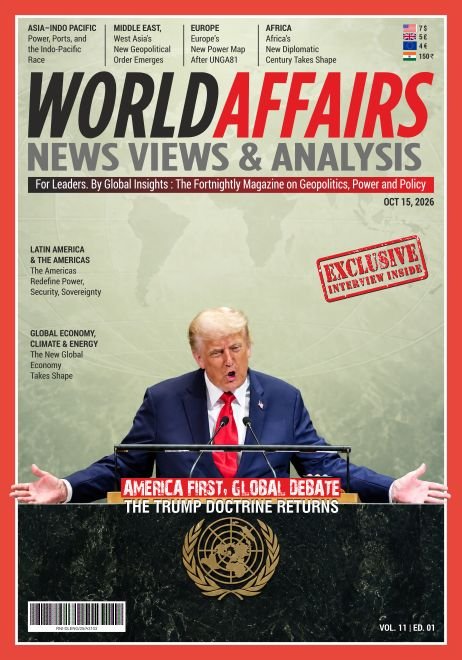
READ THE FULL E-MAGAZINE | WorldAffairs: See the Power Shifts Coming Before They Reshape the World