


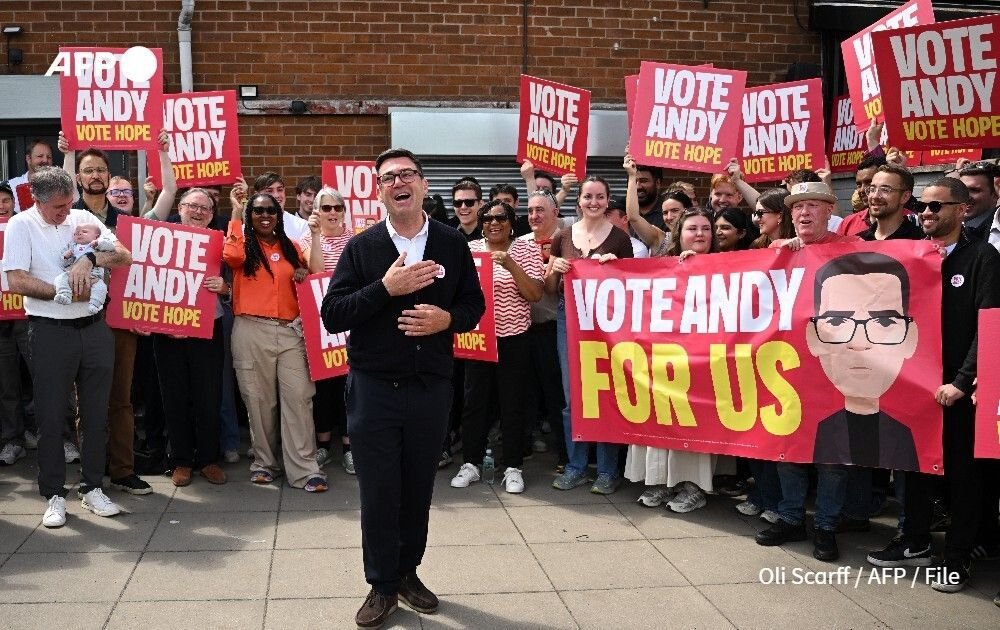
LONDON: Foreign policy rarely decides British elections, but once a new government takes office, it often defines how Britain is perceived on the global stage. As Andy Burnham prepares to become the United Kingdom’s next prime minister later this month, one issue appears set to test his leadership from day one: Britain’s approach to the Israel-Gaza conflict.
In one of his strongest foreign policy statements to date, Burnham has argued that the UK must move beyond expressions of concern and adopt a firmer stance toward Israel over its military operations in Gaza. His comments suggest that a Burnham-led government could pursue a more assertive and values-driven Middle East policy than Britain has traditionally embraced.
Speaking to The Guardian, Burnham acknowledged that London had taken some important diplomatic steps but argued they came far too late.
“We’ve got to do more to put pressure on the Israeli government,” he said. “Let’s be honest, the UK was too slow to call for a ceasefire. We must now strengthen our approach.”
The remarks are more than campaign rhetoric. They reflect the profound transformation that has taken place within British politics since Hamas launched its deadly attack on Israel in October 2023, triggering one of the region’s most devastating wars in decades.
At the time, then-Prime Minister Keir Starmer resisted demands from many within his own Labour Party to call immediately for a ceasefire, instead supporting temporary humanitarian pauses. That position created deep divisions inside Labour and sparked criticism from local leaders, lawmakers, and civil society.
As the humanitarian crisis in Gaza intensified, however, Britain’s policy gradually shifted. Starmer eventually backed a ceasefire, imposed sanctions on several far-right Israeli ministers, and formally recognized the State of Palestine, a diplomatic move that reflected growing international frustration with the conflict.
Burnham now believes Britain should go even further.
His proposals include examining additional sanctions against individuals linked to violence in Gaza and considering restrictions on trade involving goods produced in Israeli settlements in the occupied Palestinian territories, which much of the international community considers illegal under international law.
These are not symbolic proposals. If implemented, they would represent one of the most significant changes in Britain’s policy toward Israel in recent history.
Such measures would inevitably strain relations with Jerusalem, one of London’s longstanding strategic partners. At the same time, they would likely bring Britain closer to several European governments that have adopted a tougher position on settlement expansion and humanitarian access.
The debate is no longer simply about diplomacy. It is increasingly about Britain’s identity as a global actor.
Should London continue balancing strategic cooperation with Israel while urging restraint? Or should it use economic and political leverage to influence Israeli policy when humanitarian concerns become overwhelming?
Burnham appears to favor the latter.
His position also reflects changing public sentiment across Britain. Over the past three years, hundreds of thousands of people have participated in demonstrations calling for a ceasefire, while growing concern over civilian casualties has transformed Gaza into one of Britain’s most contentious political issues.
Yet governing is often more complicated than campaigning.
A future Burnham administration would have to balance humanitarian principles with Britain’s security partnerships, intelligence cooperation, regional stability, and its close relationship with the United States. Any escalation in diplomatic pressure would need to account for ongoing security threats posed by Hamas, as well as the broader regional tensions involving Iran and Hezbollah.
For Israel, Burnham’s remarks will be closely watched as an indication that London’s political consensus is evolving. For Palestinians, they may offer hope that Britain is prepared to play a more active diplomatic role.
Whether these proposals ultimately become government policy remains to be seen. But one thing is increasingly clear: the conversation in Britain has moved beyond whether pressure should be applied to Israel. The debate now centers on how far that pressure should go.
If Andy Burnham enters Downing Street as expected, Britain’s Middle East policy may enter its most consequential chapter in decades, one that seeks to balance strategic interests with international law, humanitarian responsibility, and renewed diplomatic engagement.
-William Potter