


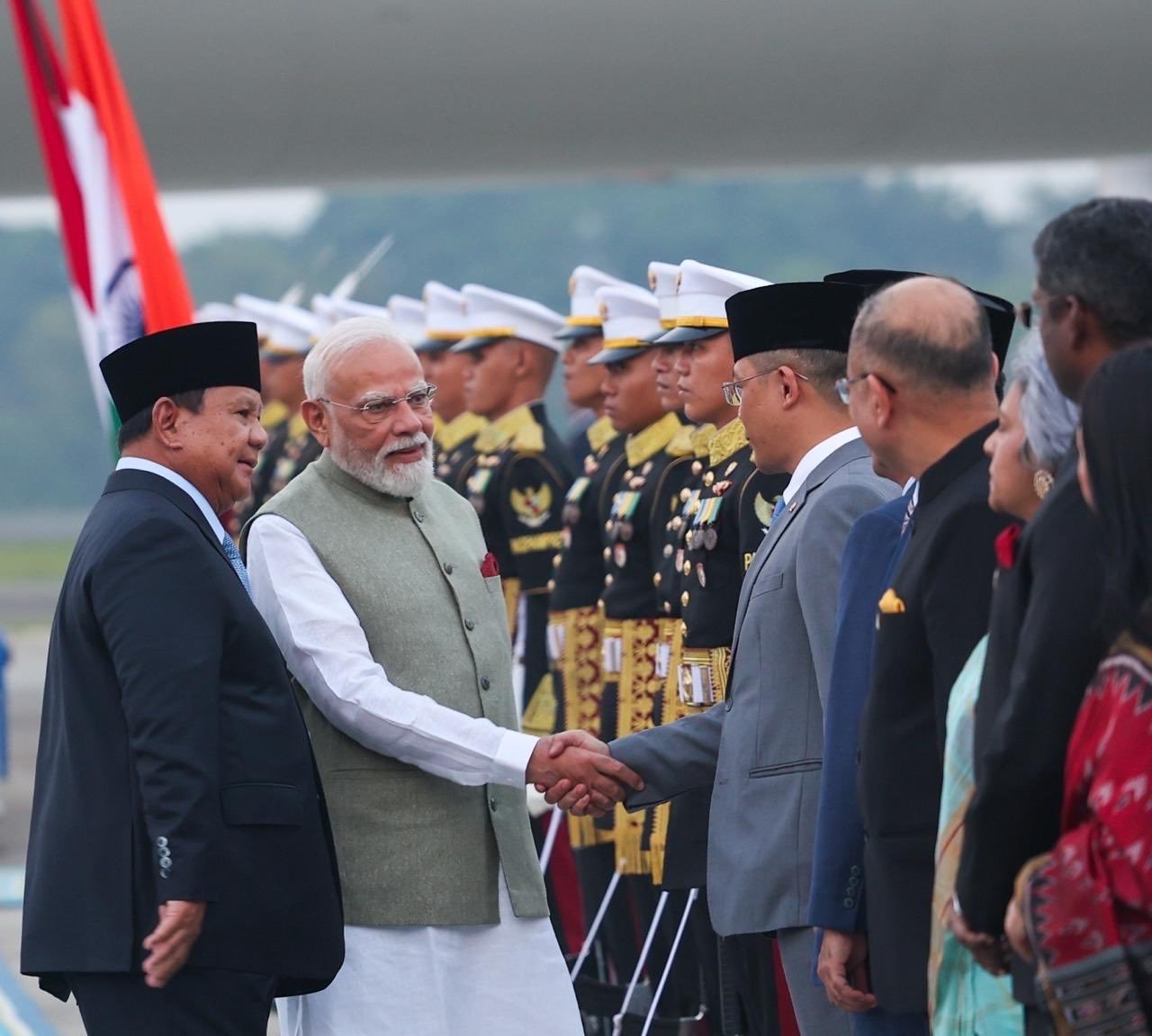
JAKARTA/ NEW DELHI: Diplomatic summits are often judged by the agreements they produce. Yet some meetings matter less for immediate announcements than for what they reveal about the direction of a bilateral relationship. Prime Minister Narendra Modi’s visit to Indonesia falls into the latter category.
As Modi meets Indonesian President Prabowo Subianto in Jakarta, the agenda extends well beyond ceremonial diplomacy. Defence cooperation, maritime security, food resilience, trade and cultural heritage together reflect how India and Indonesia have gradually transformed their relationship into one of growing strategic relevance within the Indo-Pacific.
The visit is Modi’s first to Indonesia since 2023 and follows President Prabowo’s visit to New Delhi last year, where both countries reaffirmed their Comprehensive Strategic Partnership through a broad range of bilateral agreements. Rather than introducing an entirely new framework, the current summit is expected to advance the implementation of that existing partnership.
Indian Ambassador Sandeep Chakravorty has indicated that multiple initiatives remain under discussion. Some may be concluded during the visit, while others continue to be negotiated, an indication that bilateral engagement is increasingly driven by sustained institutional cooperation rather than one-off diplomatic events.
Defence remains one of the most closely watched aspects of the relationship. Officials have confirmed that discussions will include the BrahMos supersonic cruise missile programme alongside cooperation in maritime domain awareness and counter-piracy efforts.
Indonesia has explored the possible acquisition of the BrahMos missile system for several years. In 2023, BrahMos Aerospace stated that negotiations had reached an advanced stage for a potential agreement valued between US$200 million and US$350 million. However, no purchase agreement has been officially announced, making any outcome from the current visit subject to formal confirmation.
The defence dialogue reflects a broader strategic reality. India and Indonesia occupy pivotal positions along the Indian Ocean and the maritime approaches to the Pacific, with the Andaman Sea, the Malacca Strait, and surrounding waters serving as critical arteries for global commerce. Ensuring maritime security, improving domain awareness and combating piracy therefore represent practical shared interests rather than purely military objectives.
Economic interdependence provides another important pillar of the partnership.
Indonesia remains a major supplier of palm oil and coal to India, making stable commercial relations mutually beneficial. Jakarta’s recent policy to centralise exports of several strategic commodities has generated international attention, yet Indian officials have publicly stated that they understand Indonesia’s policy objectives and do not consider the measure a significant obstacle to bilateral trade.
Food security has likewise become an increasingly prominent area of cooperation. Global supply-chain disruptions, climate-related challenges and commodity price volatility have elevated agricultural resilience from a domestic concern to an important component of international economic diplomacy. Discussions between the two governments reflect this broader global trend.
The summit also highlights the role of cultural diplomacy in modern statecraft. Modi’s scheduled visit to Prambanan Temple in Yogyakarta-Indonesia’s largest Hindu temple complex and a UNESCO World Heritage Site will coincide with the planned announcement of restoration work supported through bilateral cooperation. The initiative illustrates how shared historical and civilisational links continue to complement an expanding strategic partnership.
The broader significance of the visit lies in regional geopolitics.
India’s Act East Policy has consistently sought deeper engagement with Southeast Asia, while Indonesia continues to occupy a central position within ASEAN and remains one of the Indo-Pacific’s most influential middle powers. Despite differences in geography and political systems, both countries have repeatedly emphasised support for an open, inclusive and rules-based regional order, respect for international law and ASEAN centrality in regional architecture.
These common positions do not amount to a formal alliance, nor do they seek to create one. Instead, they reflect a gradual convergence on issues where national interests increasingly overlap from maritime stability and resilient supply chains to regional connectivity and economic security.
Former Indian diplomat Rajiv Bhatia recently argued that New Delhi and Jakarta have an opportunity to achieve greater alignment on international issues amid shifting geopolitical dynamics. While that assessment represents independent strategic analysis rather than official policy, it reflects a broader debate among regional experts regarding the growing importance of cooperation between major Indo-Pacific middle powers.
Measured against the standards of headline diplomacy, the summit may not produce a transformational announcement. Its significance lies elsewhere.
India–Indonesia relations have evolved through consistent, incremental progress rather than dramatic breakthroughs. Defence dialogue has expanded, maritime cooperation has deepened, trade has remained resilient, and cultural engagement continues to reinforce political trust. Together, these developments illustrate a partnership that is becoming steadily more consequential not because of a single agreement, but because of sustained convergence across multiple sectors.
In an Indo-Pacific increasingly shaped by long-term strategic competition and economic interdependence, the strongest partnerships are often those built patiently over time. The India–Indonesia relationship increasingly appears to be one of them.
-Martin Widianto with Dr. M Shahid Siddiqui