



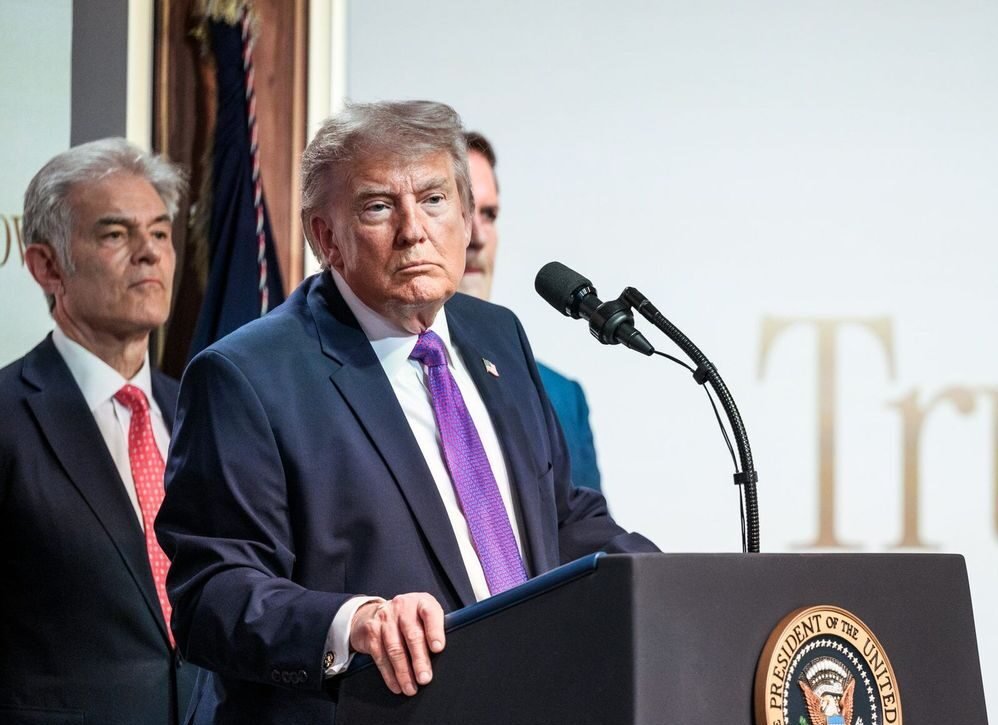
WASHINGTON: President Donald Trump’s latest declaration that the United States will send an additional 5,000 troops to Poland has thrown America’s European allies into yet another cycle of strategic uncertainty, raising fresh questions about whether Washington still has a coherent security doctrine for Europe.
The announcement, made on Trump’s Truth Social platform, came only weeks after the administration signaled plans to reduce the American military footprint across Europe by nearly the same number. The contradictory messaging has left NATO capitals scrambling to understand whether the United States is expanding its deterrence posture against Russia or retreating from Europe altogether.
Trump framed the decision as both strategic and political, linking the deployment directly to the election of Polish President Karol Nawrocki, whom he publicly endorsed.
“Based on the successful Election of the now President of Poland, Karol Nawrocki, who I was proud to Endorse, and our relationship with him, I am pleased to announce that the United States will be sending an additional 5,000 Troops to Poland,” Trump wrote.
But beneath the political symbolism lies a growing policy contradiction that is increasingly unsettling NATO allies already anxious about the future of American commitments on the continent.
Only days earlier, U.S. officials had confirmed that approximately 4,000 American troops from the Army’s 2nd Armored Brigade Combat Team, 1st Cavalry Division would no longer deploy to Poland as part of a broader reduction of forces in Europe. A separate deployment to Germany involving personnel trained in long-range missile operations was also halted.
Those moves were widely interpreted as part of Trump’s long-standing belief that European allies have relied excessively on American military protection while failing to adequately finance their own defense capabilities. The administration has repeatedly pressured NATO members to increase military spending and shoulder greater responsibility in confronting Russia, particularly during the ongoing war in Ukraine.
Yet Trump’s sudden reversal has only intensified perceptions of unpredictability inside the administration’s national security apparatus.
Even senior military leadership appeared uncertain about the final direction of policy. As recently as Tuesday, U.S. Gen. Alexus Grynkewich, commander of both American and NATO forces in Europe, publicly stated that approximately 5,000 troops would be withdrawn from Europe. Pentagon officials later attempted to characterize the changes as a “temporary delay,” though they offered little clarity about whether forces would ultimately return to Poland or be repositioned elsewhere.
The confusion has now become a diplomatic problem.
Republican Congressman Don Bacon described Polish officials as “blindsided” by the earlier withdrawal plans, calling the decision “reprehensible” and “an embarrassment to our country.” Such criticism is notable not only because it came from a Republican lawmaker, but because Poland has emerged as one of Washington’s most loyal and strategically important allies in Europe.
For Warsaw, the stakes are existential. Poland sits on NATO’s eastern frontier and has become one of the alliance’s central military hubs since Russia’s invasion of Ukraine. The country has dramatically increased defense spending, expanded arms purchases, and positioned itself as one of the alliance’s strongest supporters of Ukraine. Any indication of wavering U.S. commitment sends immediate shockwaves through Eastern Europe.
Trump’s approach appears increasingly transactional rather than institutional. Military deployments are being framed not solely around strategic planning but around personal political relationships, campaign endorsements, and domestic messaging. That dynamic risks undermining the credibility of NATO’s collective defense architecture, which depends heavily on predictability and long-term commitments.
The timing could hardly be worse.
Secretary of State Marco Rubio arrived in Sweden for meetings with NATO counterparts amid mounting concerns over Washington’s reliability. European leaders are already struggling to interpret mixed signals from the Trump administration regarding Ukraine, NATO burden-sharing, and broader transatlantic security priorities. Trump’s Poland announcement adds another layer of uncertainty at a moment when Europe is searching for stability in the face of Russia’s continued aggression.
Former U.S. diplomat Ian Kelly captured the growing concern bluntly, arguing that there appears to be “no process” guiding major troop deployment decisions. His remarks reflect a broader fear among allies that American security policy is increasingly driven by impulse rather than coordinated strategic planning.
Whether the United States ultimately increases or reduces forces in Poland may matter less than the perception now taking hold across Europe: that Washington’s security commitments can shift abruptly without consultation, consistency, or strategic clarity.
For NATO allies confronting the most serious European security crisis since the Cold War, unpredictability itself may be becoming the greatest risk.
-Andrea Lawder
READ THE FULL E-MAGAZINE | WorldAffairs: For Decision-Makers Who Need More Than Headlines