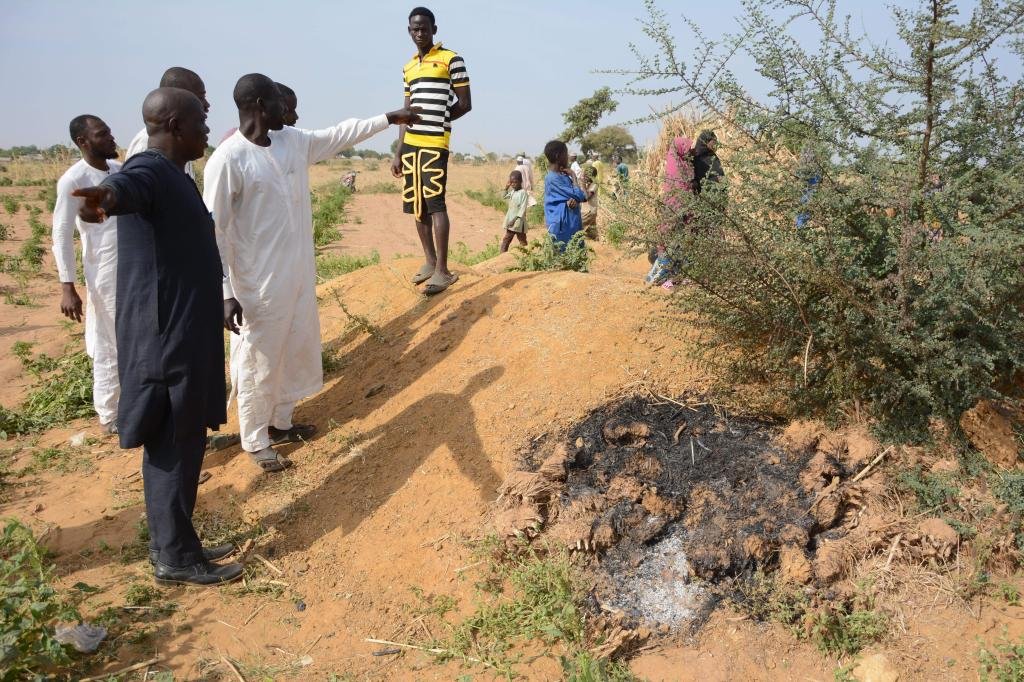
JABO, Nigeria: Residents of the Nigerian village of Jabo were jolted awake by powerful U.S. airstrikes that lit up the night sky in red and caused homes to shake, triggering panic and confusion among villagers unaccustomed to such military action in their area.
Sanusi Madabo, a 40-year-old farmer, said he was preparing for bed late Thursday when he heard a deafening sound resembling a plane crash. Rushing outside his mud house with his wife, he saw the sky glowing intensely red.
“It was almost like daytime,” Madabo recalled, adding that the light persisted for hours.
Villagers later learned the spectacle was the result of a U.S. military strike targeting what Washington described as an Islamic State-linked camp. U.S. President Donald Trump announced that American forces had carried out a “powerful and deadly strike” against Islamic State fighters in Nigeria, a claim subsequently confirmed by Nigerian authorities, who acknowledged cooperation with the U.S. government.
Residents of Jabo, located in Nigeria’s northwestern Sokoto state, told reporters they were seized by fear as the explosions rocked their community. Many said the village itself had never previously been attacked by armed groups, even though neighboring areas have faced repeated violence.
“As it approached our area, the heat became intense,” said Abubakar Sani, who lives near the blast site. “Our rooms began to shake, and then fire broke out. The government should protect us. We have never experienced anything like this.”
The Nigerian military has not disclosed how many locations were targeted or provided details of casualties. Security operatives have since cordoned off the affected area, while residents reported finding scattered debris from the strikes.
A New Phase of an Old Conflict
Nigerian officials described the airstrikes as part of intensified security cooperation following months of diplomatic tension between Abuja and Washington. The Trump administration has repeatedly claimed Nigeria is facing a “Christian genocide,” an assertion the Nigerian government has strongly rejected.
Foreign Minister Yusuf Tuggar described the strikes as “a new phase of an old conflict,” noting that sectarian and militant violence has affected both Christians and Muslims for years. He indicated that further operations could follow.
Security analyst Bulama Bukarti of the Tony Blair Institute said the lack of transparency has deepened local fear.
“What would reduce tension is clear communication, who was targeted, what was hit, and the outcome,” he said. “The more opaque the governments are, the more panic will grow on the ground.”
Questions Over the Target
Analysts suggest the strikes may have targeted the Lakurawa group, a relatively new armed faction operating in northwestern Nigeria, believed to include foreign fighters from the Sahel region. While the group has been linked to rising insecurity, experts caution that its alleged ties to the Islamic State remain unproven.
Nigeria’s primary Islamic State affiliate, the Islamic State West Africa Province (ISWAP), is largely active in the northeast, where it is locked in a long-running conflict with Boko Haram.
Village leader Aliyu Garba said residents rushed to the blast site, with some collecting fragments of debris, raising fears of injury from unexploded or hazardous material.
For 17-year-old Balira Sa’idu, the strike brought personal uncertainty. Preparing for her wedding, she said fear has now overshadowed celebration.
“I should be thinking about my wedding, but now I am panicking,” she said. “My family is afraid, and we don’t even know if it is safe to stay.”
-Adetayo