



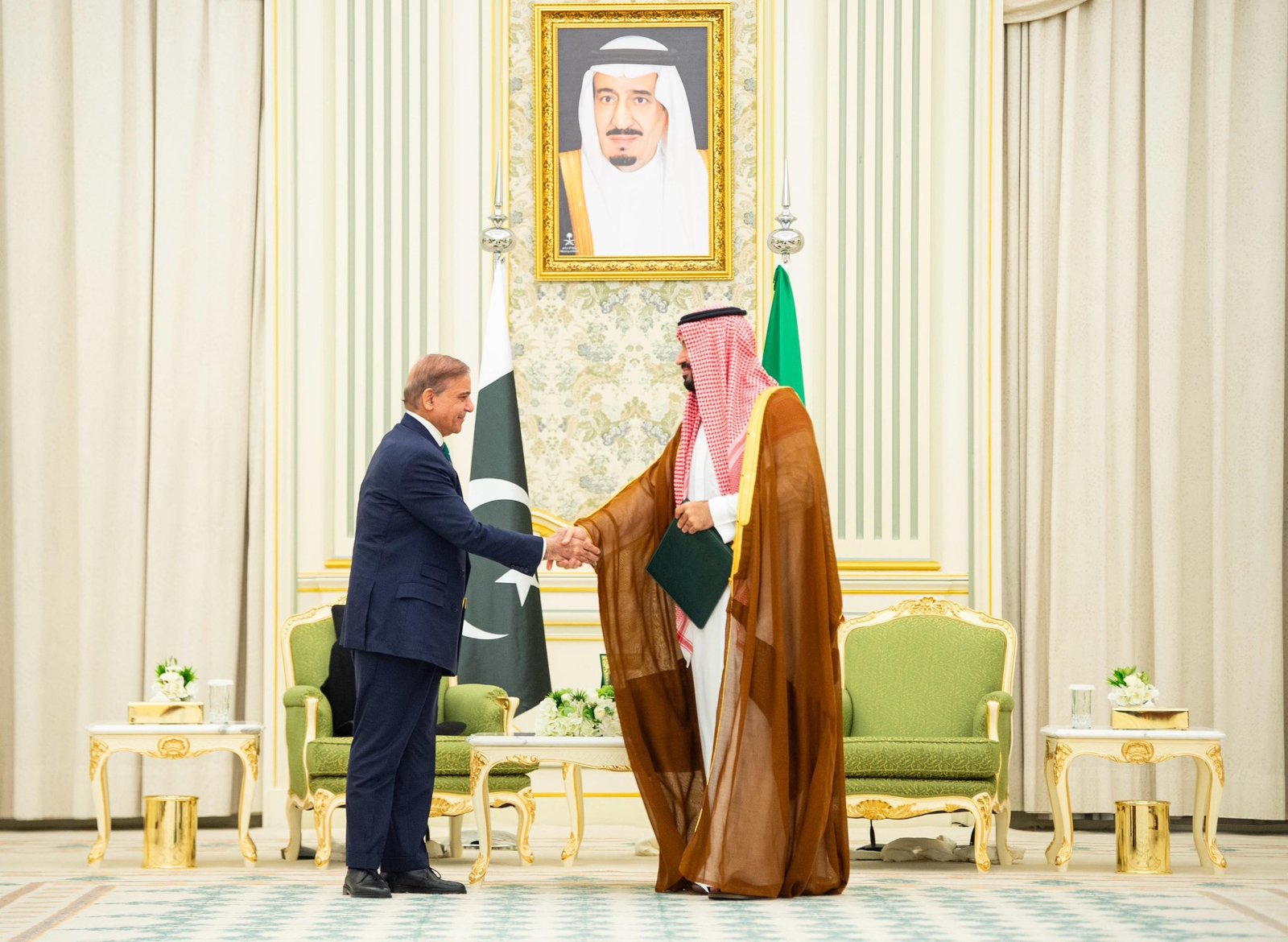
When Saudi Arabia and Pakistan signed a new strategic security agreement on Wednesday (September 17), the move was more than a reinforcement of their longstanding ties; it represents a pivotal recalibration of regional geopolitics, with implications stretching from the Gulf to the Himalayas.
By linking Riyadh directly to Pakistan’s nuclear deterrent, the agreement integrates South Asia’s strategic dynamics into West Asia’s security framework. Its reverberations are set to influence Tehran, Tel Aviv, New Delhi, Kathmandu, and Dhaka alike.
Saudi-Pakistani relations have deep historical roots. Since the 1950s, Saudi Arabia has extended financial and diplomatic support to Pakistan, while Pakistani military personnel, including pilots, trainers, and advisory teams, have contributed extensively to the Kingdom’s defense capabilities.

For decades, discussions about a “nuclear umbrella,” where Pakistan could provide strategic assurance against regional contingencies, have circulated. This agreement formalizes such a framework, establishing a mutual defense understanding that ties the Kingdom’s security to the only Muslim nuclear power in the world. Unlike previous arrangements, this pact is designed as a long-term strategic commitment rather than a temporary measure.
For India, the agreement comes at a sensitive moment. New Delhi perceives it as an augmentation of Pakistan’s strategic depth, particularly in the aftermath of the Pahalgam incident and the subsequent four-day engagement between the two countries in May.
By aligning Saudi Arabia’s considerable economic influence with Pakistan’s defense capacity, Islamabad strengthens its position in regional diplomacy and enhances its strategic reach. India’s measured initial response indicates careful consideration of potential implications, recognizing that the pact could influence defense modernization, missile defense investments, and nuclear doctrine adjustments.
At the same time, India is likely to deepen partnerships with the United States and Israel, expand defense cooperation with France and Japan, and engage closely with Gulf partners such as the UAE and Oman, ensuring that it maintains strategic equilibrium in a shifting regional architecture.
Nepal, already navigating domestic transitions and political reforms, faces new strategic considerations. The Saudi-Pakistan pact introduces an additional dimension to Kathmandu’s regional calculus. With both India and China actively engaging in Nepal, Pakistan’s enhanced position in the Gulf may extend soft power influence into the country through economic assistance, charitable programs, and specialized training initiatives.
Nepal will need to maintain careful diplomatic balance, ensuring continued economic stability while managing competing interests from South and West Asia. The pact underscores the increasingly interconnected nature of regional security and the importance of strategic foresight for smaller states in complex geopolitical landscapes.
Bangladesh, with its large labor diaspora in the Gulf, is closely tied to Riyadh economically and diplomatically. The new agreement strengthens Dhaka’s existing ties to the Gulf while simultaneously highlighting the importance of maintaining strong relations with India.
As Saudi Arabia deepens strategic cooperation with Pakistan, Bangladesh may find itself balancing between supporting shared initiatives within the Islamic world and maintaining its longstanding partnership with India. For Dhaka, the pact reinforces the need for nuanced diplomacy to navigate both economic reliance on the Gulf and regional security partnerships.
The Saudi-Pakistan agreement effectively establishes a cross-regional security network linking West and South Asia. Pakistan’s nuclear deterrent is now a recognized component of Gulf defense planning, potentially encouraging smaller Gulf states, such as Qatar and the UAE, to explore defense collaborations with South Asian partners, including India.
The agreement is poised to influence regional security dynamics, with Tehran likely assessing it as a significant strategic development, Israel recalibrating its engagement with the Gulf, and Turkey pursuing complementary defense initiatives. Beyond the region, global powers including the United States, China, and Russia are bound to consider the implications for regional stability, multipolar strategic alignments, and long-term deterrence planning.
It is important to clarify that Pakistan is not transferring nuclear weapons to Saudi Arabia. The pact constitutes a political and strategic assurance, integrating nuclear deterrence logic into Gulf security planning. Symbolically, this formalization signals a new era in regional defense collaboration, comparable to historical shifts in Middle Eastern security frameworks.
The implications for South Asia are equally significant. India may reassess its nuclear and conventional defense posture, Nepal continues to balance competing regional influences, and Bangladesh navigates between Indian partnerships and Gulf relations. Together, these developments create a tightly integrated security network that links West and South Asia more closely than ever before.
In an era of rapidly evolving alliances from humanitarian crises in Gaza to drone conflicts in the Red Sea, and from political transitions in Nepal to India-Pakistan military engagements the integration of Saudi resources with Pakistan’s strategic capabilities represents a historic transformation.
West and South Asia are now connected within a nuclear-aware security framework, signaling a transformative new era of regional stability, strategic cooperation, and coordinated deterrence. The Saudi-Pakistan pact is not just a bilateral agreement; it is a cornerstone of the emerging security architecture that will shape the geopolitical landscape for decades to come.
– Dr. Shahid Siddiqui; follow via X @shahidsiddiqui
LIKE and SUBSCRIBE YOUTUBE CHANNEL FOR GLOBAL GEOPOLITICAL NEWS















Can you be more specific about the content of your article? After reading it, I still have some doubts. Hope you can help me.
Your point of view caught my eye and was very interesting. Thanks. I have a question for you. https://www.binance.com/futures/ref?code=MBLCVVZG
Thanks for sharing. I read many of your blog posts, cool, your blog is very good.
Can you be more specific about the content of your article? After reading it, I still have some doubts. Hope you can help me.
Your article helped me a lot, is there any more related content? Thanks! https://www.binance.bh/register?ref=GGYHGRE