

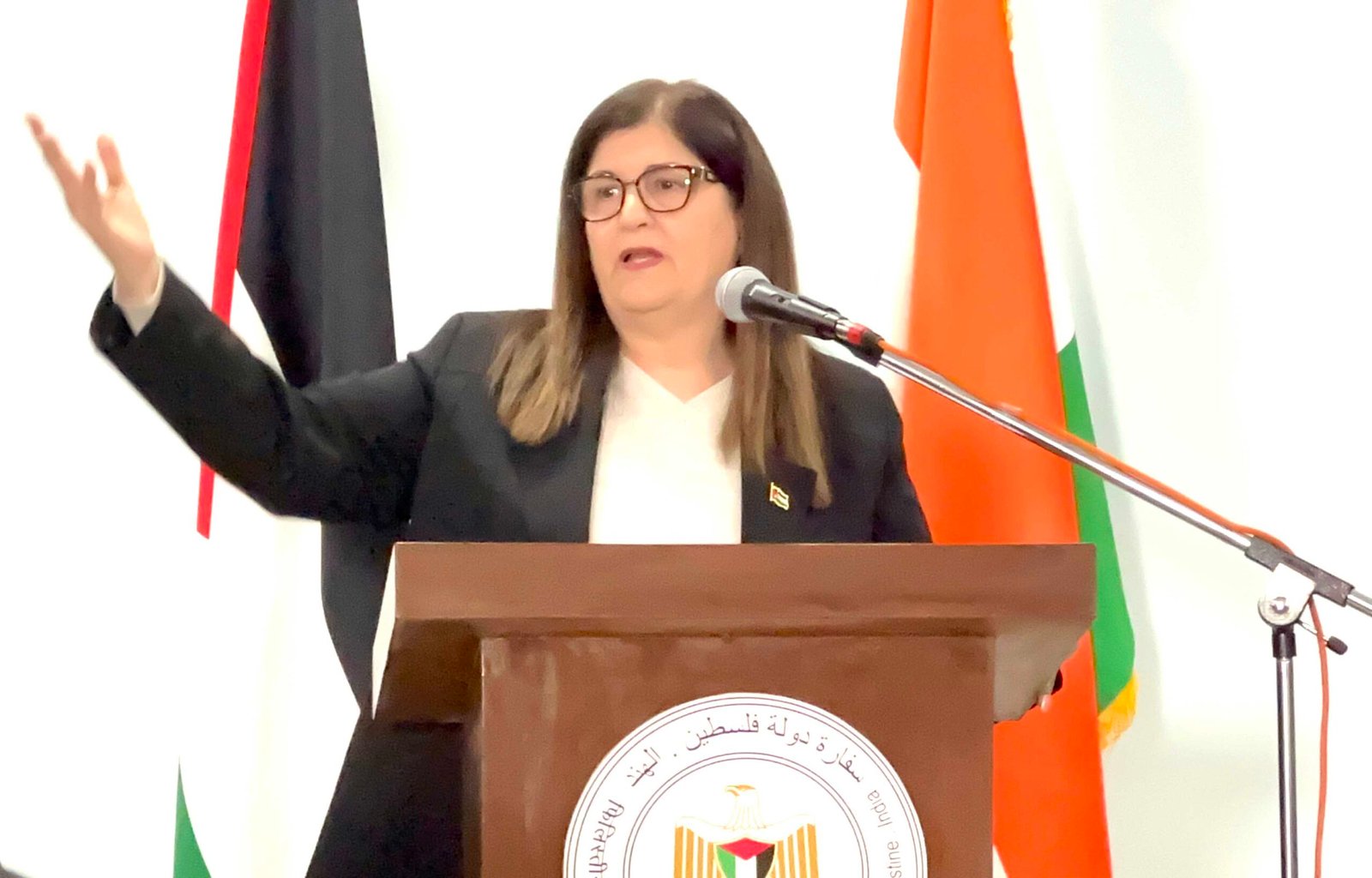
NEW DELHI, India: This week, diplomacy gave way to destiny, as Palestine transformed a routine engagement into a global appeal for justice, law, and leadership. Speaking at the Embassy of Palestine ahead of the second India–Arab Foreign Ministers’ Meeting, H.E. Dr. Varsen Aghabekian Shahin delivered a powerful address that fused history, international law, humanitarian urgency, and geopolitical strategy into a single, compelling message and New Delhi stood at the center of that call. Her argument was unambiguous: the international system is failing Palestine, and India is uniquely positioned to help restore its credibility.
“India is very well positioned to act as a mediator, interlocutor,” she said, emphasizing that New Delhi’s rare status as “a friend to both Palestine and Israel” gives it a diplomatic role no other power currently occupies. This was not a call for neutrality; it was a call for principled leadership rooted in law.
Dr. Shahin rejected the framing of the conflict as a post-1967 dispute. “The dispossession of Palestinian land did not begin in 1967,” she said, tracing its origins to the Balfour Declaration and the 1947 UN Partition Plan. Under that plan, Israel received 54% of historic Palestine, while Palestinians were allocated 46%. “We were not happy with 46%,” she said. “Who would accept someone coming to your home and cutting it in half?”
Yet, she noted, Israeli leaders were also dissatisfied. “This was the map given by the UN, but we have our own map,” she recalled, arguing that this mindset shaped a long-term strategy of annexation and expansion from 1948 through 1967 and into the present.
At the core of her address was a stark asymmetry. “As Palestinians, we recognized Israel on 78% of historic Palestine. What we are asking for is recognition on the remaining 22%,” she said. That 22%, East Jerusalem, the West Bank, and Gaza is, in her words, “non-negotiable” if Palestine is to be a viable, contiguous state.
She noted that 160 countries now recognize the State of Palestine, with more than 20 new recognitions in the past three years. Still, she warned, Israel continues to treat even this 22% as negotiable, while advancing claims of a “Greater Israel,” sometimes publicly presented through maps at international forums. This, she argued, reflects not a peace process, but a process of permanent territorial revision.
Dr. Shahin delivered a pointed critique of religious narratives used to justify territorial claims. “They are using the biblical narrative to give themselves the upper hand,” she said, noting that this interpretation is increasingly amplified by Christian evangelical and Zionist movements. “As Palestinians, as Arabs, we are not only fighting Israelis, we are fighting a narrative,” she said.
Her challenge was not theological but civilizational. Ancient religious texts, she argued, cannot override modern principles of sovereignty, equality before law, and the right of peoples to self-determination. In her framing, the conflict is no longer merely territorial; it is also epistemic about which moral and legal frameworks govern the modern world.
She was unequivocal on the legal status of Palestinian territories. “East Jerusalem is occupied. Gaza is occupied. The West Bank is occupied,” she stated, citing the 2024 ruling of the International Court of Justice (ICJ), which confirmed “without any ambiguity” that all territories occupied in 1967 remain occupied and that the occupation must be dismantled.
Yet, she acknowledged, “Today, we are in 2026, and we see that not much has evolved.” Her critique extended beyond Israel’s actions to the global system’s failure to enforce its own laws. “Countries that believe in international law,” she said, “need to commit to measures that will help Palestinians dismantle this occupation.” In other words, law without enforcement is no law at all, it is ritual.
On Gaza, Dr. Shahin presented not only a humanitarian catastrophe but a moral and legal indictment of the international order. She disclosed that approximately 82% of Gaza’s structures have been destroyed, more than 72,000 people have been killed, and between 10,000 and 20,000 remain missing pushing the total affected population toward four million.
“Gaza is in shambles and destruction,” she said. “You have two million people without shelters. The first thing they need is a decent shelter, water, and basic services.” Reconstruction, she argued, cannot be delayed or politicized. “The whole world should chip in, in terms of technical assistance, in terms of funding.”
Her language was deliberate: reconstruction is not charity, it is obligation, an obligation grounded in both humanitarian law and moral accountability.
Dr. Shahin also directly addressed concerns about militancy and regional radicalization. “Any border conflict should be solved through international law and around the table with negotiations,” she said, “not with violence, not with any form of terrorism, whoever that perpetrator is.” Her conclusion was categorical: “Violence breeds more violence. Violence does not hold anything.”
In doing so, she reaffirmed Palestine’s official position in favor of non-violence and political resolution, while simultaneously rejecting the logic that collective punishment or occupation can ever produce security.
Her appeal to India was among the most consequential elements of the address. “India is a great country, and it can play a great role,” she said. “Being a friend to both Palestine and Israel puts it in a place where it can be a bridge.” She acknowledged India’s strategic interests and regional relationships but emphasized that this balance gives India credibility at a time when the peace process is stalled.
“We truly believe that India can play a major role as a mediator between Israel and Palestine, towards the end of the conflict and the end of occupation,” she said, underscoring India’s consistent support for international law, UN-backed frameworks, and the two-state solution.
This is not a call for symbolic diplomacy. It is a strategic invitation for India to convert its moral capital and regional trust into political leverage. In a region increasingly polarized between power blocs, India remains one of the few actors capable of speaking to all sides without being perceived as coercive or partisan.
Dr. Shahin also acknowledged ongoing communication with the United States but warned against exclusionary diplomacy. “There is communication with the United States,” she said, “but not to the extent that is needed.” Her central concern was that Palestinians are often discussed without being directly included. “We are part of the issue, and we need people to be speaking with us, not planning for us or hearing from others about us.”
She called for broader engagement involving the United States, the Arab world, Europe, and allies to chart a path toward immediate relief, reconstruction, and eventual political resolution leading to “the establishment of the State of Palestine.”
Her address also anchored Palestine’s appeal in historical continuity. She reminded the audience that India’s support for Palestine dates back to the 1930s. “India stood with the Palestinians in 1947,” she said. “Mahatma Gandhi opposed the partition of Palestine.” She acknowledged India’s long-standing development assistance from schools and hospitals to community centers and the near-completion of Palestine’s Diplomatic Institute.
“At a time when Palestinian children are deprived of almost everything,” she said, “these spaces allow them a sense of normalcy.” She described India as being “at the forefront” of such support, not symbolically, but structurally, investing in institutions, not just relief.
Her address comes at a pivotal moment not only for Palestine, but for India’s evolving role in West Asia. With the second India–Arab Foreign Ministers’ Meeting convening after a decade-long gap, and with regional alignments shifting, India is no longer a peripheral observer.
“In the final analysis,” Dr. Shahin said, “what we want is to forge peace, a peace that reflects the respect of both people, the respect of international law, and whatever is enshrined in international law.”
In a world increasingly shaped by power over principle, Palestine is asking India to help restore the primacy of law over force, not as an external arbiter, but as a civilizational stakeholder.
That is not a diplomatic courtesy. It is a strategic responsibility.
— Dr. M Shahid Siddiqui | WNN I Follow via X @shahidsiddiqui