



WASHINGTON: Americans are increasingly losing confidence in what lies ahead, with a new Gallup survey showing that optimism about the future has fallen to its lowest level in nearly two decades.
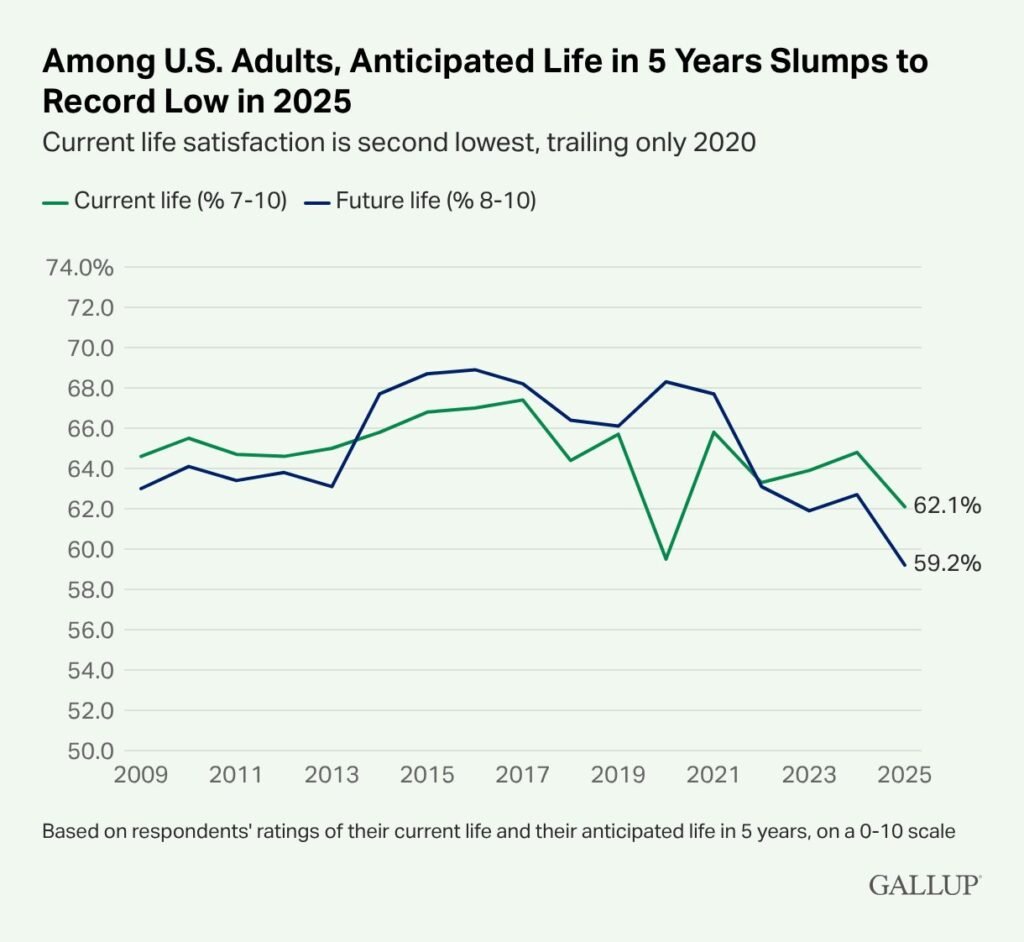
In 2025, just 59% of Americans rated their expected quality of life five years from now as highly positive the lowest figure since Gallup began tracking the measure almost 20 years ago. The finding underscores a growing sense of unease and uncertainty that has settled across the country in recent years.
Gallup’s long-running survey asks Americans to evaluate both their current life and their expected future on a scale of 0 to 10. Those who rate their future life at 8 or higher are classified as optimistic. Historically, optimism about the future has moved in tandem with satisfaction about the present. But recent data shows a widening gap: while satisfaction with current life has gradually declined over the past decade, confidence in the future has deteriorated even more sharply.
“While current life is eroding, optimism for the future has eroded almost twice as much over the last 10 years,” said Dan Witters, research director for the Gallup National Health and Well-Being Index.
Gallup also identifies Americans as “thriving” if they rate their current life at 7 or above and their future at 8 or above. By that measure, fewer than half of Americans about 48%, now consider themselves to be thriving, a sign of mounting concern about both present conditions and long-term prospects.
Political shifts appear to have played a significant role in shaping public sentiment. Democrats and Hispanic Americans reported particularly sharp declines in optimism in 2025. Traditionally, when political power changes hands in Washington, supporters of the incoming administration tend to grow more hopeful while those aligned with the outgoing party become less so, often balancing each other out. That pattern did not hold this time.
Democrats’ optimism dropped markedly from 65% to 57% during the transition from President Joe Biden’s administration to President Donald Trump’s second term. Republicans, while somewhat more optimistic after Trump’s return to the White House and Republican control of Congress, did not experience a strong enough increase in confidence to offset the decline among Democrats.
“The regime change in the White House almost certainly was a big driving factor,” Witters noted, adding that Democrats were particularly affected by the shift in political power.
At the same time, Republicans are still less optimistic than they were at the end of Trump’s first presidency. A January AP-NORC survey found that although most Republican voters continue to support the president, many believe his economic performance has not met their expectations, contributing to a more subdued outlook.
Hispanic Americans also reported a notable decline in optimism. The share expressing strong hope for the future fell from 69% to 63% during Trump’s first year back in office, a steeper drop than among white or Black Americans. Analysts suggest that economic pressures, health care concerns and anxiety over immigration enforcement may be contributing factors.
Polling indicates that immigration enforcement policies have become highly visible in Hispanic communities. A Pew Research Center survey found that about six in 10 Latinos had seen or heard of immigration raids or arrests in their communities within the past six months. Such developments may be intensifying feelings of uncertainty and insecurity, particularly in areas with large Hispanic populations.
Economic stress also appears to weigh heavily. Surveys conducted in predominantly Hispanic communities found declining optimism through 2025, alongside falling approval ratings for the administration among Hispanic voters and higher reported levels of financial strain compared with other demographic groups.
Gallup’s findings are based on more than 22,000 interviews conducted throughout 2025 as part of its National Health and Well-Being Index. Together, the results paint a picture of a nation grappling not only with present challenges but with a growing sense that the future may offer fewer opportunities for improvement, a shift that could have far-reaching social and political implications.
–Linley Sanders