



BELEM, BRAZIL: COP30 has entered its most turbulent phase, and the contradictions running through this Amazonian summit are now impossible to ignore. The world’s biggest climate conference is unfolding inside the planet’s most fragile rainforest ecosystem, yet the people who protect that ecosystem every day are still struggling for basic access to the negotiating rooms. Inside the summit halls, diplomats speak in the cautious language of climate governance, adaptation metrics, resilience frameworks, and capacity-building templates, but outside those glass walls, the voices of Indigenous communities are loud, direct, and uncompromising, reminding the world that the Amazon is more than an atmospheric regulator; it is home, history, and survival.
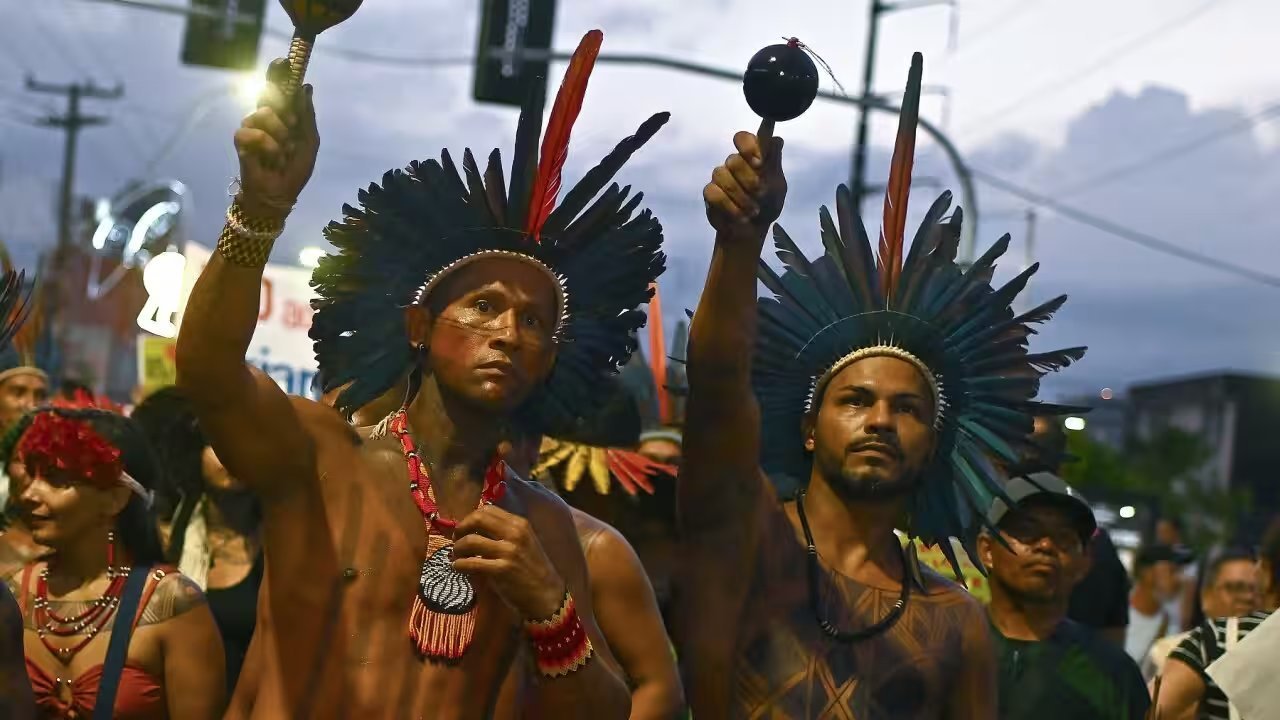
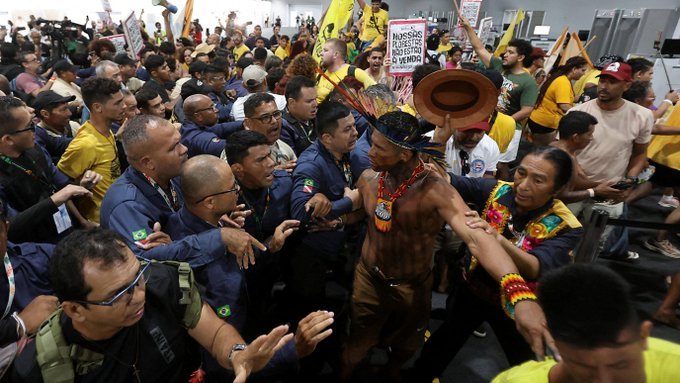
Their frustration erupted on Friday when dozens of Indigenous leaders held a peaceful sit-in outside the venue, demanding what should never have been denied at a climate summit hosted inside their own territory: the right to participate meaningfully. “We protect the climate. The Amazon cannot keep being destroyed to enrich big companies,” declared a statement from the Munduruku people, whose territory spans nearly 24,000 sq km, an expanse comparable to New Hampshire in the United States. Their protest forced an urgent meeting with COP30 President André Corrêa do Lago, underscoring how global climate architecture still treats those most crucial to planetary stability as spectators rather than partners.
Brazilian President Luiz Inácio Lula da Silva has made Indigenous rights central to his climate diplomacy, yet the events in Belém reveal an uncomfortable truth: high-level rhetoric can diverge sharply from procedural reality. Many Indigenous representatives questioned why invitations were extended without the credentials necessary to participate meaningfully in negotiations. Environment Minister Marina Silva acknowledged that these grievances reflect deeper domestic tensions, conflicts with illegal miners, expanding agribusiness, and development models that view forest lands as extractive opportunities rather than living systems. Their protest at COP30 was not simply a demand for access; it was a plea for global accountability.
Part of the tension arises from the summit’s design. Brazil pitched COP30 as a “stability summit” focused on implementing previous commitments instead of negotiating contentious new mandates. This was intended to lower diplomatic friction and avoid the paralysis that has derailed earlier climate talks. As a result, major points of conflict- climate finance, global mitigation pathways, and accountability mechanisms were deliberately kept off the main negotiating track. For the first few days, this strategy appeared to create a sense of calm. But by mid-summit, economists, civil society groups, and several national delegations began warning that an implementation-only agenda risks falling disastrously short of reality.
Andrew Wilson, deputy secretary general for policy at the International Chamber of Commerce, captured the rising anxiety when he told WorldAffairs, “If we stay on this path, COP30 may deliver a weak outcome , a washout in a moment that demands historic action.” His assessment reflects a widening concern that climate diplomacy remains trapped in slow-motion negotiation while global warming accelerates at record speed.
The issue Brazil hoped to strategically sideline, fossil fuels has re-emerged as the summit’s most explosive fault line. After COP28’s historic but ambiguous pledge to “transition away from fossil fuels,” many expected Belém to strengthen the language. Instead, the Brazilian presidency removed fossil fuel language from the formal agenda, hoping to avert a geopolitical showdown with oil and coal-dependent states. But the omission has only intensified debate, shifting the battle to the final cover text, the document that shapes global political expectations.
Norway’s climate minister Andreas Bjelland Eriksen told WorldAffairs that avoiding fossil fuel commitments is untenable: “It is difficult, but we should try to address fossil fuels here in Belém.” Difficulty, however, is not the summit’s biggest obstacle. Politics is. Saudi Arabia, Russia, and several hydrocarbon-reliant nations are expected to resist strong anti-fossil-fuel language, while Brazil, Colombia, Norway, and segments of the EU have signaled support for reaffirming and strengthening, the COP28 direction of travel. The cover text, therefore, now carries the weight of the entire summit. A strong reference to fossil fuels would demonstrate that climate diplomacy still possesses momentum. A diluted statement would confirm global backsliding.
Complicating every discussion is the geopolitical vacuum left by the United States. With Washington stepping back from climate leadership under President Trump, the negotiating tables feel noticeably unanchored. U.S. climate finance commitments remain stalled, regulatory rollbacks have weakened international credibility, and American negotiators are less central to technical discussions than they have been at any COP in the past decade. The absence of a traditional power broker has forced other blocs – the EU, Latin American coalitions, and African negotiators to shoulder the burden of leadership, often with uneven capacity and conflicting priorities. The result is fragmentation: everyone wants climate progress, but few can marshal the alignment required to deliver it.
Amid these structural hurdles, the core moral and political battle of COP30 remains the question of who gets to decide the future of the world’s forests. The Amazon is not simply a carbon sink; it is a geopolitical asset, an economic paradox, and a sacred cultural heartland. More than 80% of global biodiversity is protected by Indigenous peoples, a fact repeatedly cited by environmental scientists and civil society groups throughout the summit. Their presence in Belém forces negotiators to confront truths often softened in diplomatic language: climate stability is inseparable from Indigenous land rights; conservation without consent replicates extractive colonial models; and climate finance must reach communities directly, not only flow through ministries or international intermediaries.
The legacy of COP30 will therefore hinge not only on technical language or diplomatic craftsmanship, but on whether Indigenous communities leave Belém with concrete gains rather than symbolic gestures. Their demands territorial protection, formal negotiation roles, and climate finance that reaches on-the-ground defenders test whether the global climate system can evolve beyond top-down governance.
As the summit enters its decisive phase, the stakes have never been clearer. The Amazon is nearing ecological tipping-points that scientists warn could trigger irreversible dieback. Global temperatures are accelerating toward thresholds that threaten food systems, coastal cities, and economic stability worldwide.
Meanwhile, political systems appear increasingly incapable of matching the severity of the threat. Delegates inside the halls continue to refine cautious formulations. Activists outside continue fighting for the survival of their lands. Governments pledge progress while negotiating exceptions. And the Amazon, the lungs of the planet stands at a point where the margin for error is dissolving.
A meaningful agreement in Belém would prove that multilateral climate action still holds coherence, that nations can unite despite geopolitical fractures and contested sovereignties. A weak outcome, however, would send an even louder signal: that the world’s climate institutions are faltering just as the emergency reaches its most dangerous phase.
The Amazon is watching. History is listening. And the time left to act is rapidly collapsing.
–Dr. Shahid Siddiqui From Belem, Brazil | Follow on X @shahidsiddiqui