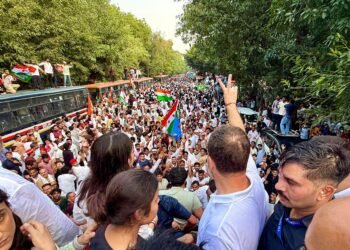



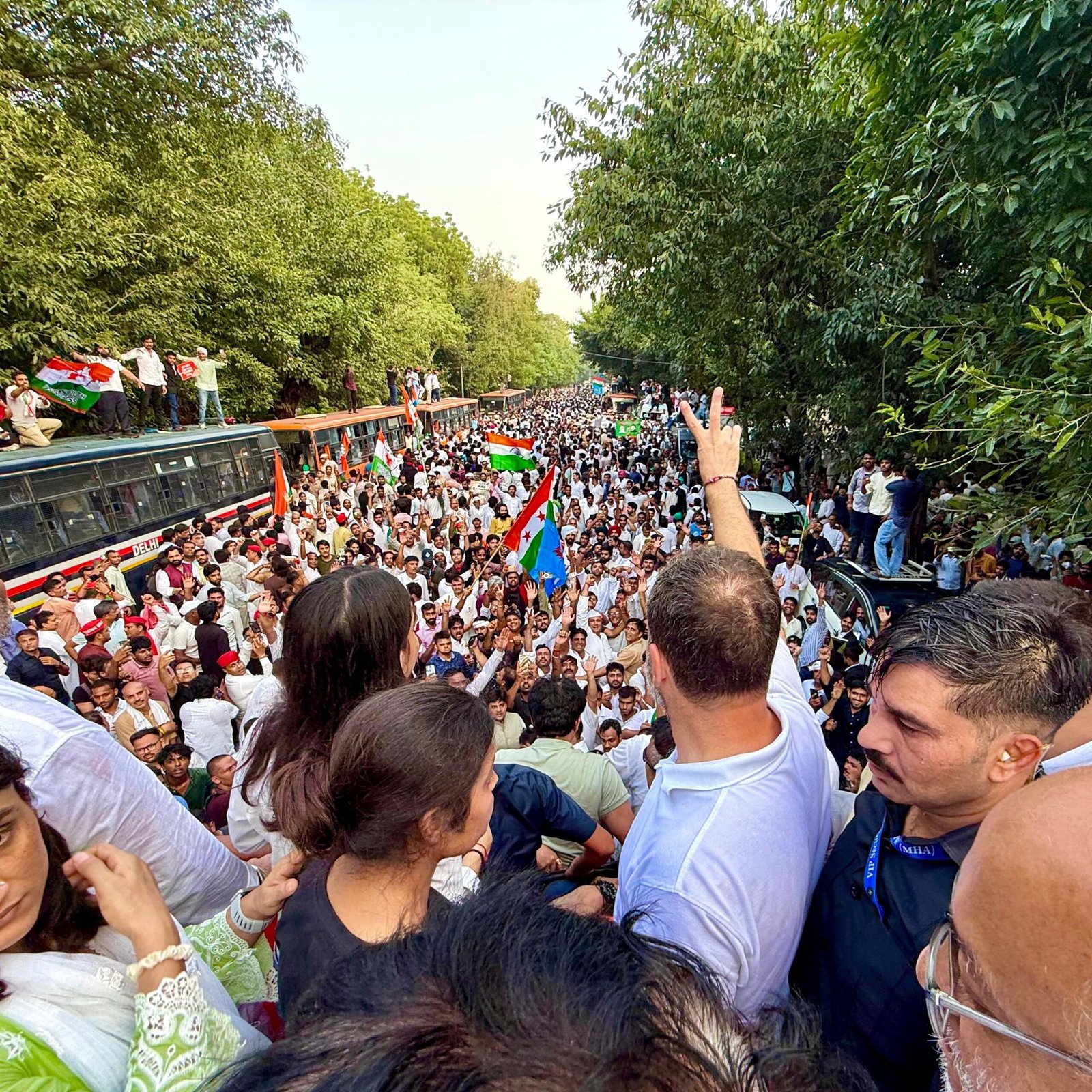
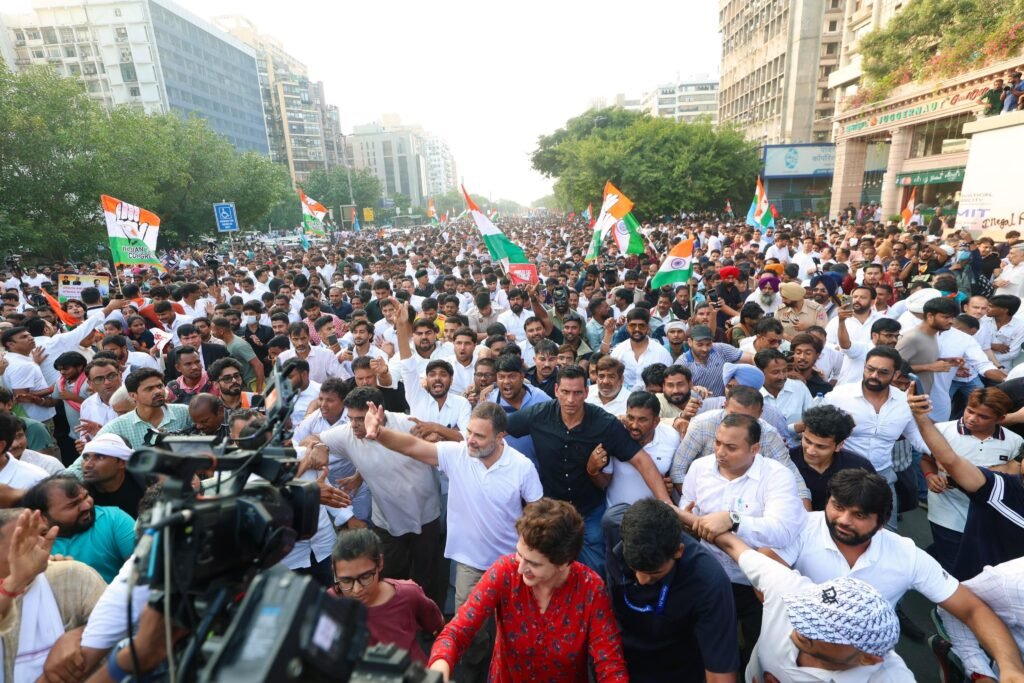
NEW DELHI: India’s escalating voter-list controversy is becoming a defining test of Rahul Gandhi’s ability to unite a fragmented opposition against Prime Minister Narendra Modi’s Bharatiya Janata Party (BJP). Thousands of demonstrators marched towards the Supreme Court on October 12, demanding scrutiny of a nationwide electoral roll revision that has reportedly removed more than 130 million names. The confrontation has transformed an administrative dispute into a broader political battle over electoral transparency, institutional credibility and the future direction of India’s opposition.
The significance of the mobilisation extends beyond the immediate allegations against the Election Commission of India. It lies in the emergence of a common opposition campaign led by Gandhi, bringing together political parties with competing regional interests around a question central to democratic participation: whether every eligible citizen can exercise the right to vote through a fair, transparent and accessible process.
The protest also places India within a wider international conversation about political accountability and youth mobilisation. From Kenya to Nepal and Madagascar, younger generations have taken to the streets over different combinations of economic insecurity, governance failures, corruption and political exclusion. Although these movements have distinct causes and cannot be treated as a single global phenomenon, they demonstrate how public dissatisfaction can challenge established political structures.
For India, the immediate question is whether Gandhi can convert opposition unity and growing public scrutiny into sustained political coordination, credible institutional reforms and a viable national alternative to the BJP.
Rahul Gandhi’s Opposition Strategy Gains Momentum
The October 12 march demonstrated the potential for a more coordinated opposition response. Congress leaders and representatives of regional parties joined the campaign against the voter-list revision, while supporters of the youth-led Cockroach Janta Party movement added a generational dimension to the protests.
For Gandhi, this represents an opportunity to address one of the opposition’s longstanding weaknesses: the difficulty of bringing parties with different electoral interests under a common national strategy. Congress may seek to challenge the BJP nationally, but regional parties have their own political priorities, voter bases and leadership ambitions. Cooperation against a common opponent does not automatically resolve disagreements over constituencies, candidates or the distribution of political influence. The voter-list dispute offers a potentially powerful point of convergence. Electoral transparency is an issue that opposition parties can raise collectively without first agreeing on every aspect of economic or social policy. By framing the controversy around constitutional safeguards and the protection of eligible voters, Gandhi can seek to broaden the campaign beyond Congress’s organisational base.
International coverage has brought this political development to a wider audience. Al Jazeera and the Associated Press, including reporting carried by The Washington Post, covered the opposition march, the security restrictions in New Delhi and the dispute over electoral registration. Their reporting reflects the international significance of the confrontation, although media attention should not be confused with independent confirmation of every allegation made by protesters.
Gandhi’s challenge is to turn this moment of coordination into something more durable. A successful opposition strategy requires more than demonstrations and joint statements. It requires sustained cooperation among political parties, credible evidence supporting allegations of irregularities and a programme addressing the economic and social concerns that shape voters’ choices.
The march offers a visible demonstration of collective action. Whether that unity survives the pressures of electoral competition remains an open question.
The Voter List Controversy: What Is at Stake?
The reported scale of the electoral revision has intensified public concern. More than 130 million names have reportedly been removed from voter lists, including approximately 28 million entries attributed to deceased individuals, 63 million to people who relocated and 30 million to individuals who could not be traced. The figures demand scrutiny, but they must be interpreted carefully. Removing deceased voters, correcting duplicate entries and updating outdated records are legitimate responsibilities of electoral authorities. Accurate voter lists are essential to the integrity of elections.
However, the legitimacy of the objective does not establish that every deletion was correct. Nor does the scale of the revision, by itself, prove deliberate disenfranchisement. The central question is whether the procedures reliably distinguish ineligible entries from citizens who remain entitled to vote. People who relocate may still qualify to participate in elections, while individuals who cannot be traced during verification are not necessarily ineligible.

Opposition parties have alleged that Muslim voters and other minorities may be disproportionately affected. The Election Commission and the BJP reject allegations of partisan manipulation. These competing claims require independent examination of deletion patterns, recorded reasons for removals, demographic impacts and the effectiveness of appeal and re-enrolment procedures.
The Election Commission has maintained that voters whose names were wrongly removed can re-enrol. Yet the practical effectiveness of that remedy depends on whether affected citizens receive adequate information, can establish their eligibility and have sufficient time to correct errors.
This is particularly important for migrant workers, economically disadvantaged communities and people who face barriers accessing official documentation or digital registration services.
Electoral integrity requires two equally important protections: preventing invalid registrations and ensuring that eligible citizens are not wrongly excluded. The credibility of a voter register depends on both.
Supreme Court Battle Raises Institutional Stakes
The opposition’s petition to the Supreme Court seeks an audit of voter deletions, safeguards against removing names without notice, opportunities for affected individuals to be heard and an interim suspension of the revision nationwide. The legal challenge brings the controversy into a constitutional forum where the competing claims can be examined against applicable law and available evidence.
The Court’s task is not to endorse the political position of either the opposition or the government. It is to assess the legal framework, the evidence presented and the adequacy of procedural safeguards.
For the opposition, judicial scrutiny provides an opportunity to establish whether specific irregularities occurred and to seek remedies that protect eligible voters. For the Election Commission, the proceedings provide an opportunity to demonstrate that its procedures are legally sound, consistently applied and open to appropriate scrutiny.The reported concerns raised internally by two election commissioners about aspects of the revision, registration procedures and digital systems have added to the debate. Those concerns warrant examination, but their precise implications must be established through documentary evidence and official responses. The broader institutional lesson is clear: public confidence is strengthened when authorities explain their decisions transparently, correct errors and permit credible examination of contested procedures. Democratic institutions should not be presumed guilty because they face criticism. Equally, questioning their decisions should not automatically be dismissed as an attempt to undermine democracy.
Youth Protests Connect India to a Wider Global Movement
The involvement of young demonstrators adds another dimension to the controversy. The Cockroach Janta Party movement has mobilised protests over issues including education, school infrastructure, employment and governance. Its participation suggests that electoral concerns are intersecting with wider frustrations among sections of India’s younger population.
Internationally, youth-led demonstrations have become a prominent feature of political debate in several countries. In Kenya, protests initially driven by opposition to a controversial finance bill in 2024 expanded into broader demands concerning the cost of living, corruption and government accountability. In Nepal, youth mobilisation in 2025 developed into a major political crisis following restrictions on social media and wider public anger over governance. Madagascar also experienced significant youth-led demonstrations amid grievances over public services and living conditions. These movements differ in their origins, political structures and outcomes. Their common significance lies in the willingness of younger citizens to challenge established authorities and demand responses to concerns they believe traditional institutions have failed to address.
International reporting by the Associated Press, alongside analysis published by Chatham House, has examined this broader pattern of youth mobilisation across countries and regions. India’s present situation is not identical to those cases. The voter-list controversy centres on electoral procedures and political representation, while protests elsewhere have involved taxation, unemployment, public services or restrictions on civil liberties. Nevertheless, the Indian mobilisation illustrates how established political parties and youth movements can converge around questions of accountability.
For Gandhi, engagement with younger demonstrators presents both an opportunity and a challenge. Their participation could broaden the opposition’s reach, but young activists may resist being absorbed into conventional party structures. Their continued involvement will depend on whether political leaders address substantive grievances rather than merely use youth mobilisation to strengthen electoral campaigns.
International Scrutiny and India’s Democratic Credibility
India’s political developments attract international attention because of the country’s population, economic importance and position in global affairs. The credibility of its electoral institutions matters to domestic voters and forms part of the international assessment of its democratic governance.
Coverage by Al Jazeera, the Associated Press, The Washington Post and other international outlets has brought the protests and the electoral dispute to a global audience. Editorial commentary in The Guardian has also examined the political implications of youth mobilisation and the government’s response. News reporting and editorial analysis serve different purposes. Reporting documents events, official statements and competing claims, while commentary evaluates their broader implications. Neither should be treated as a substitute for independent verification of the underlying allegations. International attention does not establish that electoral manipulation has occurred, just as official assurances do not eliminate the need for scrutiny. The relevant question is whether the revision can withstand transparent examination and whether eligible voters have effective remedies if their names have been removed incorrectly.
For India, a credible response would include clear explanations of the verification methodology, appropriately anonymised information about deletions, accessible appeal procedures and timely correction of demonstrable errors. Such measures would strengthen electoral confidence regardless of which political party gains an advantage from the controversy.
Can Rahul Gandhi Turn Protest into Political Change?
The voter-list dispute has created an opportunity for Gandhi to strengthen his position as a coordinating figure for India’s opposition. It has brought several political parties into a common campaign, elevated questions of electoral transparency and connected the dispute with wider debates about governance and political participation. But the distance between protest and political transformation remains considerable.
Congress and regional parties must still navigate differences over leadership, seat-sharing and state-level competition. The opposition must also demonstrate that it can develop credible policies on employment, economic opportunity, education and public services rather than define itself exclusively through opposition to Modi. The BJP, meanwhile, faces the responsibility of addressing questions about electoral administration with evidence and transparency. Political counter-accusations cannot substitute for explanations of how deletions were conducted or how affected citizens can seek correction. The ultimate test for Gandhi is whether he can transform a common grievance into sustained political cooperation and an alternative programme of governance. The test for India’s electoral institutions is whether they can demonstrate that voter registration is accurate, fair and accessible. For young demonstrators, the test is whether mobilisation produces meaningful responses to their concerns.
Rahul Gandhi’s emerging role as a focal point for India’s opposition is an important development, but a united march is only the beginning not proof of a durable political realignment. Its lasting significance will depend on whether the campaign produces verifiable accountability, stronger safeguards for eligible voters and sustained cooperation among parties with different political interests. For the international community, the central lesson extends beyond India: democratic credibility depends not merely on holding elections, but on ensuring that the procedures governing participation are transparent, fair and open to scrutiny.
India’s challenge is to protect electoral integrity without compromising democratic inclusion. The opposition’s challenge is to turn mobilisation into credible reform. And the challenge for political leaders worldwide is to recognise that public trust must be earned through accountability, not demanded through authority.
-Dr. M Shahid Siddiqui