



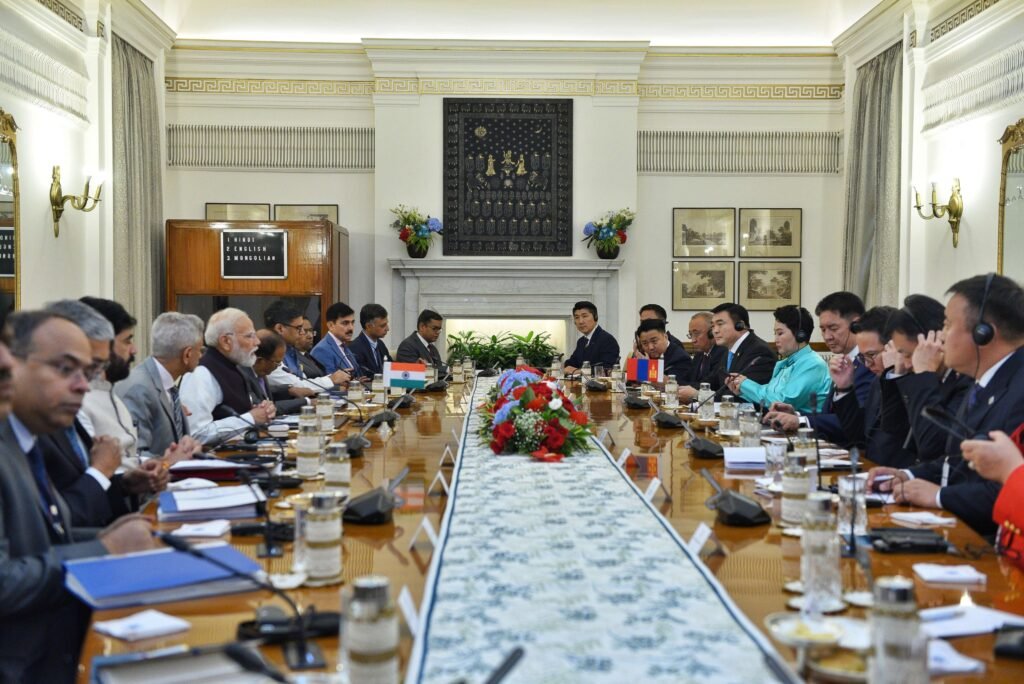
NEW DELHI: India and Mongolia have long shared a civilizational bond rooted in the teachings of Lord Buddha, a connection that transcends geography and politics. But in New Delhi this week, that spiritual kinship took a decisive strategic turn. As Mongolian President Khurelsukh Ukhnaa embarked on his first state visit to India, both nations reaffirmed their commitment to an enduring partnership that blends heritage, technology, and geopolitical purpose.
Prime Minister Narendra Modi and President Khurelsukh Ukhnaa held extensive talks at Hyderabad House, culminating in the signing of ten Memorandums of Understanding covering areas as diverse as humanitarian aid, immigration, geology and mineral resources, promotion of cooperatives, and digital cooperation. The two leaders also jointly released a commemorative postage stamp marking the 70th anniversary of diplomatic relations between India and Mongolia, a symbolic reminder of how far this partnership has evolved since 1955.
Prime Minister Modi, addressing the joint press conference, spoke with characteristic warmth and conviction:
“India has decided to provide free e-visas to Mongolian citizens. We will also sponsor the annual visit of young cultural ambassadors from Mongolia to India,” he announced. “Our relationship is not merely diplomatic, it is a soulful and spiritual bond between our nations.”
Modi evoked the shared Buddhist legacy that connects Nalanda University with Mongolia’s famed Gandan Monastery, calling it a “living bridge of wisdom.” He added, “India and Mongolia’s approach to global issues is based on shared values. We stand as close partners in international forums, supporting a free, open, inclusive, and rules-based Indo-Pacific. Together, we are amplifying the voice of the Global South.”
The Indian Prime Minister also underlined New Delhi’s tangible role in Mongolia’s development journey. “India has been a steadfast and reliable partner in Mongolia’s progress. The Oil Refinery Project, being built with India’s 1.7 billion US dollar line of credit, will strengthen Mongolia’s energy security and economic resilience.”
President Khurelsukh Ukhnaa, in turn, expressed deep gratitude for India’s consistent support, calling the partnership “a model of trust and mutual respect.”
“We thank India and Prime Minister Modi for their all-around support in our oil refinery project,” said the Mongolian leader. “The MoU on digital cooperation is another landmark step in strengthening our bilateral relations.”
He also announced a new people-to-people bridge: “A Mongolian air carrier is preparing to operate charter flights to Amritsar and New Delhi later this year. This will significantly expand our cooperation in tourism and business.”
The symbolism of the visit went beyond agreements. Prior to the talks, both leaders planted a sapling at Hyderabad House in honor of President Ukhnaa’s mother, linking India’s ‘Ek Ped Maa Ke Naam’ campaign with Mongolia’s ‘One Billion Trees’ initiative. The gesture embodied a shared environmental ethic and an emotional depth that few diplomatic relationships command.
During his visit, the Mongolian President also paid homage to Mahatma Gandhi at Rajghat and met Vice President C.P. Radhakrishnan, who described the encounter as “a reaffirmation of the ancient bonds of friendship and a blueprint for the future.” External Affairs Minister S. Jaishankar, who called on President Ukhnaa earlier, appreciated his “warm sentiments on advancing the strategic partnership between the two nations.”
The Ministry of External Affairs summarized the visit as “a milestone moment in advancing the India–Mongolia Strategic Partnership.” Secretary (East) P. Kumaran noted that the two leaders “adopted a joint statement charting a shared vision for future engagement, including resilient supply chains, critical minerals, and a forward-looking cooperation framework.”
Over the past seven decades, India and Mongolia have built a partnership anchored in democracy, faith, and mutual respect. From defense and security cooperation to education, energy, and technology, the relationship now carries strategic weight. Yet, as both leaders emphasized, its foundation remains profoundly human and spiritual.
As the commemorative stamps were unveiled and the ink dried on ten new agreements, it was clear that India and Mongolia are not merely renewing ties, they are redefining what 21st-century partnerships between ancient civilizations can look like: rooted in history, driven by trust, and aimed squarely at shaping a shared and sustainable future.
– Dr. Shahid Siddiqui; follow via X @shahidsiddiqui










Your point of view caught my eye and was very interesting. Thanks. I have a question for you. https://accounts.binance.info/tr/register?ref=MST5ZREF