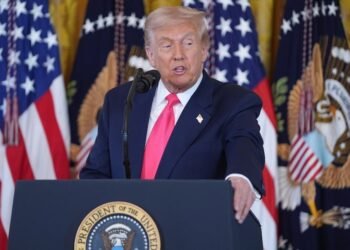


DAVOS, Switzerland: President Donald Trump’s speech at the World Economic Forum in Davos marked one of the most confrontational moments in recent transatlantic diplomacy. Standing before political leaders, CEOs, and diplomats, Trump openly declared that he wants to “get Greenland, including right, title and ownership,” while insisting he would not use force. Yet his repeated warnings to European allies and NATO left little doubt that pressure, economic and political will be his weapon of choice.
By urging NATO to “stand aside” and suggesting that U.S. expansionism should not be blocked, Trump challenged the very foundations of the post–World War II order. His framing of Greenland as “a piece of ice” that belongs to North America signals a shift away from respect for sovereignty toward a transactional view of territory, one where power and leverage, rather than law and consent, determine outcomes.
Although Trump said he does not want to use force, his language carried unmistakable menace. “You can say yes, and we will be very appreciative. Or you can say no, and we will remember,” he told allies. This is not diplomacy in the classical sense; it is coercion wrapped in strategic rhetoric. For NATO; an alliance built to prevent precisely this kind of power politics, the message was destabilizing and unprecedented.
European leaders responded swiftly and firmly. Britain vowed not to compromise its principles under tariff threats. France warned against accepting “the law of the strongest.” The European Commission promised a united and proportional response if the United States moves ahead with punitive trade measures. Denmark and Canada reiterated that Greenland is not for sale and cannot be transferred.
Trump’s threat to impose tariffs starting at 10 percent and rising to 25 percent on Denmark and other allies has injected economic anxiety into an already tense geopolitical moment. Markets reacted nervously, and economists warned that such measures could disrupt the fragile trade truce between the U.S. and the European Union, driving up costs and slowing growth on both sides of the Atlantic. For an administration that claims to prioritize lowering the cost of living, these threats appear self-defeating.
The president also used his Davos platform to argue that Europe is declining while the U.S. is booming. “You all follow us down, and you follow us up,” he said, portraying America as the engine of global prosperity and Europe as a weakened partner. While the U.S. economy has indeed shown resilience, this framing risks reducing allies to subordinates — eroding the mutual respect that underpins durable alliances.
Trump’s Greenland fixation overshadowed other issues, including his administration’s plans to address the U.S. housing crisis and his proposal for a U.S.-led “Board of Peace” to oversee ceasefires, including in Gaza. While his desire to play a role in conflict resolution may appeal to parts of his domestic base, bypassing established multilateral institutions risks further fragmenting global governance rather than strengthening it.
At its core, Trump’s Davos speech was not just about Greenland. It was about redefining how power is exercised in the international system. By openly treating territory as negotiable and alliances as instruments rather than partnerships, the speech signals a profound departure from the rules-based order that has governed global affairs since 1945.
If this approach becomes normalized, the West’s moral authority to oppose territorial aggression elsewhere, whether in Ukraine, the South China Sea, or beyond — will be severely weakened. You cannot credibly defend sovereignty while openly challenging it.
Trump may insist he does not want to use force, but his strategy relies on something equally corrosive: the normalization of coercion. Greenland today, another territory tomorrow, the logic of leverage knows no natural stopping point.
The world is watching closely, not just for what Trump does next, but for how allies respond. If they stand firm, they defend not only Greenland, but the principle that borders and sovereignty are not bargaining chips. If they falter, the consequences will ripple far beyond the Arctic.
This is no longer simply about a “piece of ice.” It is about whether global trust, alliance solidarity, and the rule-based international order can survive an era of transactional power politics.
– WNN