



WASHINGTON: U.S. President Donald Trump has launched an ambitious and highly controversial global initiative to rebuild Gaza, announcing that roughly $7 billion has already been pledged by participating nations to a reconstruction fund tied directly to the disarmament of Hamas and the stabilization of the war-torn enclave.
At the first meeting of his newly created Board of Peace in Washington, Trump presented the effort as a breakthrough in post-war planning for Gaza. Yet beneath the headline numbers lies a fragile framework shaped by political exclusion, security conditionality and competing visions for the region’s future.
A reconstruction plan built on conditions
Trump told representatives from 47 nations that the United States will commit $10 billion to the Board of Peace, while countries including Gulf and Central Asian partners have collectively pledged $7 billion as an initial down payment for rebuilding Gaza. Additional contributions are expected from the United Nations with $2 billion earmarked for humanitarian relief and FIFA, which plans to allocate $75 million for sports infrastructure.
The funding model signals a departure from traditional humanitarian assistance. Reconstruction financing is explicitly tied to the disarmament of Hamas and the establishment of a new security and governance architecture inside Gaza. That conditionality may appeal to Israel and Washington but risks delaying urgently needed rebuilding if political benchmarks are not met.
Trump framed the initiative as part of a broader peace architecture that could eventually extend beyond Gaza to other global conflicts, raising concerns among diplomats that the new structure might overlap with or sideline the United Nations as the primary multilateral forum for conflict resolution.
Legitimacy gaps and diplomatic unease
The Board of Peace includes Israel but excludes Palestinian representatives, a notable omission that complicates claims of inclusivity and raises questions about long-term legitimacy. While Trump insisted the initiative would “strengthen” the UN, skepticism persists given Washington’s own funding arrears and the creation of a parallel diplomatic platform.
Norway, initially cited as a host for future Board events, clarified it is not formally joining the initiative, underscoring hesitations among some Western partners about fully endorsing the framework.
Security-first stabilization
Central to the plan is an International Stabilization Force designed to operate in Gaza once conditions permit. Indonesian President Prabowo Subianto announced Jakarta could contribute up to 8,000 troops, potentially forming the largest single contingent in a multinational deployment led by a U.S. general with an Indonesian deputy.
The force would initially operate in Israeli-controlled zones such as Rafah, training a new Palestinian police force and eventually expanding to around 20,000 troops while preparing a 12,000-member local security structure. The concept reflects a security-first approach to reconstruction prioritizing order and disarmament before full-scale rebuilding.
Yet the presence of foreign troops in Gaza without a fully negotiated Palestinian political framework could generate resistance and complicate implementation.
Hamas disarmament: the decisive variable
The success or failure of the entire initiative hinges on one unresolved question: whether Hamas will disarm. Trump said he hopes force will not be required but acknowledged uncertainty over whether the group will surrender its weapons voluntarily.
Israeli Prime Minister Benjamin Netanyahu has taken a more uncompromising stance, declaring Hamas will be disarmed “one way or the other.” Hamas officials, while signaling openness to discussions on disarmament within a broader settlement, remain wary of Israeli military intentions and skeptical of external forces operating without guarantees on troop withdrawal.
Without a credible mechanism for disarmament acceptable to all sides, the reconstruction fund risks remaining largely theoretical.
Regional pressure and strategic timing
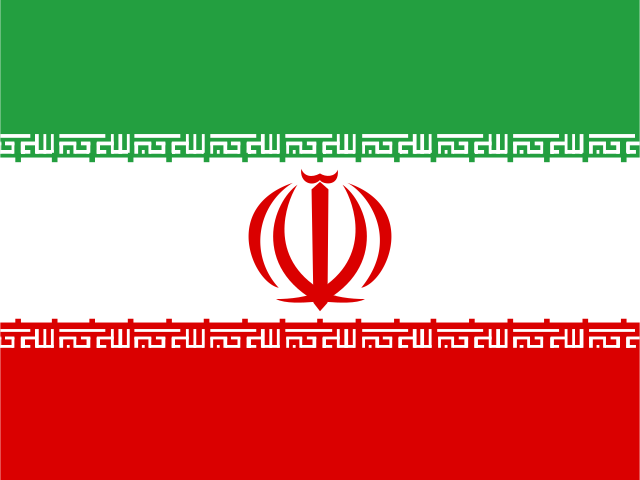
The initiative unfolds amid heightened U.S. pressure on Iran and an expanded American military presence across the Middle East. Trump has linked progress on Gaza indirectly to wider regional diplomacy, stating that any potential nuclear deal with Tehran must be “meaningful” and indicating a short timeline for determining whether negotiations can advance.
This convergence suggests the Board of Peace is not merely a humanitarian vehicle but part of a broader geopolitical strategy aimed at reshaping regional security dynamics after the Gaza war.
A high-stakes experiment
The Board of Peace represents a bold attempt to merge reconstruction funding, security restructuring and diplomatic leverage into a single framework. Its scale is significant, but so are its uncertainties:
- Reconstruction funds remain conditional on militant disarmament
- Palestinian political representation is absent from the governing structure
- International troop deployment could face local resistance
- Coordination with existing UN mechanisms is unclear
For now, the $7 billion pledged for Gaza symbolizes both hope and hesitation, a financial commitment waiting on political realities. If disarmament, governance and security arrangements align, the initiative could mark the beginning of Gaza’s rebuilding. If not, it risks becoming another ambitious plan stalled by the same divisions that have long defined the conflict.
-Steve Hunnicutt