


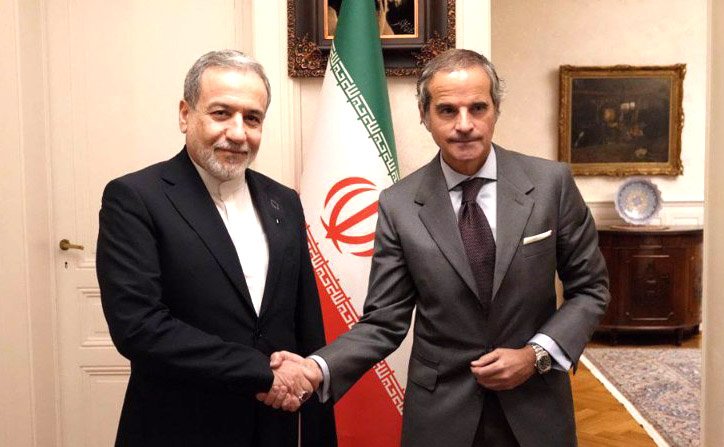
GENEVA, Switzerland: Iran’s diplomatic push ahead of renewed nuclear negotiations intensified as Foreign Minister Abbas Araqchi met Rafael Grossi, chief of the International Atomic Energy Agency, to address concerns over Tehran’s nuclear programme and inspection access.
The meeting comes as the United States and Iran prepare for another round of high-stakes talks aimed at reviving diplomacy after months of escalating tensions, military signalling and stalled negotiations. Despite renewed engagement, both sides remain far apart, with Washington seeking broader constraints beyond nuclear activity and Tehran insisting sanctions relief must precede any meaningful concessions.
U.S. Secretary of State Marco Rubio acknowledged the difficulty of reaching a deal, signalling cautious openness to diplomacy while warning that substantive agreements with Tehran remain complex. Araqchi, meanwhile, reiterated Iran’s readiness for a “fair and equitable” settlement but rejected negotiating under military pressure.
Regional tensions have sharpened significantly. The United States has deployed additional naval and air assets to the Middle East following joint American-Israeli strikes on Iranian targets earlier this year, while Iran has launched new military drills in the Strait of Hormuz, a vital global oil artery. Tehran has repeatedly warned that any attack could trigger closure of the strategic waterway, threatening nearly a fifth of global crude flows.
The diplomatic agenda is also expanding. Washington seeks to include Iran’s missile capabilities and regional security posture in the negotiations, but Tehran maintains that its ballistic programme is non-negotiable and insists uranium enrichment on Iranian soil will continue for civilian purposes.
The IAEA continues to press Iran for clarity on its stockpile of highly enriched uranium and has called for full inspection access to key nuclear facilities, including Natanz, Fordow and Isfahan, which were hit in previous strikes.
Adding to the pressure, Israeli Prime Minister Benjamin Netanyahu has urged U.S. President Donald Trump to ensure any future agreement dismantles Iran’s enrichment infrastructure entirely rather than merely limiting production, underscoring deep scepticism in Israel about the durability of a potential deal.
Trump said he would be involved “indirectly” in the upcoming Geneva talks and suggested Tehran is now more inclined toward compromise following last year’s U.S. strikes on Iranian nuclear facilities. He indicated that Iran understands the consequences of failing to reach an agreement, while expressing cautious belief that diplomacy could still yield results.
Meanwhile, Iran has continued to signal preparedness on multiple fronts, including conducting chemical defence drills at the Pars Special Economic Energy Zone to strengthen readiness for potential incidents affecting its critical energy infrastructure.
With military deployments rising and diplomatic red lines hardening, the upcoming negotiations will test whether a viable diplomatic pathway remains or whether the nuclear standoff is entering a more dangerous and prolonged phase.
Elwely Pamuk