


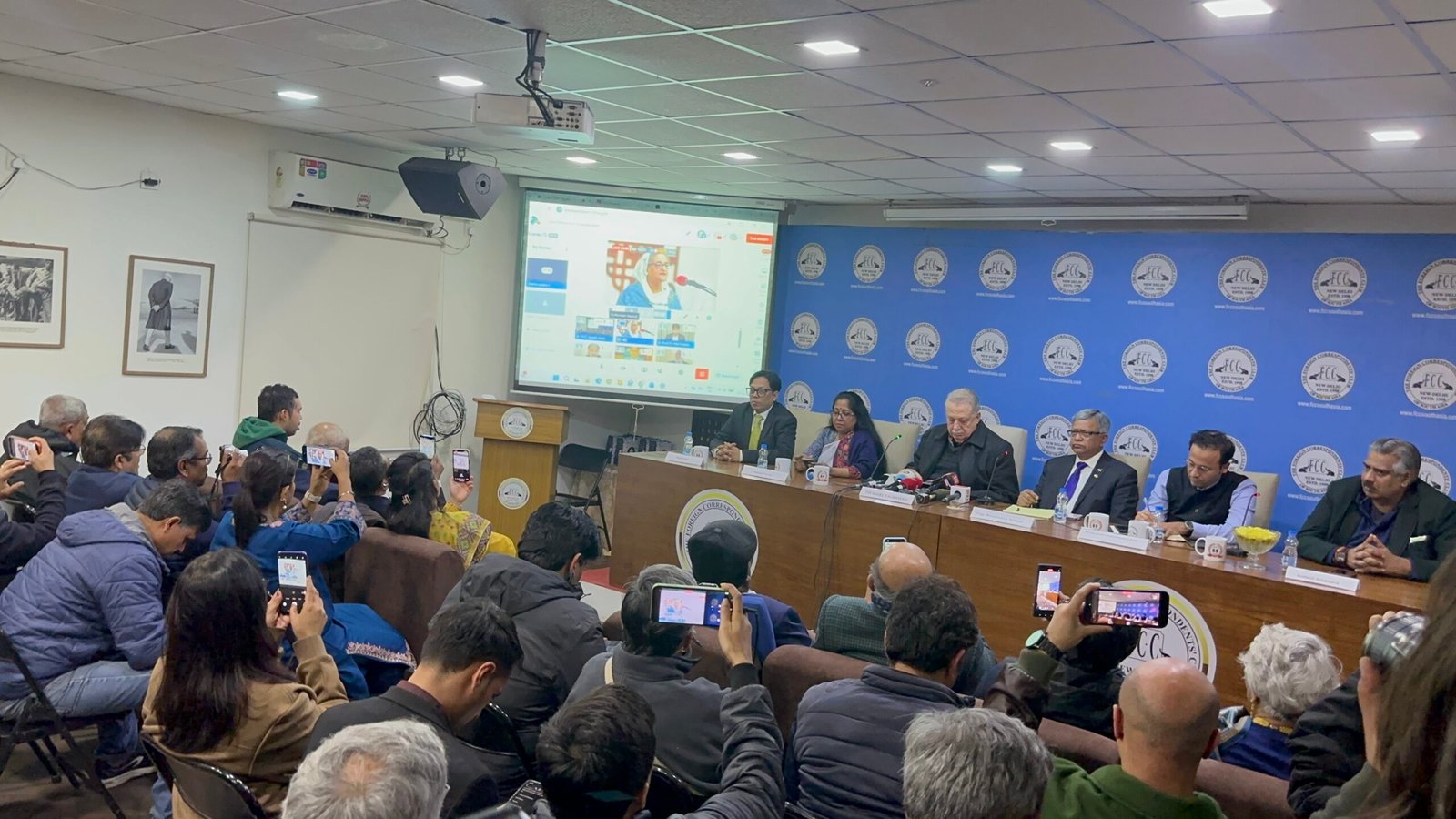
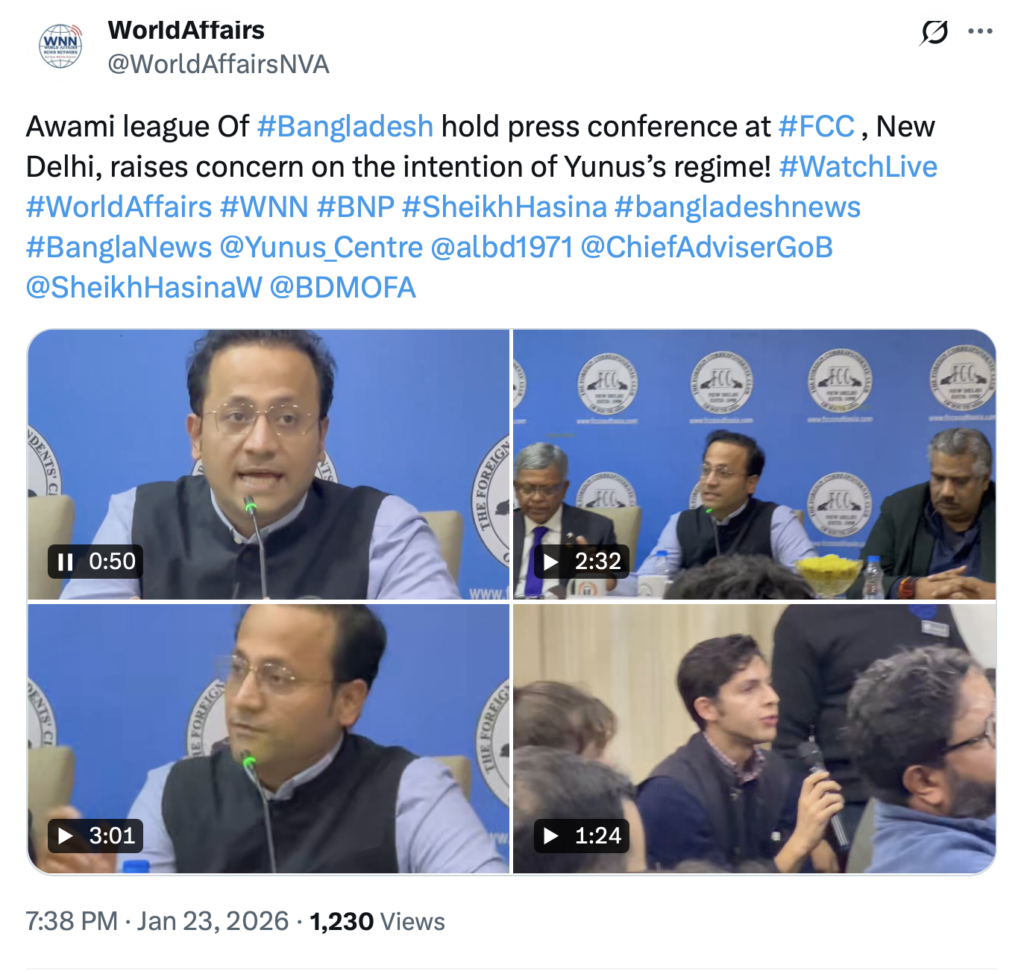
NEW DELHI, India: Sheikh Hasina’s first public address from exile in India marked a dramatic re-entry into Bangladesh’s political discourse. Speaking via audio to an audience in New Delhi, the former prime minister launched a fierce critique of the interim leadership in Dhaka and of Nobel laureate Muhammad Yunus, whom she accused of presiding over an illegal and violent administration that, in her words, has dismantled democracy and undermined national sovereignty.
Hasina framed her ouster in August 2024 not as a routine political transition but as a constitutional rupture. She claimed that law and order had collapsed, minorities and women were facing heightened insecurity, and democratic institutions, including the judiciary and the media, had been systematically weakened. Drawing heavily on the symbolism of the 1971 Liberation War and the legacy of her father, Sheikh Mujibur Rahman, she cast the present crisis as a civilizational struggle rather than a partisan contest. Her appeal called for unity among pro-Liberation and democratic forces to restore constitutional rule and hold fresh, credible elections.
Beyond rhetoric, Hasina laid out five core demands: removal of the current administration, restoration of public order, protection for minorities and vulnerable groups, an end to what she described as politically motivated prosecutions, and an impartial international investigation preferably under United Nations auspices into the events surrounding her removal and the subsequent unrest. These demands position her not merely as an opposition figure but as a claimant to moral and constitutional legitimacy.
Yet even as Hasina seeks to mobilise resistance from abroad, Bangladesh’s political landscape is undergoing a profound shift. Jamaat-e-Islami, once banned under her government, has re-emerged as a significant political force. The party has made gains in student politics, including at Dhaka University, and is widely expected to play a substantial role in the next national elections, potentially emerging as a leading contender behind the Bangladesh Nationalist Party (BNP).
Jamaat’s resurgence is not just a domestic development; it is reshaping Bangladesh’s external relationships. Reports that the United States has explored engagement with Jamaat including discussions with journalists about its growing influence have sparked intense debate. While U.S. officials have publicly stated that Washington does not favour any particular party and intends to work with whichever government the Bangladeshi people elect, the perception of outreach to an Islamist party with a controversial past carries geopolitical consequences.
For India, the implications are particularly sensitive. Jamaat’s historical opposition to Bangladesh’s liberation, its ideological alignment with political Islam, and its longstanding anti-India stance have made it a source of concern in New Delhi. Any perceived international legitimisation of Jamaat risks complicating India’s security calculus in the eastern subcontinent and could further strain already delicate regional alignments.
Jamaat’s leadership, for its part, has attempted to soften its image. Party chief Shafiqur Rahman has publicly stated that Bangladesh under Jamaat would not become Pakistan, Afghanistan, or Iran, and has pledged governance based on justice, rule of law, and equal rights for all citizens. Yet these assurances coexist with a political legacy that continues to provoke deep unease among secularists, minorities, and regional observers.
What emerges is a Bangladesh caught between three competing forces: an exiled former prime minister invoking constitutional continuity and the Liberation War ethos; an interim political order navigating legitimacy, stability, and reform; and an Islamist movement re-entering mainstream politics amid shifting international engagement. Overlaying these domestic dynamics is a broader geopolitical recalibration, particularly involving the United States and India, that adds another layer of complexity to Bangladesh’s political future.
This is not simply a contest for power but a struggle over identity, governance, and alignment. The question facing Bangladesh is not only who governs, but what kind of state it becomes: a secular republic rooted in its liberation legacy, a recalibrated democracy accommodating Islamist political forces, or a fragmented polity shaped as much by external influence as by internal consensus.
How this moment unfolds will have consequences far beyond Bangladesh’s borders. It will affect regional stability in South Asia, the future of India–Bangladesh relations, and the broader balance between secular democratic governance and political Islam in the Muslim world. Sheikh Hasina’s return to the political stage from exile has reignited old battles, but the deeper test now lies in whether Bangladesh can navigate this transition without sacrificing constitutionalism, social cohesion, or strategic autonomy.
-Dr. Shahid Siddiqui; follow via X @shahidsiddiqui
READ THE FULL E-MAGAZINE | WorldAffairs: For Decision-Makers Who Need More Than Headlines