

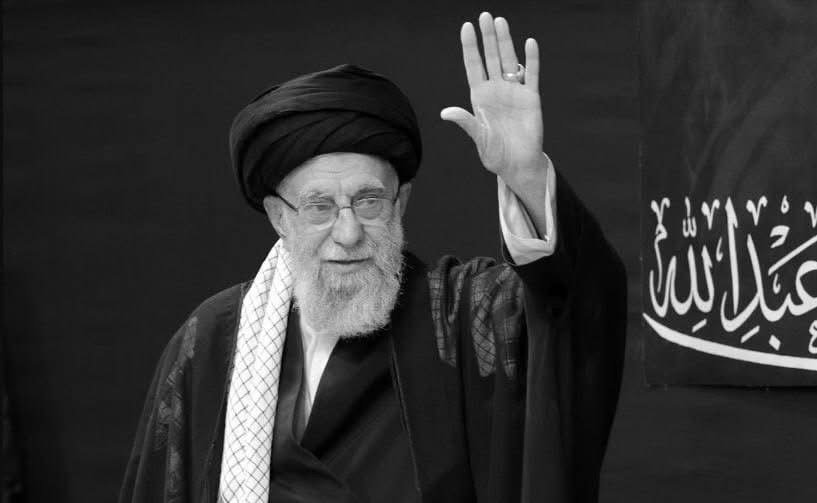
TEHRAN: The reported death of Iran’s Supreme Leader Ayatollah Ali Khamenei following a joint U.S.–Israeli strike marks the most consequential rupture in the Islamic Republic’s political order since the 1979 revolution. For more than three decades, Khamenei functioned not merely as head of state but as the ideological anchor, strategic arbiter, and ultimate power broker of Iran’s complex system of clerical rule. His removal abrupt, violent, and externally driven introduces an unprecedented moment of institutional stress, geopolitical recalibration, and domestic uncertainty.
Iranian state media confirmed his death without detailing the operational circumstances, while U.S. President Donald Trump described the strike as a decisive moment that could offer Iranians their “greatest chance” to reclaim political agency. Israeli officials signaled the operation was part of a broader effort to dismantle Iranian strategic capabilities, particularly its nuclear and missile infrastructure. If accurate, the strike was not only tactical but transformational: it removed the individual who embodied continuity within a revolutionary system built to resist external pressure.
Khamenei’s centrality to Iran’s governance structure cannot be overstated. The Islamic Republic is neither a pure theocracy nor a conventional republic; it is a layered architecture where elected institutions function within boundaries defined by clerical oversight. At the apex stands the Supreme Leader, constitutionally empowered to command the armed forces, appoint key judicial and media officials, and set broad strategic direction. In practice, Khamenei’s influence extended beyond formal authority. He mediated factional rivalries, balanced conservative and pragmatic currents, and ensured that no initiative particularly on nuclear negotiations or relations with Washington advanced without his consent.
The immediate consequence of his death is a vacuum at the core of this architecture. While the Assembly of Experts is constitutionally tasked with appointing a successor, the political reality is far more complex. Succession will unfold not only in seminaries and clerical councils but also within the corridors of the Islamic Revolutionary Guard Corps (IRGC), which has evolved into the most powerful military-economic institution in the country. The IRGC’s role in shaping the next phase of governance will likely be decisive. Over decades, it accumulated influence through control of missile programs, foreign expeditionary units, infrastructure projects, and strategic industries. Khamenei cultivated the Guard as both shield and sword, ensuring its loyalty while empowering it to suppress dissent and project power abroad.
This raises a fundamental question: does the system outlive the man, or was the man the system’s stabilizing force? Revolutionary regimes often claim institutional resilience, yet history shows that long-serving leaders frequently become indispensable nodes of equilibrium. Khamenei’s tenure, which began in 1989 under circumstances that initially cast doubt on his authority, evolved into one of consolidation and endurance. Lacking the charisma and clerical seniority of Ayatollah Ruhollah Khomeini, he compensated by building alliances within the security establishment and overseeing the expansion of parallel institutions such as the Basij paramilitary force and the financial conglomerate Setad. These mechanisms provided both coercive capacity and economic leverage.
Externally, Khamenei’s strategic doctrine rested on asymmetric deterrence. Confronted by technologically superior adversaries, Iran invested in ballistic missiles, proxy militias, and nuclear latency. The “axis of resistance” spanning Lebanon’s Hezbollah, Iraqi militias, Syrian allies, and Yemeni forces, became the outward expression of this doctrine. Rather than confront Israel or the United States directly, Tehran sought to encircle and complicate their strategic calculations. Yet this network suffered cumulative blows in recent years. The October 7, 2023 Hamas attack on Israel triggered a regional realignment that weakened Iran’s proxies and intensified scrutiny of its nuclear program. Israeli operations degraded Hezbollah’s capabilities, while shifts in Syria disrupted Tehran’s logistical corridors.
Against this backdrop, negotiations over Iran’s nuclear program faltered. Khamenei’s concept of “heroic flexibility,” invoked during the 2015 nuclear agreement, reflected a willingness to tactically compromise for economic survival. However, the U.S. withdrawal from that agreement during Trump’s first term reinforced his long-held suspicion that Washington sought regime change rather than coexistence. Tehran responded by incrementally expanding uranium enrichment and reducing compliance. Missile development remained non-negotiable. For Khamenei, relinquishing ballistic capabilities would have stripped Iran of its primary deterrent.
The strike that reportedly ended his life thus represents the culmination of escalating deterrence failure. Each side sought leverage; neither achieved de-escalation. If the objective of the operation was decapitation removing the architect of Iran’s resistance strategy, the long-term strategic outcome remains uncertain. Decapitation can disorient adversaries, but it can also harden resolve or accelerate militarization under new leadership.
Domestically, the timing intersects with deep social strain. Iran’s economy has labored under sanctions, currency volatility, and youth unemployment. Protests over rising prices and social restrictions evolved into broader anti-regime demonstrations, particularly following the 2022 death of Mahsa Amini in custody. Khamenei’s response relied on repression rather than reform. Security forces arrested thousands; executions followed controversial trials. While the state reasserted control, it did not extinguish underlying grievances. The generational divide widened, with younger Iranians expressing aspirations that diverged sharply from the revolutionary ethos of 1979.
In this context, Khamenei’s death could function as either catalyst or containment. Reformist factions might view the transition as an opening to recalibrate governance and reengage diplomatically. Hardliners, especially within the IRGC, may interpret it as a moment demanding consolidation and retaliation. Much depends on the speed and transparency of succession. A prolonged power struggle risks economic panic, capital flight, and social unrest. Conversely, a swift appointment particularly of a figure aligned with the Guard could signal continuity.
Regional actors are recalibrating in real time. Israel may regard the development as a strategic victory, disrupting the chain of command behind Iran’s proxy network. The United States faces a delicate balance: while some policymakers may argue that deterrence has been restored, others warn that escalation could spiral. Gulf states, long wary of Iranian assertiveness, must weigh potential relief against fears of retaliatory strikes targeting energy infrastructure. Oil markets, sensitive to disruptions in the Strait of Hormuz, have already shown volatility in response to the news.
The prospect of retaliation looms large. Iran has historically responded to perceived aggression through calibrated, often indirect measures missile strikes on regional bases, cyber operations, or activation of allied militias. Whether a transitional leadership would adopt a similar playbook or opt for restraint remains uncertain. Strategic culture within the IRGC emphasizes deterrence through visible resolve. Yet economic fragility and domestic fatigue could argue for caution.
Beyond immediate security calculations lies a broader question of ideological continuity.
Khamenei personified a generation shaped by revolution and war with Iraq. His worldview was forged in existential struggle, imprisonment, and survival. Younger clerics and political figures did not experience those formative events firsthand. As power shifts, so too might the narrative framing Iran’s identity and external posture. The Islamic Republic has long balanced revolutionary rhetoric with pragmatic statecraft. The equilibrium between those impulses may shift in unpredictable ways.
History offers limited parallels. Leadership transitions in revolutionary systems often redefine their trajectory. The Soviet Union after Stalin, China after Mao, and even Iran after Khomeini illustrate how succession can recalibrate ideology without dismantling institutions. In each case, the successor’s consolidation strategy determined whether reform or retrenchment prevailed. Khamenei’s successor, whoever emerges, will inherit a state more globally integrated yet economically constrained, more militarily assertive yet regionally encircled.
For the Iranian public, reactions are likely to be layered and personal. Supporters may mourn a leader they credit with preserving sovereignty against external pressure. Critics may interpret his passing as the end of an era defined by repression and isolation. Many may simply seek stability in uncertain times. Public sentiment will shape, but not determine, elite calculations. In systems where security institutions dominate, transitions are often negotiated from above before being presented as consensus.
Khamenei’s legacy will remain contested. He oversaw Iran’s rise as a regional power capable of influencing conflicts far beyond its borders. He maintained clerical authority in a rapidly modernizing society. He navigated sanctions, covert operations, and diplomatic overtures while sustaining institutional cohesion. Yet his tenure also coincided with narrowing political freedoms, economic hardship, and persistent confrontation with the West. The paradox of his rule lies in its durability: a leader once considered a compromise candidate became the defining architect of Iran’s contemporary statecraft.
The immediate future hinges on three interlocking variables: succession management, retaliation calculus, and international response. If Tehran achieves internal consensus and limits escalation, the system may endure with modified posture. If factional rivalry intensifies and external confrontation expands, the region could enter a more volatile phase. Either way, the reported death of Ayatollah Ali Khamenei represents not simply the loss of an individual but the destabilization of a strategic equilibrium that has shaped the Middle East for more than a generation.
In moments of historic rupture, outcomes are rarely predetermined. Institutions reveal their strengths or fragilities under pressure. Rivals reassess assumptions. Populations reconsider expectations. Iran now stands at such a juncture. The era defined by Khamenei’s cautious defiance and calibrated resistance has ended. What follows reform, retrenchment, or rupture will determine not only the trajectory of the Islamic Republic but the broader balance of power in a region already accustomed to upheaval.
-Dr. Shahid Siddiqui; follow via X @shahidsiddiqui
READ THE FULL E-MAGAZINE | WorldAffairs: Understand the World Before It Shapes You