



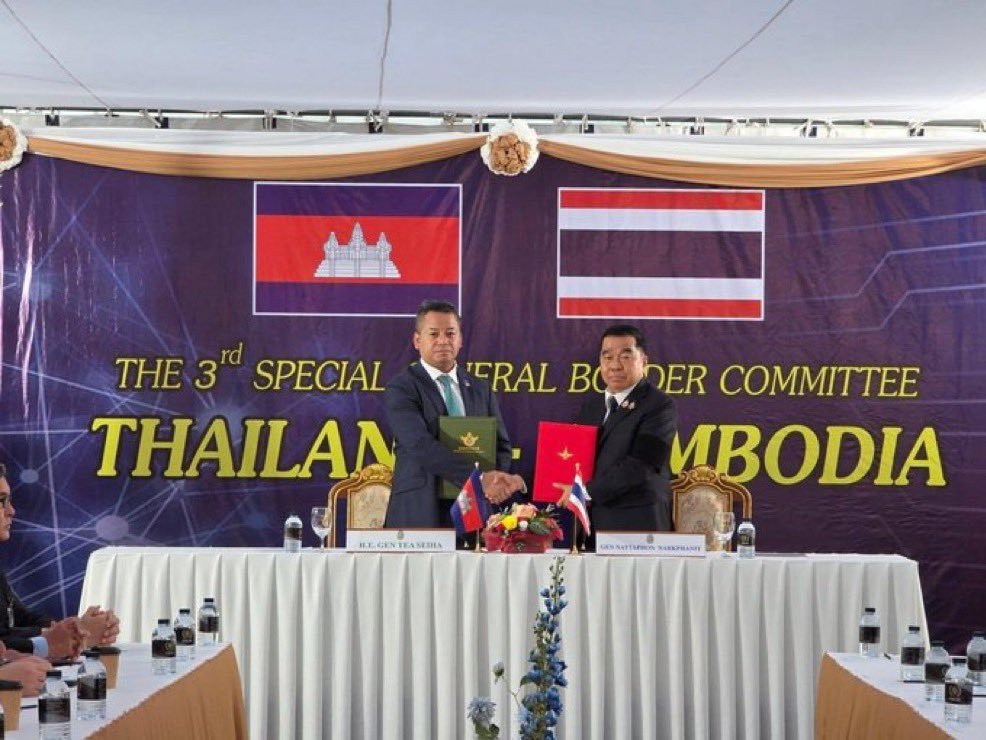
BANGKOK: Thailand and Cambodia signed a new ceasefire agreement on Saturday aimed at ending weeks of intense fighting along their disputed border, seeking to contain an escalation that has displaced hundreds of thousands of civilians on both sides.
The ceasefire took effect at noon local time (0500 GMT) and mandates an immediate halt to military movements and any use of airspace for combat purposes. According to Cambodia’s Defense Ministry, Thailand had carried out airstrikes against Cambodian positions as recently as Saturday morning, making Bangkok the only side to have employed air power during the latest round of hostilities.
Under the agreement, Thailand has committed to repatriate 18 Cambodian soldiers captured during clashes in July, provided the ceasefire holds for at least 72 hours. Their return has been a central demand from Phnom Penh. However, just hours after the signing, Thailand’s Foreign Ministry lodged a formal protest, saying a Thai soldier had suffered permanent disability after stepping on an anti-personnel land mine that Bangkok alleges was newly laid by Cambodian forces.
The accord was signed at a border checkpoint by Cambodia’s Defense Minister Tea Seiha and Thailand’s Defense Minister Nattaphon Narkphanit, following three days of lower-level military talks. It reaffirms both sides’ commitment to an earlier ceasefire that halted five days of fighting in July, as well as subsequent follow-up agreements.

That July truce was brokered by Malaysia and reinforced by pressure from then U.S. President Donald Trump, who warned that trade privileges could be withdrawn if the two neighbors failed to halt hostilities. The ceasefire framework was later elaborated in October at a regional meeting in Malaysia attended by Trump.
Despite those understandings, relations between Bangkok and Phnom Penh deteriorated in recent months. A sustained propaganda war and sporadic border incidents continued, eventually flaring into heavy fighting in early December. On Saturday, U.S. Secretary of State Marco Rubio welcomed the new ceasefire and urged both countries to fully implement the agreement and honor earlier commitments reached in Malaysia.
The human cost of the fighting has been significant. Thai officials say 26 soldiers and one civilian have been killed since Dec. 7, with 44 civilian deaths also reported. Cambodia has not released official military casualty figures but says 30 civilians have been killed and 90 wounded. The clashes have forced the evacuation of hundreds of thousands of residents from border areas on both sides.
“Today’s ceasefire also paves the way for displaced people living in the border areas to return to their homes, work in the fields, and allow their children to resume schooling,” Tea Seiha said after the signing. Both governments, however, continue to accuse each other of initiating the violence and insist their forces acted in self-defense.
Land mines remain a major point of contention. The agreement calls on both sides to comply with international conventions banning their deployment. Thailand says its soldiers have been wounded in at least 10 incidents this year by what it claims are newly planted Cambodian mines. Cambodia counters that the explosives are remnants from decades of civil war that ended in the late 1990s.
Following the latest injury, Thailand’s Foreign Ministry said the ceasefire includes provisions for joint humanitarian demining operations to protect civilians and troops. Another clause commits both sides to refrain from spreading “false information or fake news,” a nod to the information warfare that has accompanied the conflict. READ FULL MAGAZINE HERE;
The deal also provides for renewed efforts to demarcate the long-disputed border and for cooperation against transnational crimes, particularly online scam networks that have defrauded victims worldwide of billions of dollars—an issue on which Cambodia has faced sustained international scrutiny.
Malaysian Prime Minister Anwar Ibrahim, who played a key role in mediating earlier talks, said the agreement reflected a shared understanding that restraint was essential, especially to protect civilians. Still, skepticism remains. Many of the provisions echo clauses in the October ceasefire that were only partially implemented.
Thailand’s Defense Ministry spokesperson Surasant Kongsiri underscored the fragility of the new truce, saying the safe return of displaced civilians would be a key indicator of stability before the captured Cambodian soldiers are released. “The 72-hour ceasefire is not an act of trust,” he said, “but a period to prove whether Cambodia can truly cease the use of weapons, provocations, and threats in the area.”
–Sopheng Chin
READ FULL MAGAZINE HERE (360 DEGREE VIEW ON GEOPOLITICS, WORLD ECONOMY & GLOBAL POLICY)