


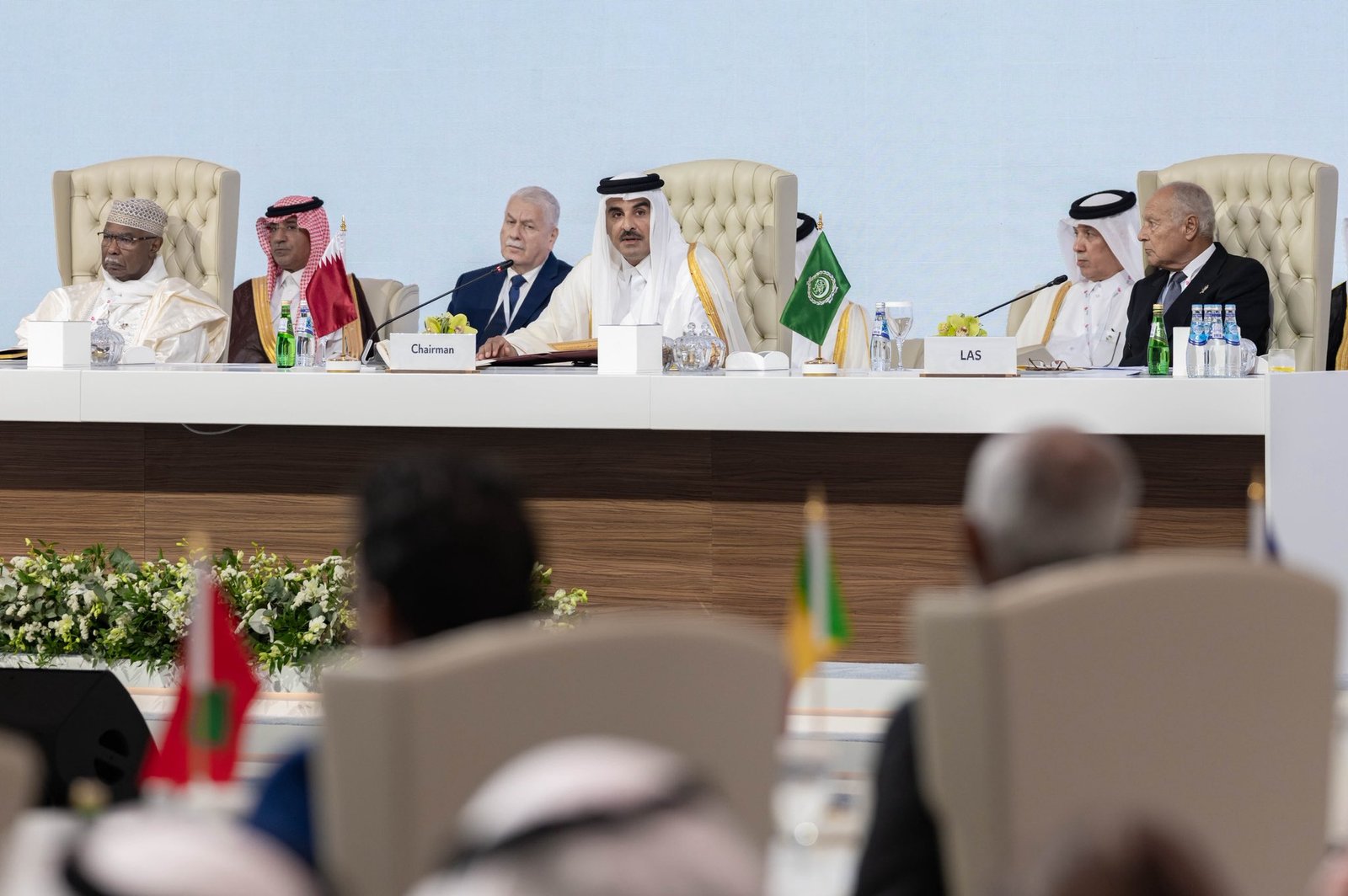
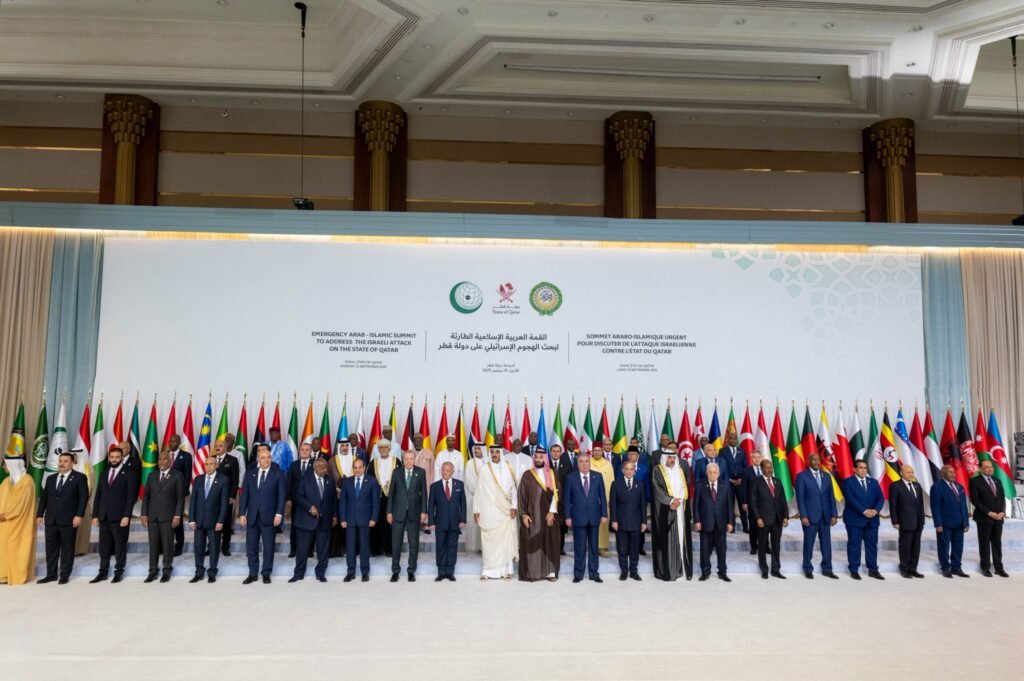
DOHA. Qatar: Leaders from across the Arab and Muslim world converged in Doha on Monday in what many analysts are already describing as the most consequential regional gathering in two decades. The emergency summit, jointly convened by the Arab League and the Organization of Islamic Cooperation, followed Israel’s strike on the Qatari capital that killed five Hamas members and a Qatari security officer. The attack, which narrowly missed a Hamas team engaged in ceasefire talks, was seen not only as an assault on Palestinian interests but also as a direct violation of Qatar’s sovereignty.
Emir Sheikh Tamim bin Hamad Al Thani opened the summit with pointed words that left no ambiguity about his stance. “Netanyahu dreams of the Arab region becoming an Israeli sphere of influence, and this is a dangerous illusion,” he declared. He invoked the memory of the 2002 Arab Peace Initiative, which had offered Israel recognition and normalization in exchange for withdrawal from occupied Arab territories. “If Israel had accepted the Arab Peace Initiative, it would have spared the entire region countless tragedies,” he said, reminding delegates that the failure was not Arab reluctance but Israeli rejection.
Qatar’s Prime Minister Sheikh Mohammed bin Abdulrahman bin Jassim Al Thani went further in underlining that Israel’s strike would not go unanswered. “We appreciate the solidarity of brotherly Arab and Islamic countries and friendly countries from the international community that condemned this barbaric Israeli attack,” he told reporters before the summit, pledging that Doha would pursue “legitimate legal measures to preserve the sovereignty of our country.” His words underscored Qatar’s intention to frame the incident not only as part of the Gaza war but also as a test case for defending the integrity of smaller states in a volatile region.
Pakistan’s delegation arrived in Doha with a message of urgency. Foreign Minister Mohammad Ishaq Dar pressed for what he called a “clear roadmap to deal with this situation,” noting that the Muslim world was “all eyeing this summit, waiting to see what comes out of it.” Defence Minister Muhammad Asif, speaking two days earlier, was even more explicit. “Firm action is required in response to Israel, and no country should think it will remain untouched by the Gaza war,” he warned. Dar, when asked about concrete steps, suggested that “a sort of combined security force type” was already being discussed, adding, “a nuclear-powered Pakistan obviously would stand as a member of the Ummah. It will discharge its duty.”
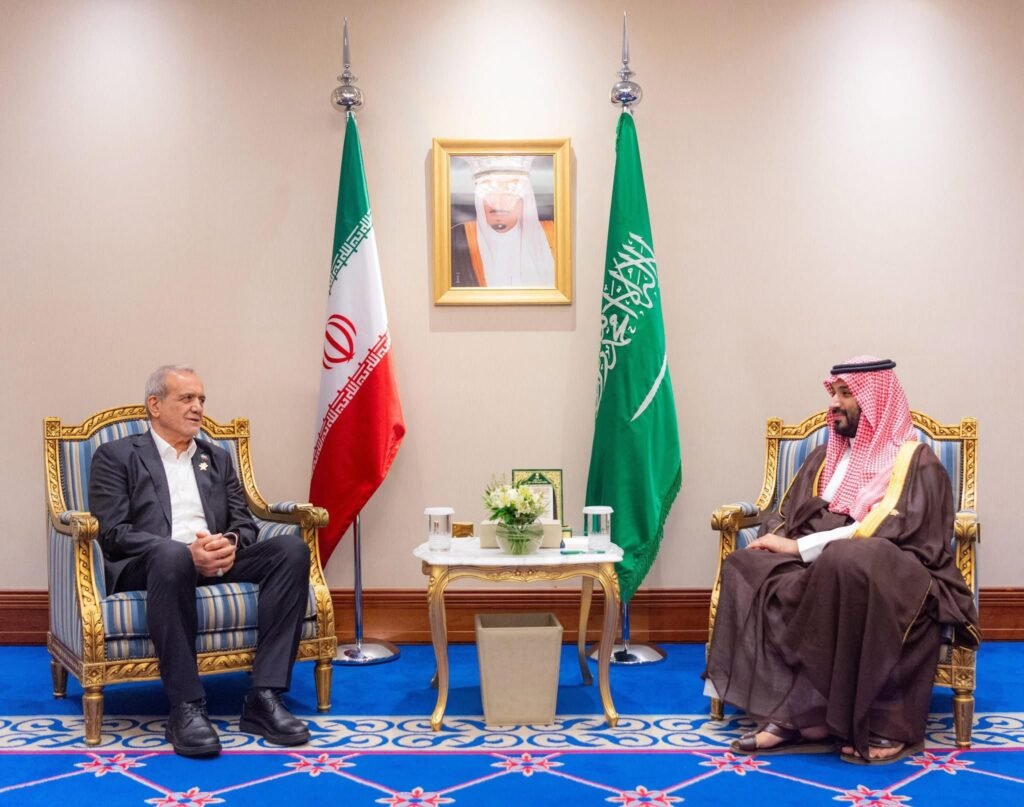
Iran’s president Masoud Pezeshkian called for an uncompromising stance before boarding his flight to Doha. “Islamic countries can sever ties with this fake regime and maintain unity and cohesion,” he said, framing the conflict as a litmus test of Muslim solidarity. His appeal resonated with hardliners but also highlighted the challenge of reconciling radical proposals with the pragmatic diplomacy pursued by Gulf states in recent years.
Saudi Arabia’s Crown Prince Mohammed bin Salman entered the summit as a central figure, underscoring Riyadh’s role as both power broker and guardian of Arab consensus. Leading the Saudi delegation, he engaged in a flurry of bilateral meetings on the sidelines with figures including Iranian President Pezeshkian, Syrian President Ahmed al-Sharaa, Jordan’s King Abdullah II, Pakistani Prime Minister Shehbaz Sharif, Iraqi Prime Minister Mohammed Shia al-Sudani, and Turkish President Recep Tayyip Erdogan. The symbolism of these encounters was unmistakable. For the first time in years, Saudi Arabia’s leadership was seen bridging divides between rival blocs, from Iran to Turkey to Pakistan, while also maintaining its influence over traditional allies.

Observers note that the Crown Prince’s outreach to Pezeshkian is particularly significant. Only months ago, relations between Saudi Arabia and Iran were defined by suspicion. Now, a new détente has created space for dialogue, and the Doha summit has provided a stage for this fragile thaw to evolve into strategic cooperation. Analysts suggest that Riyadh’s calculus is driven by the need to prevent escalation from spiraling into a regional war that could destabilize energy markets and derail Saudi Arabia’s Vision 2030 economic plans.
What unites the participants in Doha is a shared recognition that Israel’s strike has changed the political equation. For Qatar, it is about sovereignty. For Iran, it is about resistance. For Pakistan, it is about collective defense. For Saudi Arabia, it is about leadership. And for populations across the region, it is about dignity. As the summit draws to a close, expectations are high that leaders will translate fiery speeches into coordinated measures. “This summit must not be remembered as another missed opportunity,” one Arab diplomat remarked privately. “The people have heard enough statements. They are waiting for action.”
Whether Doha becomes a turning point or simply another episode in the long history of Arab summits will depend on what emerges from the final communique. But already the gathering has exposed the urgency of the moment: Israel’s attack on Qatar has galvanized an unusually broad consensus across the Arab and Muslim world, placing unprecedented pressure on leaders to rise above divisions. For once, the choice between unity and fragmentation may not be rhetorical, it may determine the trajectory of the entire region.
— WNN Op-Ed. | Dr. Shahid Siddiqui | Follow on X @shahidsiddiqui












I don’t think the title of your article matches the content lol. Just kidding, mainly because I had some doubts after reading the article.