


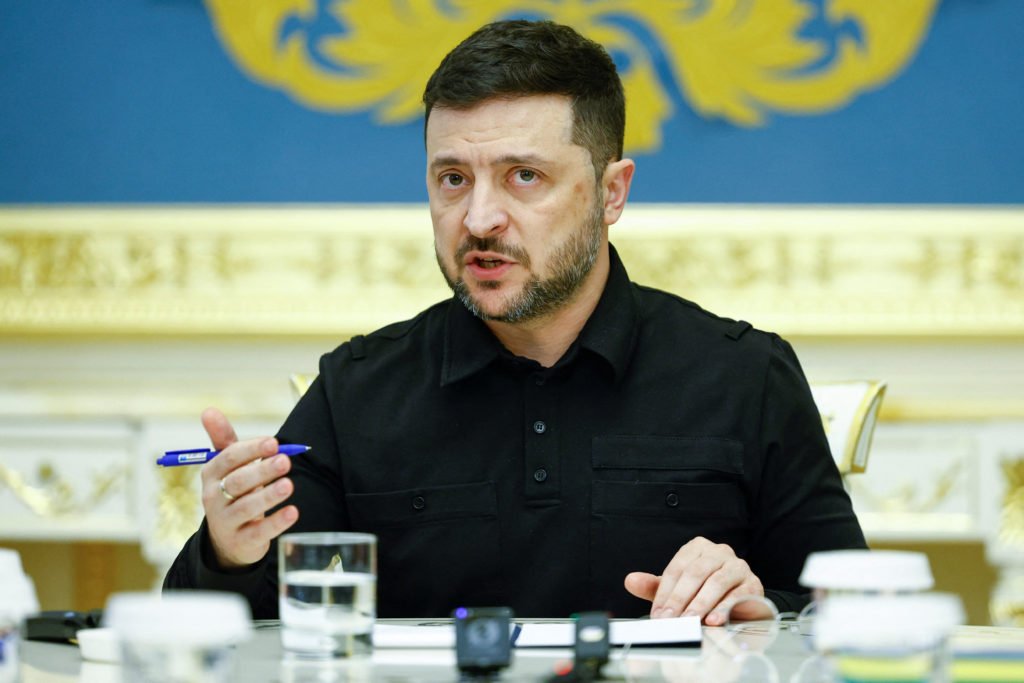
PALM BEACH, Florida: Ukrainian President Volodymyr Zelenskiy is set to hold direct talks with U.S. President Donald Trump in Florida on Sunday in a bid to push forward a plan to end the war in Ukraine, even as sharp disagreements persist over territory and Russia steps up military pressure on Kyiv.
The meeting comes against the backdrop of intensified Russian strikes. On Saturday, Russia unleashed a fresh wave of missiles and drones on Kyiv and other Ukrainian cities, knocking out electricity and heating in parts of the capital. Zelenskiy described the attacks as Moscow’s response to ongoing U.S.-brokered peace efforts.
Zelenskiy has said the talks at Trump’s Florida residence will focus on the future of eastern Ukraine’s contested Donbas region, the status of the Zaporizhzhia nuclear power plant, and other unresolved elements of the proposed settlement. The Ukrainian leader arrived in Florida late Saturday with his delegation, Deputy Foreign Minister Serhiy Kyslytsya confirmed on X, posting a photo of an aircraft bearing the U.S. president’s surname and writing, “Good evening, Florida!”
Moscow has maintained a hard line, repeatedly insisting that Ukraine surrender the entire Donbas, including areas still under Kyiv’s control. Russian officials have also rejected key parts of the emerging proposal, raising doubts about whether President Vladimir Putin would accept any agreement that might result from Sunday’s discussions.
Putin said on Saturday that Russia would continue fighting if Kyiv failed to seek a swift peace on Moscow’s terms. Russian forces have made steady gains in recent weeks, and the Defence Ministry in Moscow claimed on Sunday that additional settlements had fallen under Russian control.
Zelenskiy told Axios on Friday that he is still trying to soften a U.S. proposal that would require Ukrainian forces to withdraw fully from the Donbas. If that effort fails, he said the entire 20-point peace plan crafted after weeks of negotiations should be put to a nationwide referendum. According to Axios, U.S. officials see Zelenskiy’s openness to a referendum as a meaningful shift, suggesting he is no longer ruling out territorial compromise. Zelenskiy, however, has insisted that any such vote would require Russia to agree to a 60-day ceasefire to allow Ukraine time to prepare. Recent polling suggests Ukrainian voters may still reject the plan.
On the streets of Kyiv, reactions to the talks were mixed. “Of course I want this to end, but that’s only what we want,” said Stanyslav, a 44-year-old soldier who declined to give his surname. “We don’t really have leverage here.”
The meeting, scheduled for 1 p.m. (1800 GMT), caps weeks of intense diplomacy. European allies, sometimes sidelined in the negotiations, have increased efforts to define what post-war security guarantees for Ukraine might look like, with backing from the United States. Ahead of the talks, Zelenskiy wrote on X that “a lot can be decided before the New Year,” but stressed that peace would depend on strong and lasting support from Ukraine’s partners.
While Kyiv and Washington are aligned on much of the plan Zelenskiy said it is roughly 90% complete, the territorial question remains the central obstacle. Russia demands full control of the Donbas, while Ukraine wants any deal to freeze the conflict along current front lines. The United States has floated a compromise involving a free economic zone if Ukraine withdraws from the area, though details remain vague.
Washington has also proposed shared control of the Zaporizhzhia nuclear power plant. The International Atomic Energy Agency said on Sunday that repairs to power lines at the site have begun following another limited ceasefire brokered by the agency.
Zelenskiy and several European leaders remain wary that Trump could pursue a deal that favors Moscow, potentially leaving Europe to shoulder the long-term costs of supporting a war-ravaged Ukraine. Russian forces are estimated to have seized between 12 and 17 square kilometers of Ukrainian territory per day in 2025.
Russia currently occupies all of Crimea, annexed in 2014, and about 12% of Ukraine’s territory overall since the full-scale invasion nearly four years ago. This includes most of the Donbas, large portions of the Zaporizhzhia and Kherson regions, and smaller areas in the Kharkiv, Sumy, Mykolaiv, and Dnipropetrovsk regions, according to Russian figures.
Putin said on December 19 that any peace deal must be based on conditions he laid out in 2024, including Ukraine’s withdrawal from the Donbas, Zaporizhzhia, and Kherson regions, and Kyiv formally abandoning its bid to join NATO.
Ukrainian officials and European leaders continue to frame the war as an imperial-style land grab by Moscow, warning that a Russian victory could embolden the Kremlin to challenge NATO members in the future.
The current 20-point proposal evolved from an earlier 28-point plan linked to Russian-backed talks involving U.S. special envoy Steve Witkoff, Trump’s son-in-law Jared Kushner, and Russian envoy Kirill Dmitriev, which became public in November. Subsequent negotiations produced a version seen as more acceptable to Kyiv.
European Commission President Ursula von der Leyen said after speaking with Zelenskiy and other European leaders on Saturday that their shared objective remained “a just and lasting peace” that preserves Ukraine’s sovereignty and territorial integrity while strengthening its security and defense capabilities.
Zelenskiy said he plans further consultations with European leaders after his meeting with Trump.
-Andrea Shalal and Gram Slattery