



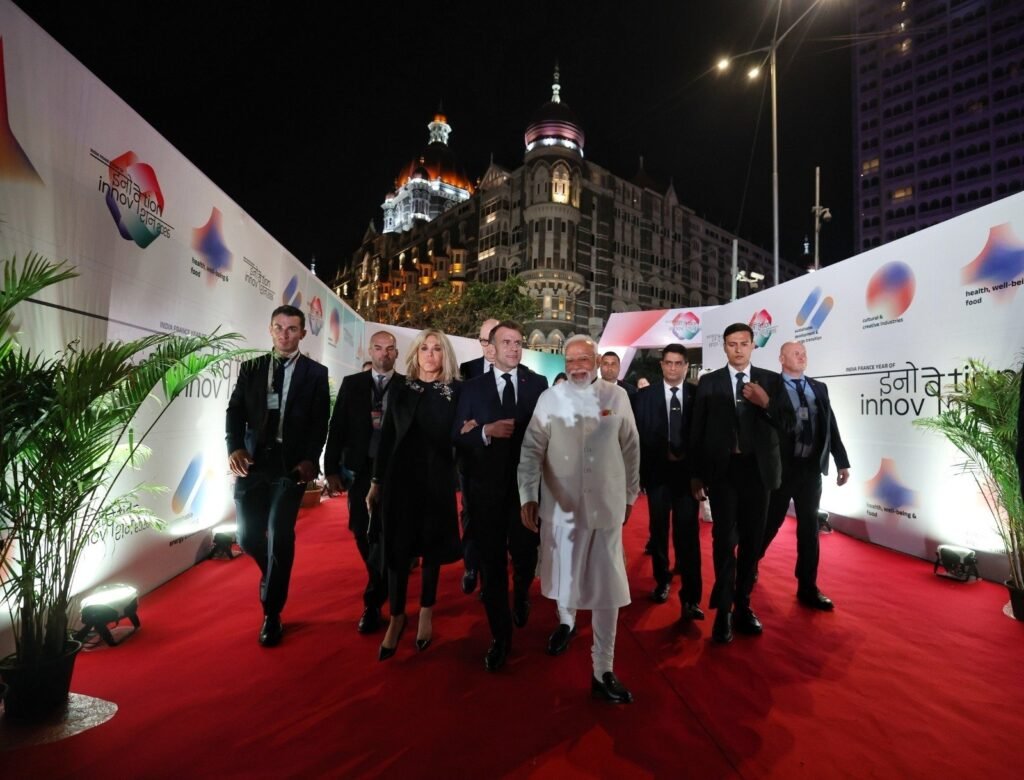
MUMBAI/NEW DELHI: When Emmanuel Macron arrived in New Delhi at the invitation of Prime Minister Narendra Modi, the symbolism was layered and deliberate. The visit coincided with a major Artificial Intelligence summit and culminated in the elevation of bilateral ties to a Special Global Strategic Partnership. But beneath the ceremony lies a deeper geopolitical recalibration.
India and France are not merely expanding cooperation. They are aligning around a shared worldview: that sovereignty in the 21st century will be defined not only by territory and military strength, but by control over technology, supply chains, energy systems and institutional rule-making.
Each pillar of the partnership reflects this emerging doctrine.
AI Diplomacy as Strategic Statecraft
Artificial intelligence has become a central variable in global power distribution. From battlefield autonomy and cyber warfare to financial markets and public governance, AI systems now shape national competitiveness and strategic leverage.
India’s decision to anchor Macron’s visit around an AI summit reflects recognition that technology governance is no longer a peripheral issue — it is geopolitical infrastructure. Hosting a high-level AI gathering signals that India seeks a seat at the table where global norms are shaped, not merely implemented.
France, for its part, has been vocal about “digital sovereignty” within Europe. Macron has consistently argued that Europe must reduce dependence on external technology platforms and develop its own innovation ecosystems. This mirrors India’s pursuit of strategic autonomy in digital infrastructure, including indigenous platforms and regulatory frameworks.
Yet their approaches are not identical. The European Union’s regulatory architecture particularly around data protection and AI risk classification emphasizes precaution. India’s model is more developmental and flexible, prioritizing innovation scalability and digital inclusion.
The challenge and opportunity lies in convergence. If India and France can harmonize regulatory philosophies while sustaining innovation momentum, they could influence AI governance frameworks across the Global South and parts of Europe.
This would reshape the global technology debate from a binary US–China rivalry into a more pluralistic order.
Institutionalizing Strategic Convergence
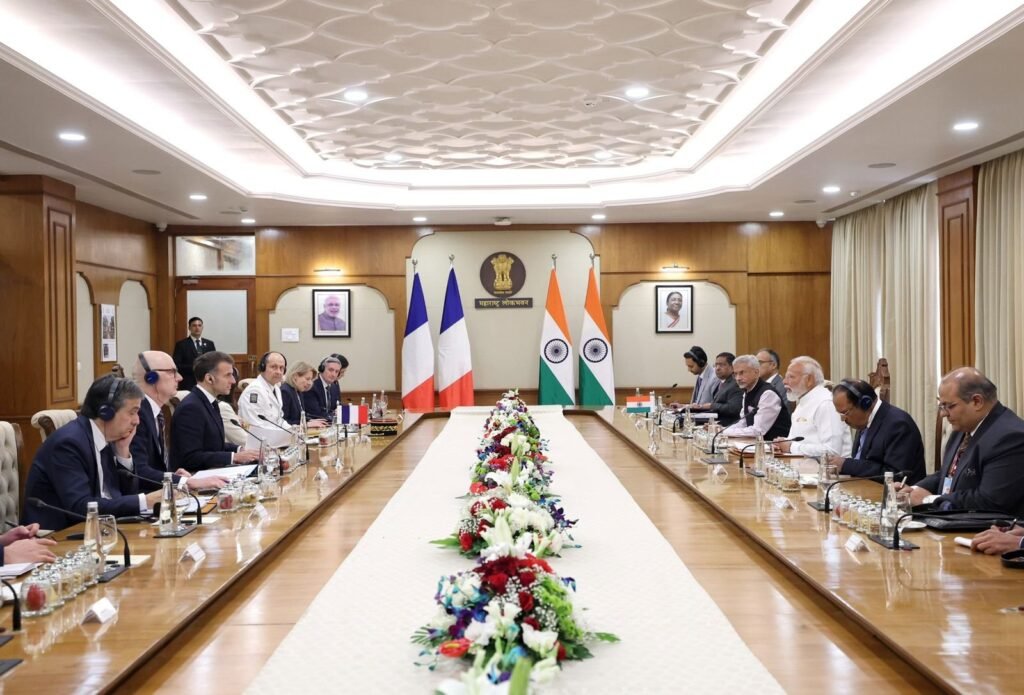
The elevation of ties to a Special Global Strategic Partnership is structurally significant. Strategic partnerships often remain aspirational. What distinguishes this upgrade is its embedded institutional architecture including annual foreign ministers’ reviews and the Horizon 2047 roadmap.
The India–France relationship dates back to 1998, when France maintained engagement despite India’s nuclear tests. That political decision fostered trust during a moment of international isolation. Over the decades, defence cooperation deepened through platforms such as the Rafale fighter aircraft and Scorpène submarine projects.
Today’s shift goes further. It reflects not merely arms procurement but systemic integration across industrial, technological and geopolitical domains.
Both countries share a commitment to multipolarity. France seeks greater European strategic autonomy within — but not outside — NATO. India balances relations with Western powers, Russia and regional actors without entering formal alliances.
This convergence of strategic philosophies gives their partnership durability beyond electoral cycles.
Defence Industrial Integration: Beyond Buyer–Seller Dynamics
Defence cooperation is the most mature pillar of the relationship, but it is now entering a transformative phase.
The inauguration of the H125 helicopter final assembly line in Karnataka marks a significant industrial milestone. It moves India from being primarily a customer to becoming part of the manufacturing ecosystem. Similarly, the BEL–Safran joint venture for HAMMER missile production indicates a willingness to share production capabilities and technological processes.
Such arrangements align with India’s defence indigenization objectives and France’s interest in diversifying production networks. Co-production builds political trust and creates long-term interdependence far stronger than one-time contracts.
The establishment of a Joint Advanced Technology Development Group suggests a forward-looking approach. Emerging domains such as autonomous systems, electronic warfare and secure communications require collaborative research, not just platform acquisition.
In a volatile Indo-Pacific security environment, deeper interoperability also enhances deterrence credibility. France’s overseas territories and naval presence in the region make it a resident Indo-Pacific power. India, geographically central to the Indian Ocean, views maritime security as existential.
Together, they represent a stabilizing axis that is not alliance-bound but strategically coordinated.
Critical Minerals: Securing the Foundations of Modern Power
Behind advanced defence systems and renewable grids lies an often invisible reality: minerals. Rare earth elements and strategic metals are essential for batteries, semiconductors, precision-guided munitions and wind turbines.
Global supply chains for these resources remain heavily concentrated, creating vulnerabilities. By committing to cooperation on critical minerals, India and France acknowledge that technological sovereignty depends on upstream resource security.
For India, expanding electric mobility and renewable energy targets requires diversified access to lithium, cobalt and rare earths. France, representing broader European concerns, seeks to reduce strategic dependencies and secure alternative supply corridors.
This collaboration extends beyond extraction to recycling and processing sectors often overlooked but strategically decisive.
In geopolitical terms, mineral diplomacy is emerging as the 21st century equivalent of energy diplomacy in the 20th century.
Energy Security, Nuclear Power and Climate Strategy
Energy independence remains foundational to strategic autonomy. France’s energy model with a majority of electricity derived from nuclear power offers lessons in balancing decarbonization with reliability.
India’s energy demand is expanding rapidly as industrialization accelerates. Renewable energy capacity is growing, but intermittency challenges persist. Nuclear cooperation therefore becomes a stabilizing component of the energy mix.
Discussions around large reactors and Small Modular Reactors (SMRs) are particularly significant. SMRs promise scalability, reduced construction times and enhanced safety features. If deployed effectively, they could become central to India’s long-term energy transition.
In parallel, both countries have championed international climate initiatives, reinforcing a belief that climate leadership must coexist with national development priorities.
Energy policy here is not merely environmental, it is geopolitical calculus.
Digital Public Infrastructure and Developmental AI
India’s digital public infrastructure spanning biometric identification, digital payments and service delivery has become a template for scalable technology deployment in emerging economies.
Integrating AI into this architecture raises both opportunities and risks. AI-driven health diagnostics, agricultural forecasting and public service optimization could accelerate development. But data governance and ethical safeguards remain critical.
The Indo-French AI in Health initiative and research partnerships in digital sciences represent practical steps toward applied collaboration. By embedding AI into public health systems rather than purely private platforms, the partnership reflects a citizen-centric model of technological progress.
France’s regulatory expertise and India’s scale could, together, influence how AI is deployed in emerging markets.
The Indo-Pacific Equation and Multipolar Stability
Strategically, the Indo-Pacific remains the most contested theatre of global power politics. France maintains naval deployments and territorial interests across the region. India anchors the Indian Ocean.
Their cooperation reinforces maritime security, freedom of navigation and regional capacity-building. Importantly, this alignment operates outside rigid alliance structures.
Such flexibility is critical. India maintains defence ties with the United States and legacy equipment links with Russia. France remains embedded within NATO and European security frameworks.
The India–France axis demonstrates that multipolar stability can be constructed through layered partnerships rather than exclusive blocs.
France’s consistent support for India’s aspiration for permanent membership in a reformed UN Security Council reflects recognition of shifting power realities.
India’s demographic weight, economic growth trajectory and technological ambitions make it increasingly central to global governance discussions. Engagement in G7 outreach formats further acknowledges this transition.
However, reform of multilateral institutions remains slow. Diplomatic endorsements must translate into coalition-building and structural negotiations.
If India and France can align reform agendas within broader coalitions, they may accelerate momentum for institutional modernization.
Constraints and Implementation Risks
Ambition alone does not guarantee transformation.
Industrial co-production requires regulatory alignment, skilled workforce development and sustained investment. AI governance frameworks must balance innovation incentives with ethical safeguards. Supply chain diversification demands long-term financing and geopolitical stability.
Additionally, automation-driven AI deployment could disrupt labor markets in India, requiring proactive workforce adaptation strategies.
Strategic convergence will only succeed if backed by consistent execution.
A Geopolitical Inflection Point
The expanded India–France partnership reflects a broader trend: middle and major powers constructing cross-regional coalitions to navigate superpower rivalry.
This is not an alliance against anyone. It is an assertion of autonomy within an interconnected world.
Algorithms, energy systems, mineral supply chains and defence industrial bases are now instruments of statecraft. By aligning across these domains, India and France are attempting to shape — rather than simply respond to — the evolving international order.
Whether this strategic reset becomes a defining geopolitical axis will depend on sustained implementation. But the direction is clear.
In an era defined by technological disruption and geopolitical flux, partnerships built on autonomy, innovation and shared strategic philosophy may prove the most resilient architecture of all.
– Dr. Shahid Siddiqui; follow via X @shahidsiddiqui