



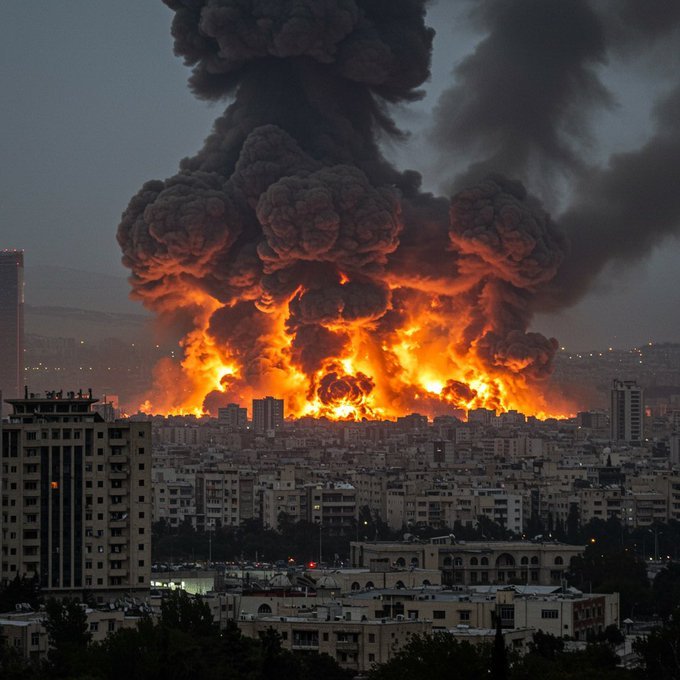
WASHINGTON/TEHRAN: When Israeli Prime Minister Benjamin Netanyahu long warned that Iran’s leadership posed an existential threat to Israel, critics accused him of threat inflation. Today, after unprecedented U.S.-Israeli strikes that decapitated key elements of Iran’s senior command structure, the debate is no longer about whether confrontation would come, but whether those who initiated it have a coherent plan for what follows.
The joint campaign has exposed subtle but consequential differences between Washington and Jerusalem. It has also drawn in regional actors such as Saudi Arabia, whose cautious positioning underscores the risks of a widening war. What began as a show of force to degrade Iran’s military capabilities now risks evolving into a test of strategic discipline and political restraint.
Divergent Objectives Beneath Public Unity
At the outset, U.S. President Donald Trump and Netanyahu projected unity. Public statements framed the operation as decisive and necessary. Yet within days, differences in emphasis became visible.
From the White House, Trump articulated concrete military objectives: dismantling Iran’s missile capabilities, neutralizing naval assets, and preventing the country from obtaining a nuclear weapon. The Pentagon reinforced that the operation was not officially a regime-change war.
Netanyahu’s rhetoric has been broader. He has repeatedly framed the campaign as an opportunity for Iranians to “take control of their destiny,” language widely interpreted as encouragement for internal political upheaval.
These are not identical goals.
Destroying missile launchers and degrading naval assets are finite military tasks. Regime change is an open-ended political ambition. U.S. defense doctrine since Iraq has treated forced regime change with caution, given the destabilizing aftermath seen in Baghdad and, later, in Libya. Verified U.S. government statements in recent years across administrations have consistently emphasized deterrence and nonproliferation over political engineering in adversary states.
That distinction matters now.
If Washington’s core objective is preventing nuclear weaponization and limiting regional escalation, it may consider the mission accomplished once those capabilities are significantly degraded. Jerusalem, however, may view partial measures as insufficient so long as the Islamic Republic remains structurally intact.
The Domestic Constraints on Washington
American foreign policy does not operate in a vacuum. Public opinion, economic impact, and electoral politics constrain presidential decision-making.
Polling from established organizations such as Pew Research Center and Ipsos has shown fluctuating and increasingly polarized American views on Middle East conflicts. Support for direct military involvement tends to decline when operations appear prolonged or when domestic economic effects become tangible.
Energy markets provide a measurable indicator. Disruptions in the Strait of Hormuz through which roughly a fifth of global oil supply passes, according to the U.S. Energy Information Administration have historically driven price volatility. Even modest increases at the pump can carry outsized political consequences in the United States.
History suggests that presidents recalibrate foreign engagements when domestic costs rise. The Obama administration’s caution after Libya and the Trump administration’s earlier reluctance to pursue sustained ground conflicts both reflected lessons drawn from Iraq and Afghanistan.
If the current campaign threatens to become protracted, Washington may seek a defined endpoint sooner than Jerusalem anticipates.
Netanyahu’s Political Incentives
Netanyahu’s political context is equally consequential.
The October 7, 2023 attacks by Hamas which killed more than 1,200 Israelis, according to Israeli government figures profoundly damaged public confidence in the country’s security establishment. The subsequent war in Gaza has imposed heavy military and economic costs on Israel. Palestinian health authorities report tens of thousands of deaths in Gaza, while Israeli officials have acknowledged significant military casualties of their own.
Netanyahu, Israel’s longest-serving prime minister, faces both electoral uncertainty and an ongoing corruption trial, which he denies. Analysts at Israeli institutions such as the Israel Democracy Institute have documented growing political fragmentation and declining public trust in leadership across party lines.
In this environment, confronting Iran long portrayed by Netanyahu as the strategic epicenter of regional hostility offers a chance to reshape the narrative. A successful, limited campaign that weakens Iran’s capacity to arm proxies like Hezbollah and Hamas could bolster his credentials.
But prolonged instability or economic fallout could erode support further. Israeli political history demonstrates that security successes can strengthen incumbents, but drawn-out conflicts without clear resolution can just as easily weaken them.
Saudi Arabia’s Calculated Distance
Saudi Arabia’s position reveals the broader regional complexity.
The Kingdom has been a principal rival of Iran for decades, competing for influence across Yemen, Lebanon, Iraq, and Syria. Yet in 2023, Riyadh and Tehran restored diplomatic ties in a China-brokered agreement, signaling a shift toward de-escalation.
Recent reporting from The Washington Post indicates that Saudi officials have privately expressed concern about the trajectory of the U.S.-Israeli campaign, even as they reinforce defensive measures. Public Saudi statements have emphasized restraint and regional stability.
This posture is consistent with Saudi Arabia’s economic priorities. Vision 2030, Crown Prince Mohammed bin Salman’s flagship modernization program, depends on foreign investment and stable energy markets. A regional war that threatens oil infrastructure as seen in the 2019 attacks on Saudi facilities attributed by U.S. officials to Iran runs counter to Riyadh’s economic strategy.
The Kingdom thus faces a strategic paradox: it benefits from a weaker Iran, but it fears the unpredictable consequences of systemic collapse or prolonged conflict.
Saudi caution also signals to Washington that regional partners are not uniformly enthusiastic about maximalist objectives.
The Regime Change Question
The most critical strategic issue is whether regime change explicit or implied is either feasible or desirable from Washington’s perspective.
Modern history offers sobering precedents. The U.S.-led invasion of Iraq in 2003 removed Saddam Hussein but unleashed sectarian conflict and long-term instability. The NATO-backed intervention in Libya toppled Muammar Gaddafi but left fragmented governance. Even in cases where authoritarian regimes collapsed internally, such as during the Arab Spring, outcomes were uneven and often turbulent.
U.S. policy documents over the past decade have consistently emphasized preventing nuclear proliferation and countering terrorism rather than restructuring adversarial political systems.
If Israel’s ambition extends to fundamentally reshaping Iran’s internal order, it may find limited appetite in Washington for that level of engagement.
The Risk of Strategic Drift
Wars often begin with clarity and end in ambiguity. Mission creep is not always deliberate; it can emerge gradually as tactical decisions accumulate without a clearly defined political endpoint.
Military degradation alone does not guarantee deterrence. Nor does leadership decapitation ensure systemic change. If Iran retains sufficient institutional coherence to absorb losses and adapt, the conflict could evolve into a protracted cycle of retaliation.
Moreover, Iran’s asymmetric capabilities including cyber operations and proxy networks complicate the picture. Verified assessments from U.S. intelligence agencies in recent years have consistently described Iran’s capacity for cyber disruption and indirect action as significant.
The more expansive the goals become, the harder they will be to achieve without deeper entanglement.
An Alliance Under Stress
The Netanyahu-Trump alignment has already reshaped Middle East geopolitics. It facilitated normalization agreements between Israel and several Arab states and coordinated pressure on Tehran.
But alliances endure not because of personal chemistry alone, but because of shared strategic limits.
If Washington concludes that its objectives preventing nuclear escalation and reestablishing deterrence have been met, it may resist further expansion. If Jerusalem insists that the moment must be pushed to its logical conclusion, friction could emerge.
Saudi Arabia’s careful positioning reinforces that the region is wary of transformative upheaval. Even Iran’s adversaries prefer managed containment to uncontrolled collapse.
The Central Question
The central question is not whether Iran’s military capabilities should be constrained. On that point, there is broad international concern, reflected in years of United Nations resolutions and International Atomic Energy Agency monitoring efforts.
The question is whether the current campaign has a clearly defined political endpoint acceptable to all major stakeholders particularly the United States.
Without one, the risk is not only escalation, but strategic drift.
The Middle East has repeatedly demonstrated that removing a threat is not the same as building stability. If this campaign is to avoid becoming another cautionary chapter in regional history, its architects must articulate and adhere to limits.
Otherwise, what began as a decisive strike could become an open-ended gamble whose consequences extend far beyond Tehran.
-Dr. Shahid Siddiqui