



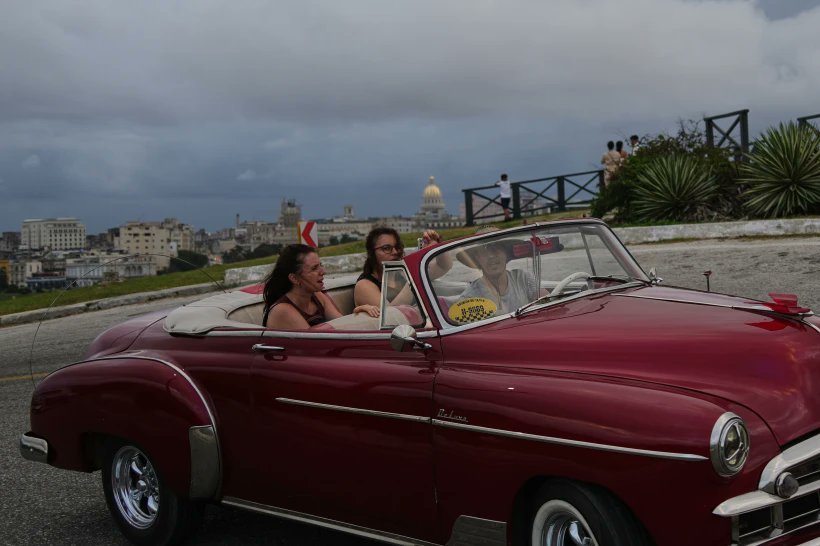
HAVANA: On Havana’s famous waterfront, a small group of tourists step off a bus, snap photos beside classic American cars, and quickly leave. Nearby, drivers wait for customers who rarely arrive.
“This is really bad,” said Reymundo Aldama, a driver of a 1957 Ford Fairlane convertible. “We’re here all day, waiting for work.”
Cuba’s tourism sector — once a pillar of the island’s economy — has suffered a dramatic collapse. Visitor numbers have fallen by nearly 70 percent since 2018, compounding economic hardship at a time when the country is facing acute shortages of fuel, food, and electricity.
For nearly two decades, tourism generated up to $3 billion annually, supporting restaurants, private hostels, transport services, and informal vendors. That momentum unraveled after the COVID-19 pandemic, followed by persistent blackouts, fuel shortages, and tightened U.S. sanctions.
The crisis has deepened further following disruptions in Venezuelan oil shipments, Cuba’s primary energy source, after U.S. military action against Venezuela and the detention of its president. Mexico has also announced a temporary suspension of oil exports to the island, worsening Cuba’s already fragile energy supply.
Economists warn the combined impact of sanctions, energy shortages, and declining tourism could push Cuba into one of its most severe economic contractions in decades.
Daily survival under strain
For 30-year-old Rosbel Figueredo Ricardo, who sells chivirico – a popular fried snack, the downturn is stark. He once sold 150 bags a day; now he carries only 50 and often returns home without selling any.
“I trained as an industrial mechanical technician,” he said. “But this is what I do now to survive.”
With three children and another on the way, Figueredo now seeks customers near embassies, where Cubans line up daily hoping to secure visas to leave the country.
Tourism – once Cuba’s economic engine
From January to November 2025, Cuba received approximately 1.6 million tourists, down sharply from 4.8 million in 2018 and 4.2 million in 2019, before the pandemic.
The decline has hit especially hard because U.S. sanctions reportedly cost Cuba nearly $8 billion in revenue between March 2024 and February 2025, according to government data nearly 50 percent more than the previous year.
Havana’s iconic Malecón, once crowded with foreign visitors, is now mostly occupied by local residents and fishermen. Seaside restaurants stand largely empty, while employees wait for customers who rarely come.
Gaspar Biart, a tourism bus driver with 16 years of experience, said that before the crisis, eight double-decker sightseeing buses ran multiple routes across Havana daily. Today, only four remain, and most depart nearly empty.
“There’s been a huge change,” he said. “What we’re missing are customers. Tourism drives an economy.”
Classic cars, shrinking demand
Classic car drivers, once overwhelmed by demand, now struggle to find passengers. Aldama said he previously worked until 9 p.m. most nights. Now, he is lucky to get one or two customers a day.
He pointed to the 2019 U.S. ban on cruise ships to Cuba as a major turning point, which sharply reduced arrivals from one of the island’s most important tourism segments.
He has cut his prices from $50 per ride to $25 sometimes even $20 just to attract passengers.
“When fuel runs out, we stop driving,” he said. “Then we find something else. There’s no choice.”
Tourists still arrive – cautiously
Some visitors continue to travel to Cuba despite the crisis.
Vincent Seigi, a tourist from Russia, said he expected shortages and disruptions.
“It feels like time has stopped here,” he said, noting the blackouts and lack of mobile connectivity.
He also expressed concern that Cuba’s situation reflects the broader impact of sanctions and geopolitical isolation.
“Politics is not good,” he said. “We already live with sanctions. This could happen anywhere.”
Many Cubans hope that countries such as China or Russia might provide economic support, but observers remain skeptical about the scale of assistance such partners could offer.
Resilience amid hardship
Brazilian tourist Gloraci Passos de Carvalho said she was not deterred by Cuba’s worsening conditions and came to better understand the country’s political and social system.
“What strikes me most is the resilience,” she said. “Surviving with less, making the best of difficult circumstances — that’s what I see here.”
Yet for thousands of Cubans dependent on tourism, resilience alone offers little protection against economic collapse.
As Aldama looked at the empty streets, he said quietly: “We wait. That’s what we do now.”
-Danica Coto
–