



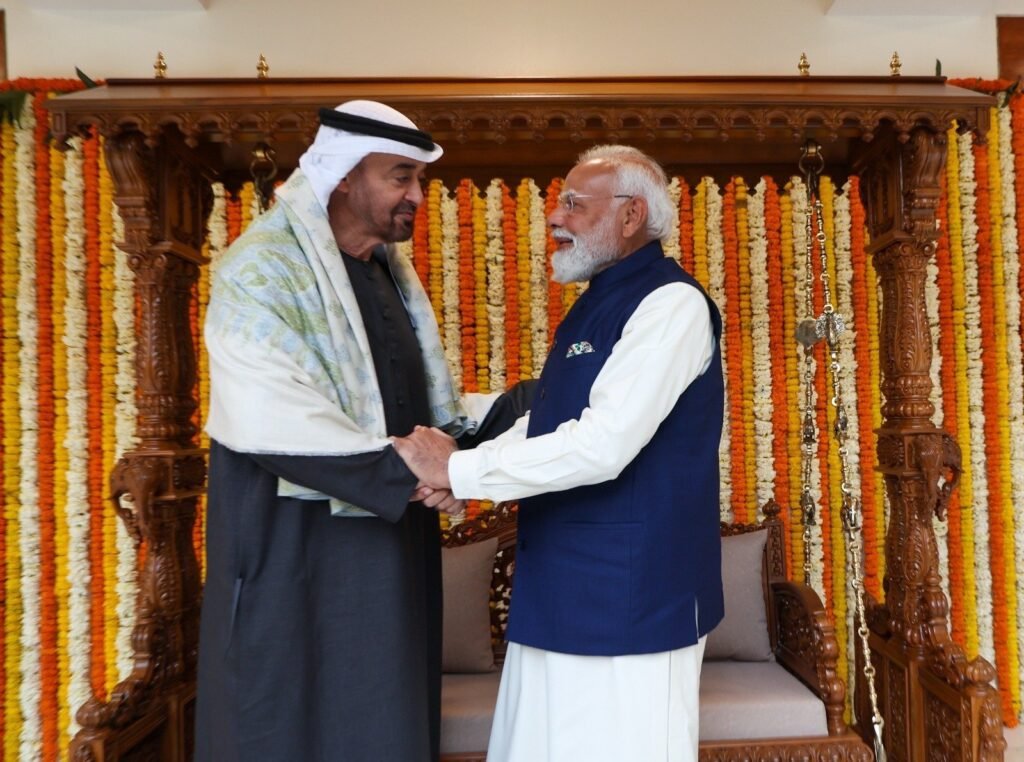
The visit of UAE President Sheikh Mohamed bin Zayed Al Nahyan to India was widely framed as a milestone in the India–UAE Comprehensive Strategic Partnership. Yet beyond the optics and the impressive list of agreements, the visit raises a more consequential question: does this expanding partnership merely reflect tactical alignment, or is it evolving into a durable strategic architecture capable of shaping regional and global outcomes over the long term?
At first glance, the breadth of cooperation is striking. From infrastructure investment and defense collaboration to space, energy, nuclear technology, digital sovereignty, and cultural diplomacy, the visit marked one of the most comprehensive bilateral engagements India has undertaken with any West Asian partner. However, such breadth also brings complexity, and with it, strategic tests.
The proposed UAE partnership in the Dholera Special Investment Region in Gujarat exemplifies both opportunity and challenge. The project’s scope, encompassing an international airport, ports, rail connectivity, smart urban infrastructure, MRO facilities, and energy systems, signals deep Emirati confidence in India’s manufacturing and logistics ambitions. Yet its success will hinge on India’s ability to deliver regulatory clarity, project execution, and long-term policy stability. For the UAE, the investment is not merely economic; it is a bet on India as a future global production and connectivity hub.
Strategic trust is even more evident in defense cooperation. The move toward a Strategic Defence Partnership Framework Agreement covering defense manufacturing, innovation, special operations, cybersecurity, and counter-terrorism marks a qualitative shift. India and the UAE are no longer limiting engagement to procurement or training; they are entering domains that require sustained intelligence sharing, interoperability, and political alignment. Over time, this could reshape India’s security engagement in West Asia, but it also demands careful calibration to avoid entanglement in regional rivalries.
Space cooperation and supercomputing initiatives further underscore the forward-looking nature of the partnership. Joint work between IN-SPACe and the UAE Space Agency, along with the proposed supercomputing cluster involving C-DAC and UAE-based G-42, places India–UAE ties squarely in the emerging technology race. However, such cooperation also raises questions around data governance, technology control, and digital sovereignty, especially as both nations seek strategic autonomy in an increasingly contested technological landscape.
Energy cooperation, traditionally the backbone of the relationship, is being redefined. The long-term LNG supply agreement between HPCL and ADNOC Gas provides stability in the short to medium term, but the more transformative signal lies in civil nuclear cooperation. The decision to explore advanced reactors and Small Modular Reactors under India’s SHANTI Act 2025 reflects a shared recognition that future energy security will be driven by cleaner, more resilient technologies. If realized, this could position the India–UAE partnership as a model for energy transition cooperation between producer and consumer nations.
The ambition to double bilateral trade to USD 200 billion by 2032 is bold, but it is also aspirational. Achieving it will require sustained reforms, deeper MSME integration, and the success of initiatives like Bharat Mart and Virtual Trade Corridors. Without structural alignment and trade facilitation at scale, the target risks becoming symbolic rather than transformative.
Equally important, but often underestimated, are the softer dimensions of the visit. Initiatives such as the House of India in Abu Dhabi, youth exchange programs, food safety cooperation, and agricultural trade facilitation indicate a recognition that strategic partnerships cannot rest solely on elite agreements. These measures aim to anchor the relationship socially and culturally, making it more resilient to political shifts.
Perhaps the most strategic and least examined outcome is the proposal to explore digital or data embassies. In an era where data is as critical as territory, such arrangements could redefine sovereignty, trust, and governance in the digital domain. If implemented, this would place India and the UAE among the pioneers of a new model of digital diplomacy.
Taken together, Sheikh Mohamed bin Zayed’s visit signals more than diplomatic warmth. It reflects an emerging strategic convergence shaped by shared interests in stability, growth, and technological leadership. Yet the true test of the partnership will lie in execution, institutional depth, and the ability to manage contradictions between openness and sovereignty, ambition and capacity, regional engagement and strategic autonomy.
In the long term, the India–UAE relationship has the potential to become one of the most consequential cross-regional partnerships of the 21st century. Whether it fulfills that promise will depend not on announcements alone, but on sustained political will, mutual trust, and the capacity to translate strategy into durable outcomes.
— Dr. Shahid Siddiqui; follow via X @shahidsiddiqui
READ THE FULL E-MAGAZINE | WorldAffairs: Inside the Forces Redefining Power, Markets, and the Global Order