


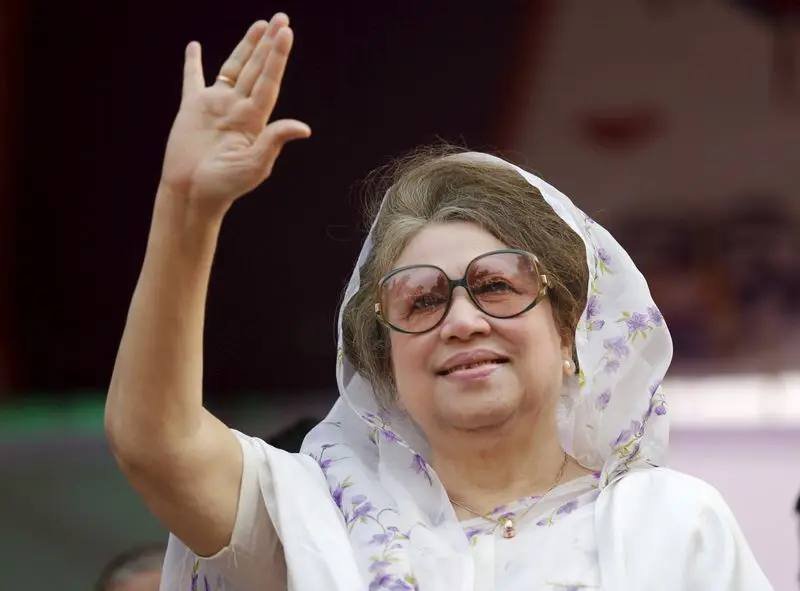
NEW DELHI/ DHAKA: The death of Begum Khaleda Zia at the age of 80 has drawn a definitive line under one of the most formative and divisive chapters in Bangladesh’s political history. A two-time prime minister, founder-leader of mass opposition politics, and half of a rivalry that shaped the country’s democratic evolution for more than three decades, Khaleda’s passing comes at a moment when Bangladesh itself is undergoing an unprecedented political reset.
Reflecting the regional and diplomatic weight of her legacy, India has announced that External Affairs Minister Dr. S. Jaishankar will represent the Government and people of India at her funeral in Dhaka on 31 December 2025. The decision underscores New Delhi’s recognition of Khaleda Zia as a central figure in Bangladesh’s modern political trajectory, even as bilateral relations oscillated under different governments.
Khaleda Zia died after a prolonged illness marked by advanced liver cirrhosis, heart and chest complications, diabetes, and arthritis, according to her doctors. Earlier this year, she spent nearly four months in London undergoing medical treatment before returning to Dhaka in visibly frail health. Her death closes a life that was inseparable from Bangladesh’s post-independence political struggles—and reopens questions about the country’s future direction.
From Personal Tragedy to Political Authority
Khaleda Zia’s entry into politics was neither planned nor ideological. Known in her early life as reserved and family-oriented, she was thrust into national prominence after the assassination of her husband, President Ziaur Rahman, in a failed military coup in 1981. Ziaur Rahman, a former army chief who later legitimised his rule through elections, had founded the Bangladesh Nationalist Party (BNP) as an alternative to the Awami League’s liberation-era dominance. Three years after his death, Khaleda assumed leadership of the BNP, inheriting both its organizational structure and its ideological emphasis on nationalism, sovereignty, and a distinct political identity separate from the Awami League’s historical legacy. Her political rise coincided with Bangladesh’s growing resistance to military rule, and in a rare convergence of interests, she joined forces with Sheikh Hasina daughter of Bangladesh’s founding leader Sheikh Mujibur Rahman to lead the mass democratic uprising that toppled military ruler Hossain Mohammad Ershad in 1990.
That unity proved fleeting.
The Rivalry That Defined a Nation
What followed was one of South Asia’s most enduring and consequential political rivalries. Khaleda Zia and Sheikh Hasina frequently referred to as the “battling Begums”, came to embody two competing visions of power, governance, and legitimacy in Bangladesh. Their rivalry was not merely personal; it became structural, shaping electoral politics, street mobilisation, and institutional behaviour for over three decades.
In the landmark 1991 general election widely regarded as Bangladesh’s first genuinely free and fair poll, Khaleda defeated Hasina, becoming the country’s first female prime minister and only the second woman to democratically lead a Muslim-majority nation after Pakistan’s Benazir Bhutto. Her victory marked the formal restoration of parliamentary democracy, replacing the presidential system and consolidating executive power in the office of the prime minister.
During her first term, Khaleda’s government introduced compulsory and free primary education, eased restrictions on foreign investment, and attempted to stabilise democratic institutions after years of authoritarian rule. Yet power alternated sharply. She lost office in 1996, returned with a landslide victory in 2001, and exited again in 2006 amid deepening political instability.
Her second term remains the most contested chapter of her career. It was marked by the rise of Islamist militant groups, persistent allegations of corruption, and the 2004 grenade attack on an Awami League rally addressed by Sheikh Hasina, which killed more than 20 people and wounded hundreds. While Khaleda’s government denied involvement and later moved against extremist networks, the attack irreversibly poisoned political relations and entrenched mutual distrust.
Detention, Decline, and Political Survival
The political deadlock culminated in 2007 when an army-backed interim government assumed power, jailing both Khaleda Zia and Sheikh Hasina on corruption and abuse-of-power charges. Though both were released ahead of the 2008 elections, only Hasina returned to office going on to dominate Bangladeshi politics for the next 15 years.
Khaleda never regained power. Convicted in 2018 in a corruption case involving an orphanage trust, she was imprisoned and later placed under house arrest as her health deteriorated. The BNP boycotted the 2014 and 2024 elections, arguing that democratic competition had been hollowed out under Hasina’s rule.
Her political fortunes shifted dramatically after August 2024, when a student-led uprising forced Sheikh Hasina from power. Khaleda was freed from house arrest, and in early 2025 Bangladesh’s Supreme Court overturned the convictions that had sent her and her son, Tarique Rahman, to jail. Rahman long in self-exile returned to Bangladesh last week after nearly 17 years abroad and is now widely viewed as the leading contender for prime minister in elections scheduled for February.
A Transformed Political Landscape
Bangladesh today is governed by neither of its historic rivals. Since Hasina’s ouster, an interim administration led by Nobel Peace Prize laureate Muhammad Yunus has been tasked with stabilising the country and restoring democratic credibility. In November, Sheikh Hasina herself was sentenced to death in absentia for her role in the violent crackdown on student protests, an extraordinary reversal that underscores the scale of Bangladesh’s political upheaval.
Khaleda Zia did not live to witness the next electoral contest, but her presence continues to shape it. Her death removes a symbolic anchor for the BNP even as it reinforces the party’s narrative of endurance, victimhood, and political revival.
Legacy and Regional Significance
Supporters remember Khaleda as composed, traditional, and resolute less overtly combative than Hasina, yet unwavering in defence of her party and political space. Critics argue that her tenure deepened polarisation and failed to decisively curb extremism. Both interpretations are woven into Bangladesh’s democratic experience.
India’s decision to be represented at the highest diplomatic level at her funeral reflects not only respect for a former head of government but also recognition of the pivotal moment Bangladesh faces. As New Delhi watches closely the country’s political transition, Khaleda Zia’s passing symbolises the end of an era dominated by personality-driven rivalry and the uncertain beginning of a new phase.
Whether Bangladesh can move beyond the politics of permanent confrontation remains an open question. But with Khaleda Zia’s death, one certainty stands: a chapter that defined a nation has closed, even as the struggle over its future intensifies.
– WNN Newsroom
READ FULL E- MAGAZINE (WORLDAFFAIRS) – A COMPLETE VIEW ON GEOPOLITICS, WORLD ECONOMY & GLOBAL POLICY