

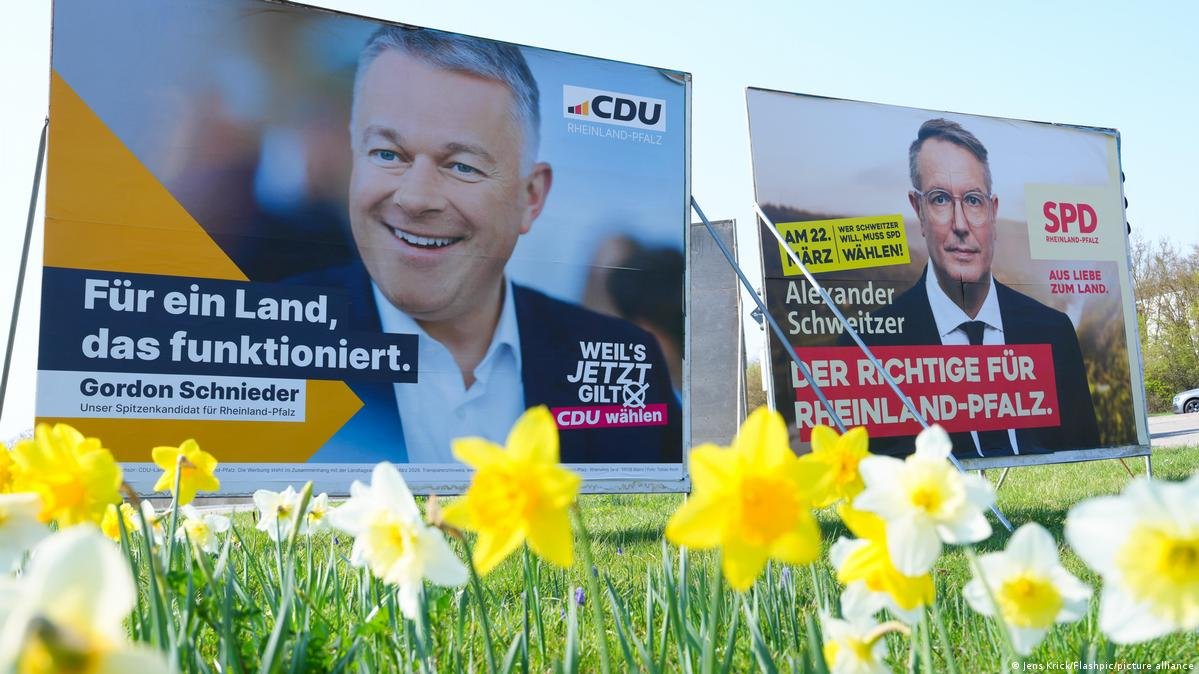
BERLIN: Germany’s conservative Christian Democratic Union (CDU) led by Chancellor Friedrich Merz secured a decisive victory in the western state of Rhineland-Palatinate with 31.0% of the vote, according to near-final results with 99.6% ballots counted, marking a significant political shift after more than three decades of dominance by the Social Democratic Party of Germany. The SPD fell to 25.9%, a dramatic decline of nearly ten percentage points compared with the previous election, reflecting mounting pressure on Germany’s center-left at both regional and federal levels. CDU state leader Gordon Schnieder is now positioned to replace incumbent premier Alexander Schweitzer, likely paving the way for a CDU-SPD coalition similar to the governing arrangement in Berlin.
The far-right Alternative for Germany recorded 19.5%, gaining more than eleven percentage points and delivering its strongest performance ever in a western German state, reinforcing its emergence as a nationwide challenger to Germany’s traditional centrist parties. The result reflects the party’s expanding electoral reach beyond its traditional eastern strongholds and signals deeper fragmentation within Germany’s political landscape ahead of upcoming state contests later this year. Alliance 90/The Greens secured 7.9%, while The Left reached 4.4% and Free Voters received 4.2%, both failing to cross the five-percent parliamentary threshold. The Free Democratic Party collapsed to 2.1%, losing representation in the state legislature, while the Sahra Wagenknecht Alliance secured 1.9% in its early regional test.
The outcome provides Chancellor Merz with important political momentum after a narrow defeat earlier this month in Baden-Wuerttemberg and comes at a sensitive moment as his government continues coordinating European support for Ukraine amid tensions with Russia and preparing for possible energy-market disruptions linked to instability involving Iran. For the SPD leadership, the result represents one of the party’s most serious regional setbacks in decades and underscores the growing challenge facing Germany’s traditional center-left as the AfD continues expanding its national footprint ahead of critical elections later this year in Berlin, Mecklenburg-Vorpommern, and Saxony-Anhalt.
With Rhineland-Palatinate becoming the second major state contest of Germany’s 2026 “super election year,” the results are widely viewed as an early indicator of shifting voter alignments that could reshape the country’s political balance ahead of upcoming regional votes and influence the trajectory of Chancellor Merz’s reform agenda across Europe’s largest economy.
-Friederike Mackenzie