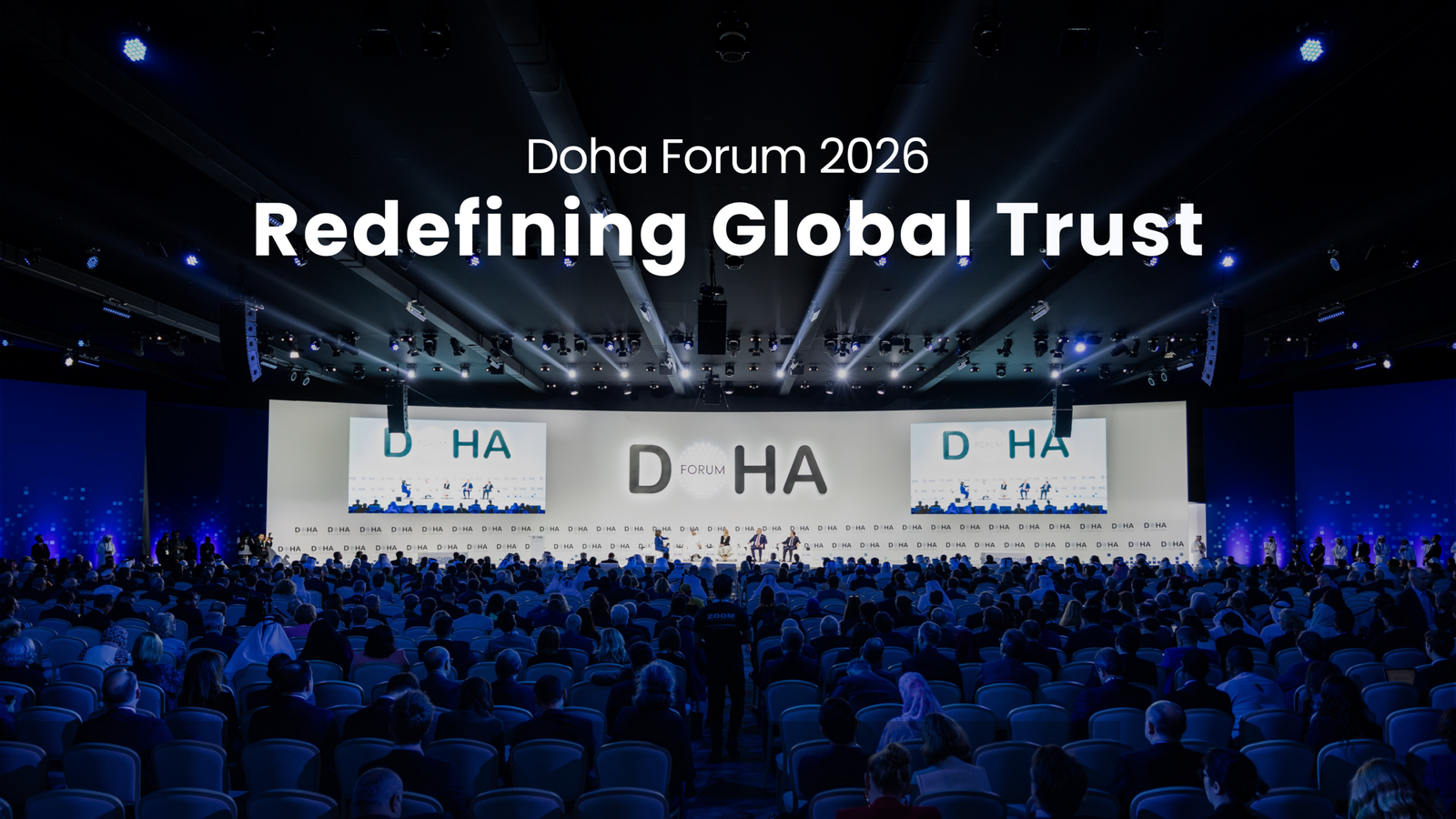
DAVOS, Switzerland : As geopolitical competition intensifies and confidence in multilateral institutions weakens, the Doha Forum has announced that its 24th edition in 2026 will focus on the theme “Redefining Global Trust.” The announcement was made at the World Economic Forum (WEF) Annual Meeting in Davos during a panel co-hosted with Foreign Policy at the Invest Qatar Pavilion.
The timing underscores a deepening global trust deficit. From the wars in Gaza and Ukraine to escalating U.S.–China rivalry, the resurgence of economic nationalism, and the weaponization of technology and information, global cooperation is increasingly shaped by crisis management rather than shared norms. Trust once the silent infrastructure of international order has become both the most contested and most essential element of diplomacy, governance, and economic stability.
Set to take place in December 2026 in Doha under the patronage of His Highness Sheikh Tamim bin Hamad Al Thani, Amir of the State of Qatar, the Forum aims to convene political leaders, diplomats, security officials, economists, and civil society actors to confront what many at Davos described as a structural breakdown in confidence between states, institutions, and societies.
Doha Forum Executive Director H.E. Mubarak Ajlan Al-Kuwari said that inherited models of cooperation no longer reflect contemporary geopolitical realities. “In a world undergoing profound change, trust cannot be assumed,” he said. “It must be deliberately built, continuously earned, and actively reinforced through inclusive dialogue, credible institutions, and cooperation that delivers tangible outcomes.”
His remarks echoed broader WEF discussions, where leaders increasingly warned that the global system is entering a post-consensus era, marked by multipolar competition, fragmented governance, and growing divergence between the Global North and South. In this environment, traditional multilateral mechanisms are struggling to maintain legitimacy, while ad hoc coalitions and power-based diplomacy are replacing rule-based cooperation.
At Davos, policymakers identified a widening trust gap across three interconnected levels: between major powers as strategic rivalry displaces cooperation on trade, technology, and security; between governments and citizens as inequality, political polarization, and digital disinformation erode public confidence; and between developed and developing countries as the Global South questions whether existing institutions fairly represent its interests, particularly on climate finance, debt relief, and development governance.
Doha Forum General Manager Maha Al-Kuwari said the 2026 theme reflects this global inflection point. “Redefining Global Trust recognizes that governance systems must evolve alongside shifting power dynamics,” she said. “The Forum will provide a platform for exploring new models of cooperation, accountability, and responsible leadership.”
Trust has emerged at WEF this year as a central constraint on global problem-solving. Delegates repeatedly argued that without trust, even technically sound solutions on climate mitigation, artificial intelligence regulation, pandemic preparedness, or conflict prevention fail to achieve political legitimacy or public acceptance. In this sense, the crisis of trust is no longer a peripheral concern but a core systemic risk.
Qatar’s growing role as a mediator has further shaped the Forum’s focus. From facilitating humanitarian negotiations in Gaza to hosting talks between rival regional and international actors, Doha has positioned itself as a hub for trust-based diplomacy. Forum organizers said the 2026 edition will draw on this experience to examine how middle powers and neutral actors can help bridge divides in a polarized international system.
The agenda is expected to center on practical pathways for rebuilding trust, including strengthening the credibility of multilateral institutions, enhancing conflict mediation and preventive diplomacy, reforming global economic governance to better reflect emerging markets, restoring confidence in information ecosystems amid AI-driven misinformation, and renewing social contracts between states and citizens.
Unlike previous editions that emphasized crisis response, Doha Forum 2026 aims to shift the global conversation toward systemic renewal addressing not only the symptoms of distrust but its deeper structural causes, including power asymmetries, governance deficits, economic exclusion, and unresolved historical grievances.
As leaders in Davos warned, the world risks entering a prolonged period of strategic paralysis unless trust is rebuilt across political, economic, and social systems. Against this backdrop, Doha Forum’s 2026 theme frames trust not as an abstract moral value, but as a strategic imperative for global stability, development, and peace.
– Dr. Shahid Siddiqui; follow via X @shahidsiddiqui
READ THE FULL E-MAGAZINE | WorldAffairs: For Decision-Makers Who Need More Than Headlines