SYDNEY: Australian authorities are investigating Sunday’s deadly attack at a Hanukkah gathering at Sydney’s Bondi Beach as an act of terrorism, after police said the two alleged gunmen appeared to have been inspired by the Islamic State group and had recently travelled to the Philippines.
The attack, which targeted Australia’s Jewish community, is the country’s deadliest mass shooting in nearly three decades. Sixteen people were killed, including one of the alleged attackers, and at least 25 others were injured.
Police identified the deceased gunman as Sajid Akram, 50, who was shot dead by officers at the scene. His 24-year-old son and alleged accomplice, Naveed Akram, remains in critical condition in hospital after being shot by police.
Australian Federal Police confirmed that both suspects had travelled to the Philippines last month. The purpose of the trip is under investigation, with Philippine authorities cooperating with Australian officials. Islamic State–linked networks have historically operated in parts of southern Philippines, although they have been significantly weakened since their peak during the 2017 Marawi siege.
“Early indications point to a terrorist attack inspired by Islamic State, allegedly carried out by a father and son,” Australian Federal Police Commissioner Krissy Barrett said.
“These are the alleged actions of individuals aligned with a terrorist organisation not a religion.”
Police said the younger suspect’s vehicle contained improvised explosive devices and homemade flags associated with ISIS, which is designated as a terrorist organisation by Australia and numerous other countries.
Authorities said the attackers fired into a large crowd for approximately ten minutes at one of Australia’s most visited tourist locations before being confronted and shot by police.
Community in Mourning
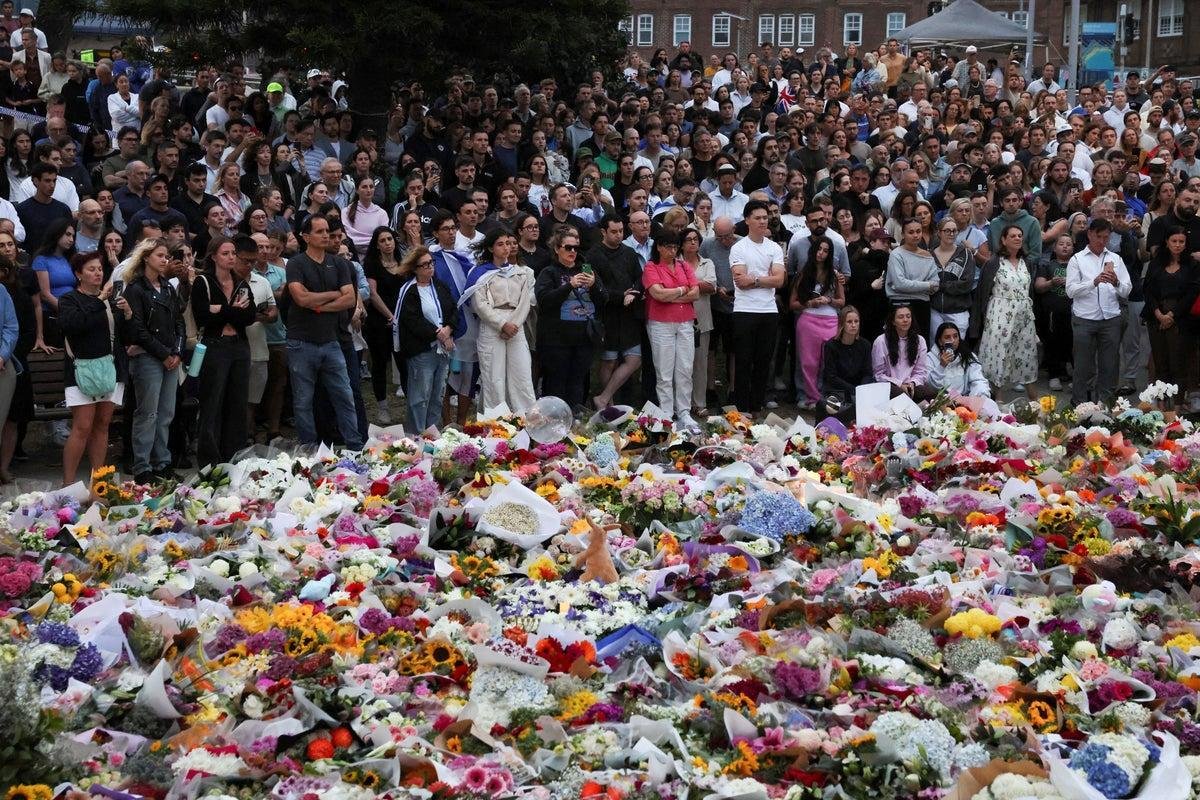
Israeli Ambassador to Australia Amir Maimon visited Bondi Beach on Tuesday, laying flowers at a growing memorial near the Bondi Pavilion and urging stronger measures to ensure the safety of Jewish communities.
“Only Australians of Jewish faith are forced to worship behind closed doors, under CCTV and armed protection,” Maimon said. “My heart is torn apart. This is insane.”
Australia has seen a rise in antisemitic incidents over the past 16 months, prompting the head of the country’s main intelligence agency to label antisemitism as the most serious threat to life it currently faces.
Bondi Beach reopened on Tuesday but remained largely deserted as residents and visitors paid their respects. Among them was Olivia Robertson, 25, who described the attack as deeply unsettling.
“This is the country our grandparents came to so we could feel safe,” she said. “And now this has happened right here.”
Acts of Courage and National Debate
One of the injured, Ahmed al Ahmed, a 43-year-old Muslim father of two, was widely praised for confronting one of the gunmen and seizing his rifle. He remains hospitalised with gunshot wounds and has been hailed as a hero globally, including by U.S. President Donald Trump.
A GoFundMe campaign established for Ahmed has raised more than A$1.9 million, reflecting widespread public support.
The attack has reignited debate over Australia’s gun laws, after police confirmed Sajid Akram was a licensed gun owner with six registered firearms. Home Affairs Minister Tony Burke said existing legislation would be reviewed.
Former Prime Minister John Howard, who introduced Australia’s strict gun laws after the 1996 Port Arthur massacre, cautioned against allowing the gun debate to overshadow the need to confront antisemitism.
The victims ranged from a rabbi and a Holocaust survivor to a 10-year-old girl, Matilda Britvan, whose family has spoken publicly of their grief. Two police officers remain in critical but stable condition.
-Christine Jose